

REQUEST DEMO
Robot CATALOG will be sent to your mailbox immediately after submission.
SUBMIT
Manufacturing facilities and factories present some of the most demanding environments for automated maintenance equipment. Floor surfaces in these sectors constantly accumulate heavy grease, oil contamination, and solid industrial debris that standard commercial scrubbers are simply not equipped to handle. Concurrently, these production spaces are highly dynamic, requiring mobile equipment to safely navigate around automated guided vehicles, driven forklifts, shifted pallets, and pedestrian personnel. Because modern production often runs on multi-shift or continuous schedules, cleaning automation must integrate seamlessly without disrupting workflows or requiring excessive manual intervention for fluid replenishment. Procuring the appropriate automated floorcare solution requires matching mechanical scrubbing power and navigational intelligence to the specific layout and soil conditions of the production floor.
In manufacturing environments, the floor plan is rarely static. The constant movement of heavy machinery creates a highly dynamic environment, requiring facility managers to evaluate how the robot processes spatial data and reacts to sudden environmental changes. Operating entities must also verify all applicable GDPR and data privacy regulations prior to deployment when utilizing solutions that rely on cameras, advanced mapping, or cloud-based data processing. Navigation systems generally fall into two categories: real-time dynamic path planning, which utilizes advanced sensors to constantly update routes around obstacles, and deterministic learn-and-repeat navigation, which follows a manually programmed route while relying on automatic braking for safety.
Industrial floors present a complex mix of soils, ranging from liquid grease spills to solid operational debris. The mechanical design of the cleaning head dictates how effectively the machine manages these diverse soils. Systems utilizing cylindrical brushes actively capture solid debris while simultaneously scrubbing the floor, which serves facilities where loose waste is continuously generated. Conversely, rotating disc heads applying high downward pressure focus on maximizing mechanical friction, effectively extracting deeply embedded oil and tire marks when combined with specialized industrial detergents.
Continuous manufacturing schedules require floor cleaning to happen without draining labor resources. The autonomy of an industrial scrubber is defined heavily by how it manages battery power and water resources. Automated docking architectures allow the machine to autonomously recharge, discharge wastewater, and refill with clean solution, enabling continuous multi-shift operation with minimal human oversight. Alternatively, high-capacity onboard storage paired with swappable batteries maximizes the uninterrupted runtime for massive warehouse spaces, though it requires staff intervention to manage the consumables.
Factory footprints vary drastically, featuring both wide-open logistics zones and densely packed production lines. Heavy-duty, large-format machines excel in vast open spaces but may struggle in tight aisles. Compact, high-agility machines navigate tight corridors and complex production lines, providing thorough cleaning in dense environments. Dual-mode ride-on machines offer the flexibility of manual human operation for targeted spill management alongside their autonomous capabilities for routine wide-area coverage. By carefully evaluating navigation intelligence, debris management, autonomous replenishment capabilities, and spatial footprint, facility managers can select a robotic solution that integrates smoothly into complex manufacturing ecosystems. The following evaluation includes our proprietary CleaniBot C5 alongside other notable market solutions.
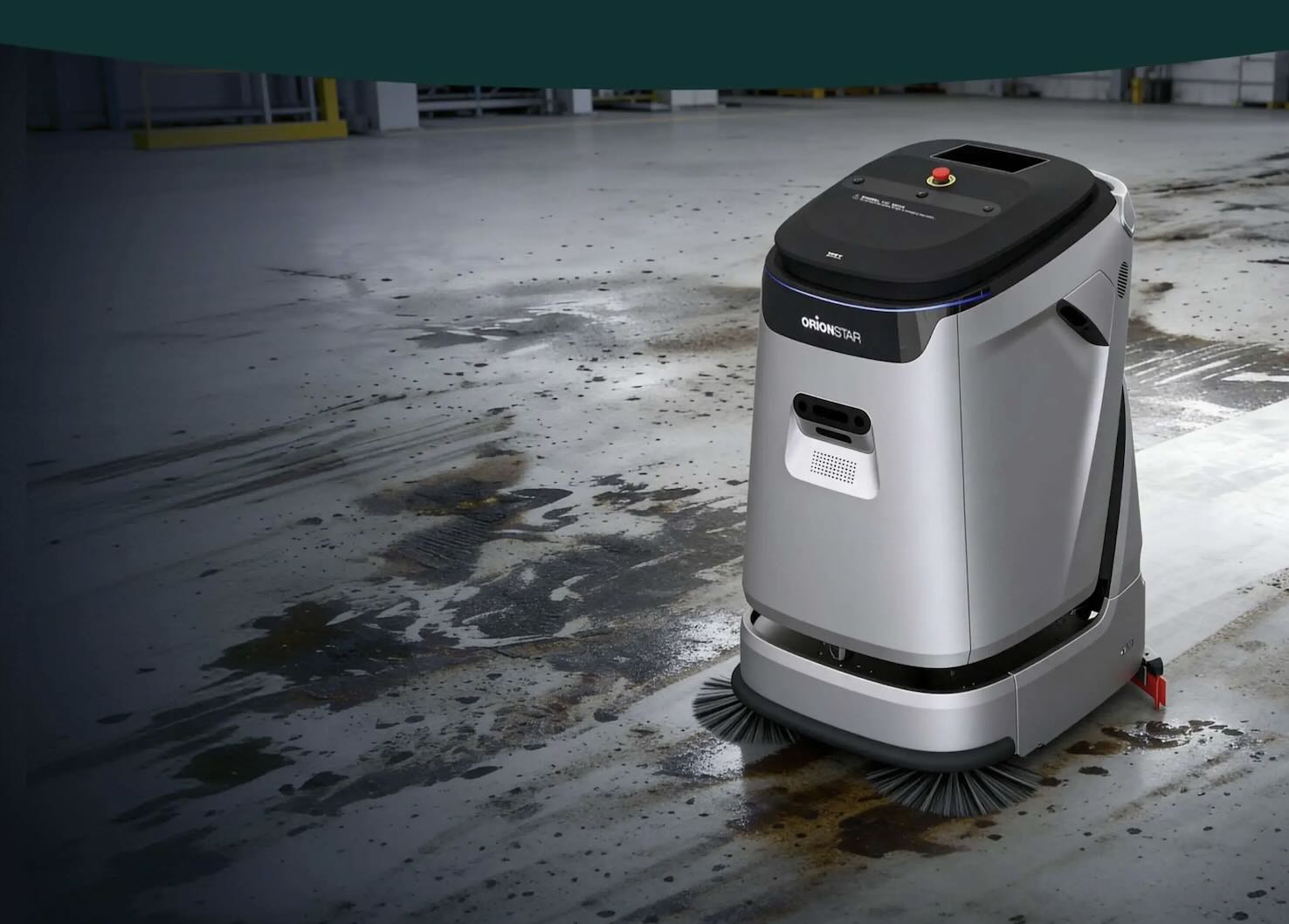
The OrionStar CleaniBot C5 is positioned for production facilities requiring robust contamination removal within tight spatial constraints and minimal human intervention across multiple shifts. This machine tackles heavy industrial grime using an industrial-grade dual-roller scrubbing system. According to manufacturer data, the unit features a 550mm cleaning width and applies sustained mechanical pressure to lift stubborn oil and dirt from the factory floor. Despite its robust scrubbing capabilities, it maintains a highly compact form factor with an 820mm-wide body, allowing it to navigate narrow production aisles and tight corridors that are often challenging for larger industrial scrubbers to access. To support continuous multi-shift operations, the machine pairs with an autonomous docking station that facilitates automatic clean water refilling, wastewater discharge, and internal self-cleaning. Under laboratory conditions, the robot supports a mapping capacity of up to 10,000 square meters. Furthermore, its combined 90L tank system reduces the frequency of necessary replenishments, ensuring consistent floor coverage throughout the manufacturing day.
Designed for large-scale manufacturing plants battling deeply embedded liquid soils, the Gausium Scrubber 75 focuses on aggressive chemical extraction and automated fleet integration. The machine is particularly suited for automotive or heavy machinery plants, featuring a dedicated oil cleaning mode that utilizes a specialized detergent kit to break down severe grease contamination. According to manufacturer data, it provides an expansive 750mm cleaning width and incorporates a specialized 270-degree rotational scrub deck, which allows the machine to clean deeply into tight ninety-degree corners where oil often accumulates. In modern smart factories, navigation compatibility is crucial; the machine addresses this with built-in intercommunication capabilities designed to allow safe coexistence with automated guided vehicles. Additionally, the unit features a sophisticated water recycling system capable of reducing freshwater consumption by up to eighty percent, which highly benefits facilities aiming to lower environmental impact and extend autonomous runtimes between manual tank drains.
The Avidbots Neo 2W specifically targets warehouse-heavy manufacturing sectors where loose debris and constantly shifting logistics layouts pose significant navigational challenges. This unit integrates warehouse-specific artificial intelligence designed to recognize and avoid floor-level industrial obstacles like pallets and forklift tines. According to manufacturer data, its proprietary Bulk Navigator technology handles frequently changing bulk storage areas by continuously updating internal maps, while a debris diverter pushes occasional solid waste out of the path to prevent clogging. For operations generating high volumes of solid waste, the machine offers a cylindrical brush option that sweeps and scrubs simultaneously. Designed for massive logistics footprints, the unit operates at travel speeds of up to 1.35 meters per second. It supports multi-shift manufacturing schedules through the use of heavy-duty swappable batteries, allowing floorcare teams to manually exchange power cells and keep the machine running continuously without waiting for long charging cycles.
For facilities transitioning from manual to automated cleaning fleets, the Tennant T7AMR offers a familiar dual-mode ride-on platform enhanced with robotic capabilities. This machine serves factories that require human operators to manually drive the equipment for targeted spot cleaning or complex spills, before switching into autonomous mode for routine wide-area scrubbing. According to manufacturer data, the unit applies heavy-duty downward scrubbing pressure of up to 86 kilograms, delivering substantial mechanical friction for stubborn industrial stains. It navigates using the BrainOS platform, which employs a deterministic learn-and-repeat model where an operator manually demonstrates the route for the robot to subsequently replicate. To support facilities seeking to reduce chemical dependency, the machine integrates optional ec-H2O NanoClean technology, which electrically converts water into a detergent-free cleaning solution. Procurement teams prioritizing post-deployment hardware maintenance are supported by a global service network that includes, according to manufacturer data, over five hundred factory-direct service professionals.
The Nilfisk Liberty SC50 is engineered for manufacturing environments operating under strict regulatory and workplace safety compliance frameworks. It distinguishes itself by holding the CSA/ANSI 336 safety certification, an OSHA-recognized standard for autonomous floorcare equipment, providing documented compliance for safety-conscious industrial facilities. According to manufacturer data, the machine utilizes a unique Fill-In autonomous path calculation mode, where an operator simply drives the perimeter of the target zone and the robot independently calculates the most efficient route to clean the interior space. For food and beverage production facilities requiring high sanitation standards, the unit can be equipped with an optional UVGI module for floor sanitization. The machine also operates with an exceptionally low acoustic footprint, registering noise levels as low as 63 dBA, which minimizes auditory disruption when deployed in populated factory zones or during daytime shifts.
Autonomous floor cleaning robots in industrial settings typically achieve payback within 12 to 24 months, depending on shift structure and labor rates. For a factory running two shifts, annual labor savings from replacing manual scrubber operation can reach $100,000-$140,000 when fully loaded labor costs are factored in (wages, benefits, supervision overhead). The total cost of ownership includes the purchase price, docking station, consumables (brushes, squeegees, detergent), and preventive maintenance, which together tend to run 10-15% of the hardware cost per year. Buyers should also account for one-time mapping and deployment costs, which some vendors include in the purchase price and others charge separately. For factories that prefer to avoid capital expenditure, Robot-as-a-Service (RaaS) programs offer monthly subscriptions (typically $575-$2,300/month depending on machine class and support scope) that bundle hardware, software, maintenance, and support into a single operating expense, shifting the investment from CapEx to OpEx. The RaaS market for commercial cleaning robots is growing rapidly and is projected to reach $2.11 billion in 2025.
Factory managers should look for robots that comply with recognized safety standards for autonomous mobile machines operating alongside workers. Key certifications include CSA/ANSI C22.2 No. 336-17 (also referenced as UL 60335-2-107), the North American safety standard for battery-powered commercial cleaning machines, which covers electrical design, battery and charging safety, and moving-part safeguards. The Nilfisk Liberty SC50 is among the few autonomous floor scrubbers certified to this OSHA-recognized standard. Additionally, IEC 63327 is the first international standard specifically for autonomous floor cleaning machines in public and commercial spaces, addressing motion safety, obstacle detection, fail-safe behavior, and electrical safety in wet conditions. BrainOS-powered robots (such as the Tennant T7AMR) are engineered to comply with IEC 63327 and hold SIL 2 functional safety certification, meaning the probability of a dangerous failure in safety-critical functions is limited to between 1 in 100,000 and 1 in 1,000,000 hours of operation. For EU deployments, factories should also verify GDPR compliance when robots use cameras or LiDAR for navigation, as several competitors note in their documentation.
Factory floors frequently accumulate oil stains, metal shavings, and other industrial debris that require more than light scrubbing. Robots equipped with dual-rolling-brush systems and high scrubbing pressure perform better in these conditions. For example, the OrionStar CleaniBot C5 applies 25 kg of downward pressure through a dual-roller design and achieves a high dirt-cleaning rate (up to 95% under lab conditions*) on heavy oil and grime in a single pass; it can also pick up debris up to roughly 3 cm in height (subject to the material and shape of the debris). The Gausium Scrubber 75 offers a dedicated Oil Cleaning Mode with a detergent kit specifically designed for heavily contaminated industrial environments, along with 45 kg of brush pressure. Robots with cylindrical brush heads (such as the Avidbots Neo 2W with its cylindrical option) are generally more effective at sweeping up loose debris compared to traditional disc-only machines. Factories with heavy oil or metal-chip contamination should prioritize machines with high brush pressure, oil-cleaning capabilities, and cylindrical brush or dual-roller systems.
Navigation capability varies significantly across available models. Leading autonomous systems utilize combinations of 3D LiDAR, 2D LiDAR, 3D cameras, and radar to build real-time maps and dynamically reroute around obstacles. The Gausium Scrubber 75, for instance, uses 20+ sensors and can perceive environmental changes, update its map, and reroute autonomously. The Avidbots Neo 2W goes further with factory-specific AI features: its Advanced Obstacle Detection recognizes pallets and forklift tines at floor level, and its Bulk Navigator handles frequently changing bulk storage areas by enabling quick map updates. In contrast, robots using BrainOS (such as the Tennant T7AMR and Nilfisk Liberty SC50) primarily rely on a learn-and-repeat model where an operator drives the route once and the robot replicates it, with basic obstacle avoidance layered on top. This approach is simpler but less adaptive in highly dynamic environments with constantly shifting layouts. Factories with frequently reconfigured production lines or high forklift traffic should prioritize robots with real-time dynamic path planning and environment-change detection over learn-and-repeat systems.
Coverage depends on the interplay of cleaning width, runtime, and water tank capacity. For a medium-to-large factory floor of roughly 5,000-10,000 m2, a robot needs a combination of sufficient runtime, adequate water capacity, and an autonomous docking station that handles refilling and draining. The OrionStar CleaniBot C5 can clean up to 1,980 m2 per hour with a 550 mm brush width and runs approximately 3 hours in scrubbing mode (up to 8 hours in mopping mode), with a 90 L combined tank (45 L clean + 45 L waste). Its docking station automatically refills clean water, discharges waste water, and self-cleans the waste tank in roughly 4 minutes, enabling multi-shift operation with minimal human intervention. The Avidbots Neo 2W offers the largest tank capacity (109 L solution + 135 L recovery) and 4-6 hours of runtime with swappable batteries. The Gausium Scrubber 75 provides 4-6 hours of runtime with a 75 L clean / 50 L waste tank configuration and an optional workstation (WS-02) for autonomous refueling and drainage. Factories should calculate total cleaning area per shift and match it against the robot's hourly productivity and tank capacity to determine whether one machine can complete a full shift unattended, or whether multiple refill cycles or a second unit are needed.
Mapping capacity and physical dimensions directly affect whether a robot can operate effectively in a given factory layout. The OrionStar CleaniBot C5 can map areas up to 10,000 m2 and requires a minimum passing width of approximately 880 mm, allowing it to navigate typical factory corridors and doorways; it can climb obstacles up to 15 mm and manage slopes up to 5 degrees loaded. The Gausium Scrubber 75 requires a minimum pass width of 1,400 mm (2,000 mm for underground garage configurations) and can only clear obstacles up to 10 mm, making it less suitable for factories with very narrow aisles or raised thresholds. The Avidbots Neo 2W is the largest machine in this category, with a gross vehicle weight up to 688 kg and widths ranging from 760 to 940 mm depending on the cleaning head, which may restrict deployment in tight spaces. The Nilfisk Liberty SC50 has a minimum turnaround aisle width of 1,592 mm. Factories with narrow aisles between production lines or tight doorways should verify the robot's minimum pass width and turning radius against their actual floor layout before procurement, as the more compact machines (such as the C5 at 820 x 680 mm) can access areas that larger industrial scrubbers cannot reach.
Third-party product specifications are based on publicly available data, documented up to specific limits, under laboratory conditions, or according to manufacturer data, and may vary in real-world application. Product names and trademarks are the property of their respective owners. If any equipment involves cameras, voice recording, mapping, or cloud data processing, the operating entity must verify GDPR compliance prior to deployment. The 'Cloud Learning' feature processes anonymized spatial mapping data only. No personal identifiable information (PII) is recorded or transmitted. Deployment of visual sensors complies with localized GDPR/PIPL protocols subject to user opt-in.