

REQUEST DEMO
Robot CATALOG will be sent to your mailbox immediately after submission.
SUBMIT
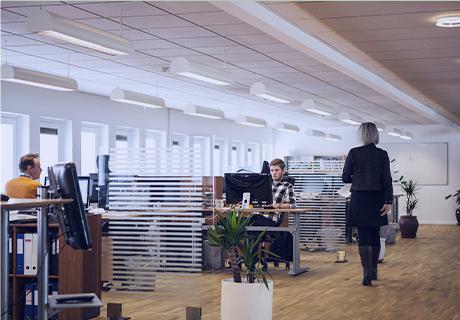
Corporate offices, office buildings, business parks, and similar professional workplace environments present a highly complex ecosystem for facility management. Deploying commercial cleaning robots for corporate offices requires navigating mixed floor surfaces, tight desk clusters, variable working hours, and strict data security policies. These professional environments combine hard flooring in reception areas and cafeterias with low-pile carpeting in boardrooms and cubicle banks. Physical layouts range from expansive open-plan lobbies to narrow corridors and standard doorways, demanding specific physical dimensions and turning capabilities from automated equipment. Furthermore, the timing of cleaning shifts dictates acceptable noise thresholds, contrasting daytime operation in occupied offices with after-hours facility maintenance. Finally, frequent minor layout changes and rigorous IT compliance standards mean that navigation architecture and environmental data handling play a critical role in equipment procurement.
Evaluating automated floor care solutions for professional environments requires examining four critical operational dimensions. Floor surface versatility dictates whether a facility adopts multi-functional platforms or dedicated hard-floor scrubbers. Multi-functional designs switch among scrubbing, vacuuming, sweeping, and dust-mopping to address mixed-surface layouts without requiring separate machines. Conversely, dedicated scrubbers are engineered exclusively for intensive liquid cleaning, prioritizing large-capacity solution tanks and heavy-duty stain removal over multi-surface transitions.
Physical footprint and layout adaptability define a machine's ability to access different zones autonomously. Compact, micro-navigating designs maintain narrow passing widths under six hundred millimeters, enabling them to navigate tight desk clusters and pass through standard doorways. Mid-sized proportional designs offer functional passing widths around seven hundred millimeters, balancing maneuverability with larger onboard capacities to support extended coverage in medium-sized open areas. Large-format, wide-path designs feature widths exceeding seven hundred and sixty millimeters and high gross vehicle weights, maximizing hourly square-footage coverage for unobstructed spaces such as corporate atriums.
Acoustic profile and shift scheduling determine when a machine can operate without disrupting the workforce. Ultra-low acoustic operation utilizes specialized settings to maintain ambient noise outputs between forty-five and fifty-five decibels, supporting continuous daytime deployment near active meeting rooms. Standard commercial acoustic operation functions at conventional noise levels ranging from sixty-three to over seventy-two decibels, supporting after-hours schedules or operations in unoccupied building wings.
Navigation architecture and environmental data handling impact both operational agility and IT compliance. Operator-taught deterministic mapping relies on a human operator to physically drive the initial route, limiting autonomous spatial decision-making but maintaining highly predictable movement. Sensor-driven autonomous mapping utilizes an array of LiDAR, optical cameras, and ultrasonic sensors to scan the environment and adjust paths in real time. Because these systems utilize cameras, active map generation, and cloud-based data processing, facility operators must verify compliance with GDPR and applicable data privacy regulations prior to deployment.
The OrionStar CleaniBot S55 Pro is positioned as a mid-sized, highly versatile solution for corporate environments that require repeatable, low-intervention cleaning across mixed-surface layouts. Its compact physical footprint features a six hundred and fifty millimeter body width and a seven hundred millimeter minimum passing width, allowing the machine to navigate mid-sized corridors, reception zones, and open office areas effectively. The robot integrates six distinct cleaning modes, switching autonomously among scrubbing, power scrubbing, sweep and vacuum, ECO vacuum, sweep-vacuum-mop, and dust mopping to manage both hard floors and low-pile carpets. Noise control is heavily emphasized for daytime shift scheduling, producing a specific noise level of fifty-five decibels in scrubbing mode and an ultra-quiet forty-five decibels in dust mopping mode. Facility teams can rely on extended operational cycles, as the battery delivers four and a half hours in scrubbing mode and up to twenty-eight hours of continuous runtime in dust mop mode according to manufacturer data. Navigation is driven by a fifteen-sensor array combining LiDAR, stereo cameras, ultrasonic sensors, and line lasers for dynamic path planning and wall-edge cleaning. Because the S55 Pro processes spatial maps and utilizes stereo cameras and cloud connectivity, facility managers must verify GDPR compliance regarding spatial data handling and cloud reporting before integrating the unit into a corporate network.
The Gausium Phantas is positioned as a micro-navigating robotic platform aimed at dense, tight office layouts where larger scrubbers may face maneuverability constraints. Its physical design is highly compact, featuring an ultra-narrow five hundred and fifty millimeter passable width enabled by software-optimized path planning, which allows it to move easily between desk clusters and through standard single doorways. A six hundred and fifty millimeter passable height further provides under-desk cleaning capability. The system features four-in-one cleaning versatility that handles vacuuming, sweeping, scrubbing, and dust mopping, effectively addressing hard floors such as ceramic tiles, natural stone, and wood, alongside low-pile carpet environments. It can operate in proximity to walls with a zero millimeter edge cleaning distance. Noise levels are kept under sixty-five decibels across its various functions, supporting operation during working hours. Runtime capabilities vary by function, delivering four and a half hours for scrubbing mode, four hours for vacuuming mode, and up to fourteen hours for sweeping mode. For mapping and obstacle avoidance, it utilizes two-dimensional LiDAR, three-dimensional depth cameras, and an RGB camera to recognize and bypass complex workplace obstacles like cables. Given its reliance on RGB cameras, deep-learning image processing, and cloud-based mobile applications, deploying the Phantas requires a thorough review of GDPR compliance to ensure workplace privacy protocols are maintained.
The Nilfisk Liberty SC50 is positioned as an enterprise-grade dedicated hard-floor scrubber for expansive corporate complexes, wide public concourses, and large institutional settings. As a heavy-duty single-function machine, it operates exclusively on hard flooring surfaces and does not support vacuuming or carpet care. The equipment relies on a large-format design with a seven hundred and sixty-two millimeter cleaning width and a turn-around aisle width of one thousand five hundred and ninety-two millimeters, utilizing substantial tank capacities to sustain high-volume scrubbing over a five to six hour runtime on a single charge. Noise output is rated at sixty-three decibels during active scrubbing mode. The navigation architecture centers on an operator-taught deterministic mapping model, specifically utilizing CopyCat and Fill-In teaching modes where a human operator physically drives the initial route or perimeter for the machine to replicate. The SC50 differentiates itself with its CSA/ANSI 336 safety standard certification, providing robust third-party validation for operation in populated commercial areas. Because the system features cloud connectivity for usage reporting, text alerts, and remote software upgrades, organizations must ensure these data transfers and sensor operations align with GDPR policies prior to implementation.
The Avidbots Neo 2 is positioned as a heavy-duty, fully autonomous floor scrubber designed for large hard-floor surfaces in extensive commercial office environments and business parks. It operates strictly as a liquid scrubber for surfaces like tile, vinyl, concrete, and terrazzo, utilizing an Active Cleaning Control System that intelligently detects floor type changes and cleaning head wear to adjust downward pressure automatically. Physical dimensions push into the large-format category, with widths ranging from seven hundred and sixty millimeters to nine hundred and forty millimeters depending on the selected cleaning head, alongside a substantial gross weight that limits its use in narrow corridors. The machine operates at an environmental sound level of seventy-two decibels, making it optimally suited for after-hours facility maintenance scrubbing. Operational longevity is supported by four to six hours of battery runtime in scrubbing mode, which can be extended via swappable batteries for continuous fleet operations. Fleet management is centralized through the Avidbots Command Center, a web-based platform providing sector-level coverage maps and real-time productivity metrics. Because the Neo 2 utilizes computer vision, deep learning spatial mapping, and persistent cloud connectivity, IT departments must audit the Avidbots platform for GDPR compliance regarding camera data and facility map storage.
The Pudu CC1 is positioned as a compact, modular multi-functional robot designed for small to medium corporate offices that require comprehensive floor care within budget-conscious parameters. It leverages a four-in-one cleaning architecture capable of standard sweeping, scrubbing, carpet vacuuming, and silent dust mopping. This allows the machine to traverse hard floors such as terrazzo and epoxy resin, while the separately attached module handles low-pile carpet vacuuming. The unit maintains a compact physical footprint with a passable width of five hundred and fifty-two millimeters, ensuring maneuverability across standard office layouts. Operational acoustics are managed through specific settings, keeping noise levels under seventy decibels generally, while a dedicated silent mopping mode enables quieter operation during active office hours. Runtime capacities are strongly aligned with shift requirements, providing five hours in scrubbing mode, four hours in carpet vacuuming mode, and up to nine hours in silent mopping mode. Navigation is powered by a dual visual and LiDAR mapping system that updates autonomously to avoid temporary obstacles. Because the navigation relies heavily on visual sensors and an integrated IoT cloud management platform to digitize cleaning reports, deploying the CC1 necessitates a strict evaluation of GDPR and data privacy compliance regarding image capture and cloud processing.
Procuring commercial cleaning robots for corporate offices requires aligning robotic capabilities with specific facility characteristics. Decision-makers must evaluate floor surface versatility, prioritizing multi-functional machines if the workplace blends hard flooring with low-pile carpet, or selecting dedicated scrubbers if operations focus strictly on expansive hard surfaces. Physical footprint and layout adaptability must be measured against the tightest corridors and desk arrangements in the facility to ensure autonomous access. Organizations planning to clean during active business hours should mandate ultra-low acoustic operation, specifically seeking machines capable of running between forty-five and fifty-five decibels to avoid disrupting professional activities. Finally, navigation architecture requires careful consideration of environmental data handling. Any transition toward sensor-driven autonomous mapping systems leveraging cameras or cloud management platforms mandates strict coordination with IT and legal departments to ensure GDPR compliance before any equipment actively maps a corporate environment.
Estimated payback periods for autonomous floor cleaning robots range from 9 to 18 months in daily-use facilities with 50,000+ sq ft of hard-floor coverage. The key driver is labor offset: a single full-time cleaning employee costs approximately $40,000–$55,000 per year in loaded labor (including benefits, taxes, insurance, and supervision), while a cleaning robot's annual operating cost runs $4,000–$7,000 for consumables, wear items, and preventive maintenance. For a corporate office running nightly floor cleaning on corridors, lobbies, and open work areas, one robot can often absorb the equivalent of one FTE's repetitive floor-care shift. Facilities that shift cleaning to overnight or off-hours schedules tend to see faster payback because they eliminate shift-premium labor costs while reducing disruption to building occupants.
The choice depends on how your organization budgets automation and how much operational responsibility you want to retain. Capital purchase delivers the strongest long-term ROI if your office has stable, high-frequency cleaning needs and internal maintenance capacity, but requires the largest upfront investment (compact-to-mid-size robots typically start around $27,500–$35,000). Equipment leasing or financing lowers the upfront barrier while keeping the asset on your balance sheet, though service contracts may be separate. Robot-as-a-Service (RaaS) bundles the robot, software, maintenance, and support into a predictable monthly fee (commonly $575–$2,300/month depending on robot class and contract scope), shifting operational risk to the provider. As of 2024, roughly 18% of new commercial cleaning robot deployments used leasing or subscription models rather than outright purchase. RaaS is often the fastest path to approval for organizations that treat automation as an operating expense rather than a capital investment.
Noise output varies significantly by cleaning mode and model. Robots running in dust-mopping or ECO vacuum modes produce the lowest noise levels — for example, the CleaniBot S55 Pro operates at 45 dB in dust-mopping mode, which is comparable to a quiet library and suitable for cleaning during business hours without disturbing desk workers. Scrubbing modes generate more noise; the S55 Pro produces 55 dB during scrubbing, while competitors like the Gausium Phantas stay under 65 dB and the Avidbots Neo 2 reaches up to 72 dBA. For corporate offices where daytime cleaning is preferred, selecting a robot with a dedicated low-noise mode is essential. Models offering dust-mopping or silent-mop modes (45–55 dB range) can operate alongside staff without exceeding typical office ambient noise levels of 50–60 dB.
Corporate offices typically feature a mix of hard flooring (tile, vinyl, marble, terrazzo, epoxy, concrete) and low-pile carpet, so an effective robot must support multiple cleaning modes rather than functioning solely as a scrubber. The CleaniBot S55 Pro offers six modes — scrubbing, power scrubbing, sweep and vacuum, ECO vacuum, sweep-vacuum-mop, and dust mopping — covering both wet hard-floor cleaning and dry carpet/hard-floor maintenance in one machine. Competitors like the Gausium Phantas and Pudu CC1 similarly provide multi-mode operation with carpet vacuuming support, while larger units such as the Nilfisk Liberty SC50 and Avidbots Neo 2 are dedicated hard-floor scrubbers without carpet capability. For offices with mixed flooring, a multi-mode robot that can switch cleaning behavior by zone — scrubbing hard floors in corridors, vacuuming carpet in meeting rooms, and dust-mopping polished marble in lobbies — avoids the need to deploy separate machines for different floor types.
Cleaning efficiency depends on the mode and the complexity of the facility layout. At the specification level, compact commercial robots deliver 700–1,368 m2/h depending on mode; the CleaniBot S55 Pro achieves up to 1,368 m2/h in sweep/vacuum and dust-mop modes and 1,197 m2/h in scrubbing modes. However, real-world coverage in office environments is typically 50–70% of the theoretical maximum due to obstacles, doorways, turns, and refill stops. In practice, a single robot can cover roughly 3,000–6,000 m2 per cleaning session in an office layout, depending on runtime and mode. The S55 Pro provides 4.5 hours of runtime in scrubbing mode and up to 28 hours in dust-mop mode, with automatic recharging in under 4 hours. For a typical 10,000 m2 corporate office, one robot running a combined scrubbing and dust-mopping schedule during off-hours can generally complete full-floor coverage in a single shift.
Autonomous operation in a dynamic office environment demands a multi-sensor navigation system. The standard approach combines LiDAR for map construction and real-time localization, ultrasonic or depth sensors for obstacle detection, and cameras for object recognition and step/cliff detection. The CleaniBot S55 Pro, for example, uses LiDAR (supporting maps up to 10,000 m2), stereo cameras, ultrasonic sensors, and line lasers for wall-edge cleaning at approximately 5 cm from walls — a total of 15 sensors providing 360-degree environmental awareness. Competitors use similar stacks: the Gausium Phantas adds deep-learning-based obstacle recognition trained on real-world images, while the Nilfisk Liberty SC50 uses a teach-and-replicate mapping approach (CopyCat and Fill-In modes). A critical consideration for corporate offices is how the robot handles dynamic obstacles — moved furniture, cords, bags, and people — in real time rather than relying on a static map. Robots with real-time map updating and dynamic path replanning can operate safely during business hours without requiring the space to be cleared in advance.
Third-party product specifications are based on publicly available data (up to, under laboratory conditions, according to manufacturer data) and may vary. Product names and trademarks are the property of their respective owners. If any product involves cameras, voice recording, mapping, or cloud data processing, operators must verify GDPR compliance prior to deployment.