

REQUEST DEMO
Robot CATALOG will be sent to your mailbox immediately after submission.
SUBMIT
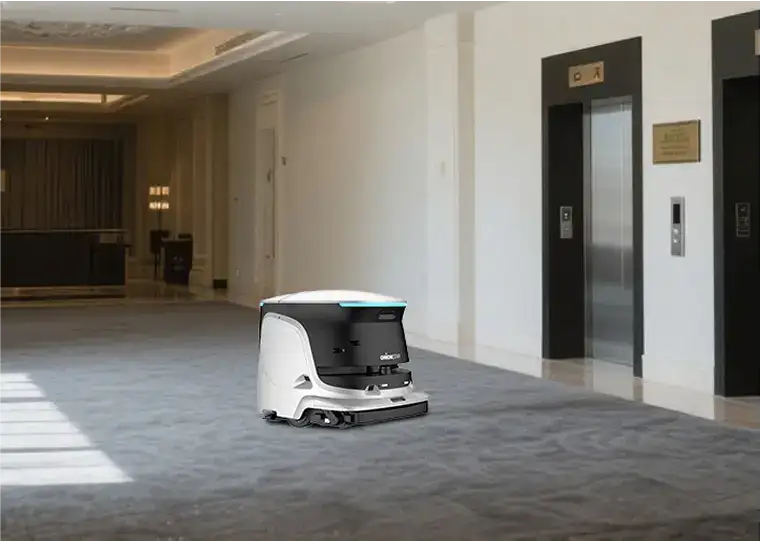
Hospitality spaces present distinct operational challenges, requiring facility managers to address mixed floor surfaces spanning from marble lobbies to heavily carpeted corridors. Maintaining cleanliness in a twenty-four-hour environment necessitates strict acoustic control to ensure guest comfort during both daytime transitions and overnight stays. Furthermore, cleaning platforms must navigate restrictive corridor passing widths, execute safe obstacle avoidance around unpredictable guest movements, and offer the rapid flexibility required for frequent scheduling adjustments in busy reception areas. Implementing commercial cleaning robots for hotels allows operators to automate these complex maintenance routines systematically while reallocating human staff to critical guest-facing services.
Evaluating these automated systems requires analyzing several structural and operational dimensions. Floor surface adaptability determines whether a platform functions as an integrated multi-surface unit capable of transitioning between hard floors and soft carpets, or operates as a dedicated wet-scrubbing or dry-vacuuming system. Chassis dimensions and navigational clearance dictate where the equipment can travel autonomously, contrasting ultra-portable designs meant for tight dining spaces against high-capacity architectures built for expansive concourses. Acoustic performance and operational timing separate ultra-low-noise models intended for continuous background deployment from standard commercial units scheduled strictly for isolated overnight work. Finally, navigation autonomy and environmental mapping govern how the equipment processes dynamic surroundings filled with moving luggage and temporary furniture. Because automated navigation systems utilize cameras, LiDAR sensors, and cloud-based data processing, facility managers must verify applicable data protection and privacy regulations prior to deployment.
Positioned for mixed-floor hotels requiring one unified platform for hard floors and low-pile carpets, the OrionStar CleaniBot S55 Pro delivers versatile multi-mode cleaning capabilities. The system features six distinct operational modes, allowing facility teams to configure workflows for sweeping, scrubbing, vacuuming, mopping, self-cleaning, and general hard-floor maintenance, helping them standardize cleaning paths and implement digital management. According to manufacturer data, the platform provides a minimum passing width of 700 millimeters, navigating effectively through standard corridors while using multi-sensor obstacle avoidance to maneuver safely around guests. Its acoustic design supports twenty-four-hour hotel operations, operating at a quiet 45 dB (based on laboratory testing) during dust mopping. Tested under standard factory conditions, the battery yields a runtime of up to 28 hours in this dust mopping mode, supporting continuous maintenance routines across expansive hospitality spaces without frequent recharging interruptions.
Positioned for tight hotel spaces like breakfast areas, furnished lounges, and narrow corridors, the Gausium Phantas provides an ultra-compact four-in-one chassis. Weighing 53 kilograms with dimensions of 540 by 440 by 617 millimeters, this platform navigates constrained hospitality environments where bulkier machines cannot operate or physically clear low furniture profiles. The system processes ceramic tiles, natural stone, and low-pile carpeting by integrating vacuuming, sweeping, scrubbing, and dust mopping within a single automated unit. According to manufacturer data, the robot utilizes deep-learning obstacle recognition to maneuver around dynamic guest foot traffic safely and detects varying surface types to adjust its active cleaning mechanism dynamically.
Positioned for large open hotel spaces like grand lobbies and convention halls, the Avidbots Neo 2W functions as a heavy-duty scrubbing platform. This architecture is designed primarily for hard-floor fluid application and recovery, omitting carpet cleaning capabilities to maximize wet-scrubbing endurance across massive architectural layouts. Operating with high-capacity fluid storage, the platform includes a 109-liter solution tank and a 135-liter recovery tank, which minimizes the frequency of manual liquid refills during extensive deployment cycles. According to manufacturer data, the machine navigates highly variable event spaces using proprietary autonomy software that adapts continuously to shifting temporary structures, staging equipment, and dynamic pedestrian flows.
Positioned for hotels featuring significant carpeted areas, the Pudu CC1 combines multi-surface processing with dedicated high-extraction capabilities. The platform integrates four-in-one functionality spanning sweeping, scrubbing, vacuuming, and dust mopping across a single deployment path. Equipped with an optional carpet module, the machine generates up to 17,000 Pascals of suction power, extracting embedded soil from soft hospitality surfaces. According to manufacturer data, the system utilizes an intelligent lifting mechanism that adjusts the active cleaning components based on detected floor types, ensuring consistent pressure transitions when the unit crosses thresholds between hard lobby stone and textile corridor flooring.
Positioned for twenty-four-hour hotel operations and flexible room-by-room deployment, the Nexaro NR 1700 utilizes a pure-vacuum design optimized for targeted dry soil extraction. Weighing only 6.5 kilograms, this ultra-portable architecture allows hotel staff to manually transport the unit easily between distinct floor levels or VIP suites. The platform operates with ultra-quiet acoustic emission, registering under 49 decibels in its Eco mode to prevent guest disturbance during critical nighttime deployment. According to manufacturer data, the machine supports infrastructure-free deployment through a spontaneous drop-and-go function, allowing facility managers to deploy the unit immediately without requiring established docking stations or pre-programmed cloud maps.
Procuring commercial cleaning platforms requires aligning the physical and operational specifications of the equipment with the distinct architectural demands of the hotel property. For floor surface adaptability, properties integrating extensive soft flooring should evaluate high-suction architectures or multi-mode systems, whereas unobstructed event halls benefit significantly from dedicated high-capacity scrubbers. Regarding chassis dimensions, ultra-compact and lightweight platforms serve highly furnished lounges and multi-level operations effectively, whereas mid-sized models balance fluid capacity with standard guest corridor clearance. Acoustic evaluation dictates operational scheduling directly, with ultra-low-decibel vacuuming and dust-mopping platforms supporting continuous daytime deployment alongside louder standard units reserved for unoccupied hours. Facilities must ultimately match the navigation methodology to their environmental volatility, securing reliable autonomous coverage across shifting hospitality spaces.
Industry sources report that robotic cleaning solutions can deliver 30-40% cost savings compared to manual labor for floor cleaning tasks. Leasing a commercial cleaning robot typically costs around $1,500-2,000 per month including maintenance and support, while the labor cost of a full-time cleaner in many markets exceeds that figure. Hotels that have deployed cleaning robots, such as Hotel Prinz Rudolf in Italy, report achieving ROI within the first months of operation by reducing repetitive floor-cleaning shifts and reallocating staff to guest-facing roles. The total cost of ownership depends on factors like whether a docking station with automated water refill is included, the frequency of consumable replacement (pads, filters, which account for roughly 8-10% of operating cost), and the size of the area covered per robot.
It depends on the model. Some robots, like the Pudu CC1 with its optional carpet vacuuming module, can vacuum both hard floors and low-pile carpets within a single platform. The CleaniBot S55 Pro offers a Sweep & Vacuum mode suitable for low-pile carpet along with dedicated scrubbing and dust-mopping modes for hard floors. However, a pure-scrubbing robot like the Avidbots Neo 2W is optimized specifically for hard floors and does not include carpet cleaning functionalities. Hotels with significant carpeted corridors or ballrooms should verify carpet capability before purchase and confirm whether a separate carpet module is included or sold as an accessory.
Most commercial cleaning robots on the market today cannot navigate between floors entirely on their own. Floor transfers generally require a staff member to carry or guide the robot to a different level. Compact models like the Nexaro NR 1700 (6.5 kg) or the Gausium Phantas (53 kg) are light enough for a single person to move between floors, while heavier units like the Avidbots Neo 2W (580+ kg) are effectively fixed to a single level. Some robots support multi-floor map storage in their management software, so a robot can resume cleaning on a different floor once manually repositioned. Hotels evaluating multi-floor deployment should factor in the weight and portability of the unit, and whether the vendor supports elevator integration as an option.
Noise output varies significantly by model and cleaning mode. The CleaniBot S55 Pro operates at 55 dB in scrubbing mode and 45 dB in dust-mopping mode, both well below the 65 dB typical of traditional manual scrubbers. The Nexaro NR 1700 is the quietest option at under 49 dB in Eco mode. The Pudu CC1 operates at under 70 dB, which may be less suitable near occupied guest rooms during quiet hours. Industry guidance suggests that commercial robotic vacuums operating around 50 dB can clean lobbies and corridors while guests are present without causing disturbance. Hotels should match the robot's noise profile to the intended operating window: low-noise modes (dust mopping, ECO vacuum) for daytime or overnight guest-occupied areas, and heavier scrubbing for back-of-house or off-peak periods.
Cleaning efficiency ranges from roughly 700-1,368 m2/h depending on the model and mode. The CleaniBot S55 Pro achieves up to 1,197 m2/h in scrubbing and 1,368 m2/h in sweep/vacuum modes, with scrubbing runtime of 4.5 hours; under optimal continuous conditions, it can cover an estimated 5,000-5,400 m2 before recharging, depending on facility layout and obstacle density. Lighter-duty modes like ECO Vacuum (19.5 h) and Dust Mop (28 h, tested under standard factory conditions) extend coverage far further but are limited by the 22 L clean water tank and 15 L waste water tank for wet cleaning tasks. Most robots support automatic recharging at a docking station; the CleaniBot S55 Pro recharges in under 4 hours, and the Pudu CC1 in under 3 hours. Some robots, such as the Gausium Phantas, offer an optional workstation that automates water refill and drainage as well, enabling near-continuous operation. Hotels with large floor plans should evaluate whether a single robot's per-charge coverage is sufficient for a shift, or whether a docking station with water management is needed.
Several cleaning robots use cameras, LiDAR, and cloud connectivity for navigation, mapping, and remote management. Models that rely on visual SLAM or RGB cameras for obstacle recognition, such as the Pudu CC1 and Gausium Phantas, capture environmental images that may include personally identifiable information. Operators in GDPR-regulated regions should verify the vendor's data processing practices, including whether images are processed locally or transmitted to cloud servers, how map data is stored, and whether the platform provides data residency guarantees. The Nexaro NR 1700 takes a privacy-conscious approach by relying on laser distance sensing rather than cameras for navigation, and its Nexaro HUB cloud platform hosts data on European servers. The CleaniBot S55 Pro uses LiDAR, ultrasonic sensors, line lasers, and a stereo camera for comprehensive navigation and safety. Hotels should request a data processing agreement from the vendor and conduct a data protection impact assessment before deployment.
Competitor data is sourced from publicly available information as of June 2025 and is intended for informational comparison only. Trademarks belong to their respective owners. All OrionStar cloud-based mapping and remote management features comply with applicable regional data protection regulations (including GDPR). Use of connectivity features (Wi-Fi/4G) and OTA updates requires user consent as outlined in the end-user privacy policy. Other third-party product specifications are based on publicly available data (up to, under laboratory conditions, according to manufacturer data) and may vary; if any product involves cameras, voice recording, mapping, or cloud data processing, operators must verify GDPR compliance prior to deployment.