

REQUEST DEMO
Robot CATALOG will be sent to your mailbox immediately after submission.
SUBMIT
When evaluating commercial cleaning robots for commercial buildings, facility managers face the unique challenge of maintaining high-traffic lobbies, narrow corridors, and expansive common areas across global markets in Europe, the US, and Asia. These spaces require a delicate balance of continuous daytime operation, discreet environmental integration, and varied cleaning intensities. Office towers and corporate campuses demand equipment that adapts seamlessly to shifting pedestrian flows while addressing diverse soil profiles, ranging from localized coffee spills in entryways to accumulated dust along baseboards. Deploying autonomous floor scrubbers in such dynamic environments necessitates a rigorous evaluation of how each system sustains its operational workflow without disrupting the professional atmosphere or placing an undue burden on the existing janitorial staff.
Establishing a comprehensive comparison framework based on core operational factors is an essential step before introducing specific models into a procurement discussion. First, operational autonomy and maintenance infrastructure dictate the true efficiency of a system. Facilities must assess whether a robot relies on manual tank servicing or utilizes fully automated workstation infrastructure and onboard water recycling systems to achieve unattended operation. Second, the physical form factor and spatial adaptability determine architectural compatibility. The choice between compact narrow-body architectures and heavy-duty wide-path platforms directly impacts a robot's ability to navigate standard office doorways or cover massive open-plan campuses. Third, cleaning strategy and edge resolution are critical for maintaining aesthetic standards. Systems may deploy vision-based active spot cleaning to conserve resources or utilize integrated hardware edge mechanisms to clean along walls. Finally, public space interaction and safety assurance are paramount. Selecting platforms with documented public-space safety certifications, multi-layered visual safety indicators, and dynamic obstacle detection ensures the equipment operates securely alongside office workers and visitors.
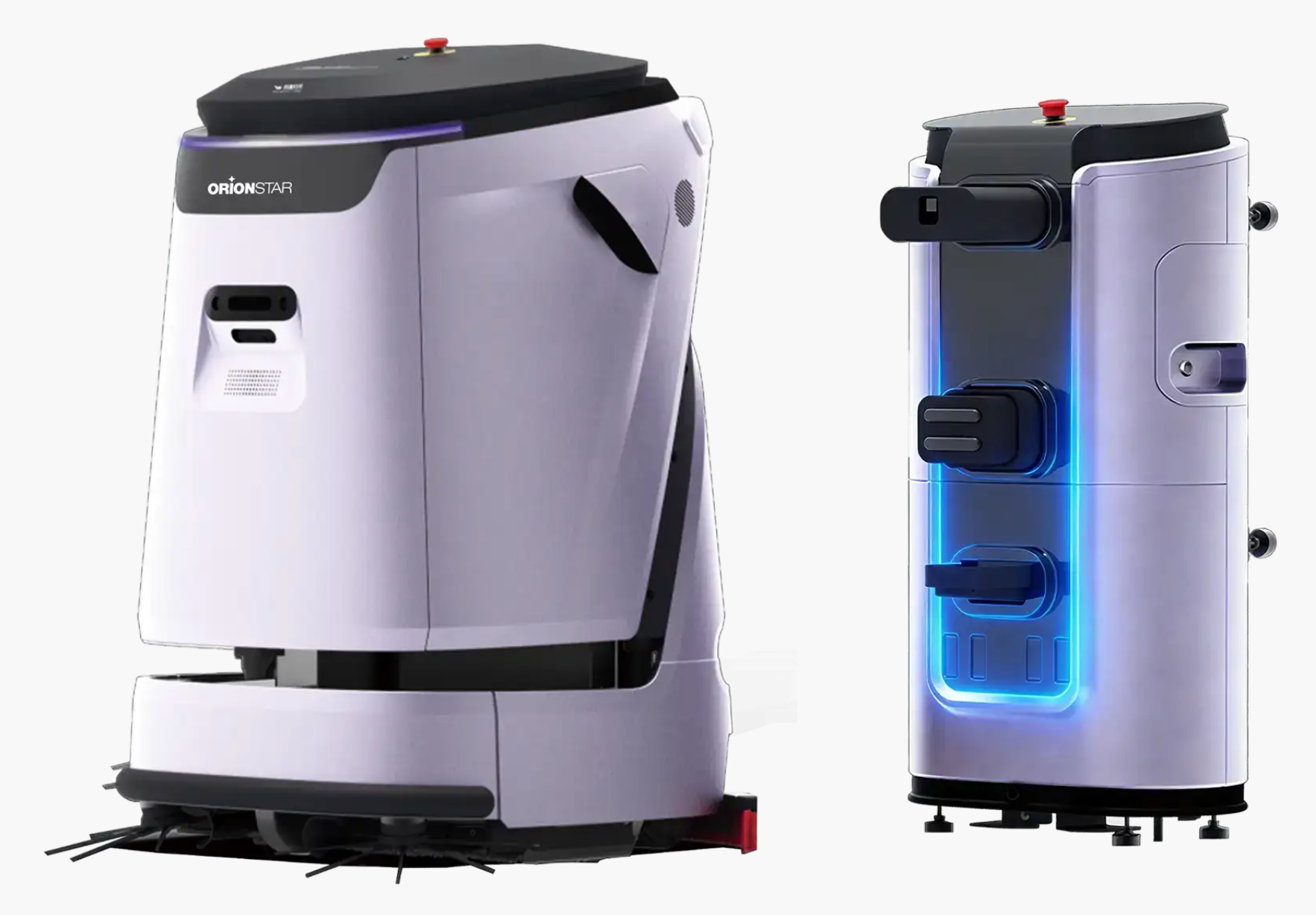
The OrionStar CleaniBot C5 is positioned as a highly adaptable solution for office buildings and corporate campuses requiring reliable daily maintenance in varied spatial layouts. A key advantage of this model is its highly autonomous continuous operation, facilitated by an advanced workstation docking system that handles automatic clean-water refilling, wastewater discharge, and high-pressure internal tank rinsing. This infrastructure allows the robot to execute consecutive shifts with minimal human intervention. To address the architectural constraints of typical commercial buildings, the C5 features a compact body with a minimal passing width of approximately 880 millimeters and a 550-millimeter main brush cleaning width, enabling it to navigate narrow corridors and standard doorways smoothly. When encountering demanding areas such as loading zones or high-traffic entryways, the unit utilizes a dual-roller heavy-duty scrubbing mechanism that delivers a downward scrubbing pressure of 25 kilograms. This configuration enables effective single-pass removal for most standard commercial surface soils, achieving a reported dirt-cleaning rate of up to 95 percent based on standardized laboratory testing according to manufacturer data. *Maximum continuous mapping area depends on hardware configurations and environmental complexity.
Designed to operate unobtrusively in populated environments, the Gausium Scrubber 50 Pro is well suited for modern corporate lobbies and open-plan workspaces where immediate response to localized soiling is necessary. Its compact form factor and quiet operation allow it to maneuver efficiently through crowded spaces without causing excessive disturbance during business hours. A prominent feature of this platform is its AI vision-based spot cleaning capability, which utilizes an RGB camera and deep-learning algorithms to proactively detect visible spills and stains, deploying scrubbing resources only where necessary rather than running continuous fluid delivery. This targeted approach is supported by an onboard water recycling system featuring multi-stage filtration, which utilizes multi-stage filtration to filter collected wastewater during operation and reduces freshwater consumption by up to 80 percent according to manufacturer data. Together, these technologies extend the floor coverage between manual tank interventions, making it highly efficient for continuous daytime deployments. Filtration performance refers to physical debris removal, not microbiological purification.
For expansive common areas, wide corridors, and large corporate campuses, the Tennant T7AMR offers a robust, high-capacity solution that blends conventional janitorial workflows with advanced robotics. Positioned as a heavy-duty platform, it features dual-mode ride-on and autonomous flexibility. This allows facility managers to utilize the machine as a traditional manually driven scrubber for complex, ad-hoc deep cleaning tasks, while relying on its autonomous mode to replicate extensive routine cleaning paths. The autonomous navigation is powered by the BrainOS platform, which utilizes a teach-and-repeat learning methodology to accurately memorize operator-driven routes. To support prolonged continuous cleaning across massive floor plans, the T7AMR is equipped with large-capacity tanks holding up to 110 liters of solution and 110 liters of recovery water. This extensive fluid capacity, combined with heavy downward brush pressure, ensures the machine can maintain high hourly square-footage coverage in wide-aisle environments without necessitating frequent stops for fluid exchange.
The Avidbots Neo 2W targets multi-building campuses and expansive industrial-style commercial facilities that require comprehensive data-driven oversight and extended operational longevity. A defining characteristic of this platform is its extended runtime, supported by high-capacity swappable batteries that deliver up to six hours of operation on a single charge, allowing dedicated cleaning teams to swap power sources seamlessly for continuous multi-shift coverage. To address the complexities of managing equipment across widespread properties, the system connects to a proprietary web-based fleet management portal, providing facility managers with real-time productivity metrics and detailed coverage maps. Furthermore, considering the diverse linguistic demographics of global janitorial teams, this platform offers robust multilingual UI support. Rather than relying on generic SDK integrations or requiring administrators to upload external cloud voice packs, the robot provides native on-device locale selection, allowing operators to switch the interface instantly among languages such as English, French, Spanish, and Japanese directly from the touchscreen.
Focusing heavily on regulatory compliance and thorough environmental coverage, the Kärcher KIRA B 50 is specifically engineered for medium to large hard-floor areas in occupied commercial facilities. A critical differentiator for this model is its IEC 63327 public-space safety certification, which provides facility managers with formalized, documented assurance that the system is validated for secure daytime operation in highly populated lobbies and busy corporate corridors. To reduce the need for secondary manual detail work, the machine features an integrated side brush designed for ultra-close edge cleaning, actively sweeping debris and scrubbing directly alongside baseboards and walls. When paired with its optional autonomous docking station, the platform operates as a self-sufficient unit, automatically navigating to its base to refill fresh water, drain waste, rinse its internal tanks, and recharge its lithium iron phosphate batteries, ensuring reliable preparation for subsequent scheduled shifts, subject to local environmental factors.
Final procurement recommendations for commercial cleaning robots depend heavily on aligning these diverse capabilities with specific facility priorities. When evaluating operational autonomy and maintenance, prioritize platforms offering fully automated workstation infrastructure and onboard fluid recycling to minimize labor dependency. For form factor adaptability, facilities with tight corridors should select compact narrow-body architectures, whereas expansive campuses benefit from the coverage of large-capacity, dual-mode ride-on machines. Regarding cleaning strategy, facilities should choose between AI-driven active spot cleaning for localized lobby spills or integrated side brushes to achieve meticulous edge resolution along corridor walls. Finally, to ensure secure integration into populated environments, procurement teams must demand rigorous public-space safety certifications and robust dynamic obstacle detection systems that maintain safe distances from pedestrians.
Published case studies show that autonomous cleaning robots can deliver measurable returns within 12 to 24 months. Case studies in the logistics and aviation sectors show significant labor hour reductions. The actual payback period depends on the robot's purchase or lease cost, the building's labor rates, the floor area covered per shift, and how many manual cleaning hours the robot displaces. Compact models represent a lower initial capital expenditure compared to heavy-duty ride-on models, so the investment range and corresponding ROI timeline vary significantly by product category. Facility managers should also factor in reduced overtime, lower staff turnover, and more consistent cleaning schedules when projecting returns.
Most autonomous cleaning robots offer optional docking or workstation accessories that enable automatic water refilling, waste-water discharge, battery charging, and in some cases internal tank self-cleaning. For example, the OrionStar CleaniBot C5 supports a workstation that handles refueling, drainage, and high-pressure tank rinsing; the Gausium Scrubber 50 Pro offers the WS-01 workstation; and the Kärcher KIRA B 50 has an optional docking station for unattended overnight operation. Infrastructure requirements typically include a water supply connection, a drain point, and a standard electrical outlet at the docking location. The C5 also supports optional mobile water tanks that do not require building plumbing modifications, which can simplify deployment in buildings where retrofitting plumbing is impractical. Docking stations are generally sold separately from the robot itself.
Autonomous cleaning robots commonly use LiDAR, 3D depth cameras, and RGB cameras for navigation and obstacle avoidance. In EU commercial buildings, if these cameras capture images of identifiable individuals or map internal building layouts, the operator may need to conduct a Data Protection Impact Assessment (DPIA) under GDPR Article 35 and ensure compliance with data minimization and purpose-limitation principles. All four competitors reviewed (Gausium Scrubber 50 Pro, Tennant T7AMR, Avidbots Neo 2W, and Kärcher KIRA B 50) note that operators should verify GDPR compliance before deployment. Practical steps include confirming whether the robot stores or transmits visual data, whether anonymization is applied on-device, and whether a data processing agreement with the robot vendor is required. Robotics manufacturers are increasingly focusing on over-the-air security updates and encryption, but compliance responsibility ultimately rests with the deploying organization.
OrionStar ensures data minimization. Localized mapping data is encrypted and stored locally or on compliant regional servers, strictly for navigation purposes. Involved data types include anonymized environmental geometric map data, anonymized infrared/depth sensor streams, and device operation logs (battery status, fault codes). This data is solely used for local navigation obstacle avoidance, fleet management, and OTA firmware updates, involving no personal biometric (facial) tracking. Data is retained only for the duration of the service period and destroyed within regulatory timeframes (typically within 30 days) upon account cancellation or deletion request. An opt-in consent mechanism is strictly enforced, requiring administrators to proactively agree to the Privacy Policy during initial setup or app binding.
Narrow passage capability is a key specification for office building deployment. The CleaniBot C5 has a minimum passing width of approximately 880 mm with a 550 mm main brush cleaning width, the Gausium Scrubber 50 Pro requires 800 mm, and the Kärcher KIRA B 50 is 750 mm wide. In contrast, models like the Tennant T7AMR at 850 mm wide and 1,650 mm long, and the Avidbots Neo 2W at 760-940 mm wide and 1,520 mm long, feature larger footprints optimized for expansive open spaces rather than tight corridors. Most robots also support "Teach and Repeat" or manual driving modes for navigating confined areas where autonomous path planning may struggle. For office towers with standard doorways (typically 800-900 mm) and narrow service corridors, compact robots with smaller footprints and tighter turning radii are generally the better fit.
Runtime varies by model and cleaning mode. The CleaniBot C5 delivers approximately 3 hours of scrubbing or up to 8 hours of dust mopping on a single charge, with a theoretical cleaning efficiency of up to 1,980 m²/h under unobstructed standard test conditions. Actual coverage varies by environment. It features a combined water-tank capacity of 90 L (45 L clean + 45 L waste). The Gausium Scrubber 50 Pro offers similar scrubbing runtime (3 hours) but with smaller tanks (30 L clean / 24 L waste). The Kärcher KIRA B 50 provides about 3.5 hours of runtime with 24V/160Ah LFP batteries. The Avidbots Neo 2W leads with 4 to 6 hours of operating time and the largest tanks (109 L solution / 135 L recovery). The Tennant T7AMR offers up to 4 hours. For a typical office tower lobby and corridor floor of 2,000 to 5,000 m2, a compact robot with a 3-hour scrubbing runtime and auto-docking can complete a full cleaning cycle and recharge during a single night shift, especially when paired with a workstation for autonomous water exchange.
Noise levels across the leading models are suitable for daytime operation in occupied spaces. The CleaniBot C5 operates below 68 dB(A), the Gausium Scrubber 50 Pro is rated at a comparable level, the Kärcher KIRA B 50 produces 69 dBA, and the Tennant T7AMR registers 70 dBA. For reference, 68-70 dB(A) is roughly equivalent to normal conversation volume, which means these robots can clean lobbies and corridors during business hours without causing significant disruption. The KIRA B 50 is explicitly safety-certified to IEC 63327 for operation in public access areas. Facility managers should note that actual noise output varies by cleaning mode, with scrubbing generally louder than dust mopping, and that scheduling quieter modes during peak occupancy hours is a common practice in corporate buildings.
Third-party product specifications are based on publicly available data as of 2024 (up to, under laboratory conditions, according to manufacturer data) and may vary. Product names and trademarks are the property of their respective owners. If any product involves cameras, voice recording, mapping, or cloud data processing, the operating party must verify GDPR compliance prior to deployment.