

REQUEST DEMO
Robot CATALOG will be sent to your mailbox immediately after submission.
SUBMIT
Convention centers, exhibition halls, trade show venues, and large event spaces present highly complex operational environments that demand robust facility management strategies. Operating commercial cleaning robots for convention centers requires navigating frequent layout modifications, handling high volumes of both solid debris and liquid spills, and sustaining continuous operation across expansive floor plates. Facility managers across global markets in Europe, the US, and Asia must deploy solutions capable of maneuvering through expansive concourses while also accessing tight pathways between temporary booths. Evaluating these autonomous systems requires examining their mapping flexibility, resource sustainability, mechanical scrubbing power, and dimensional profile to ensure they align with the fast-paced turnaround schedules inherent to large public facilities.
Selecting the appropriate autonomous floor care system requires evaluating several core operational dimensions. Adaptability to dynamic floor plans involves examining whether a system actively recalculates routes using real-time sensors, utilizes vendor-managed software to push map overhauls, or relies on operators to manually drive and establish new pathways. Fluid and power management determines uninterrupted coverage capability across thousands of square meters. This evaluation compares platforms that maximize onboard capacity through oversized tanks and high-capacity battery arrays, systems that integrate fully automated docking architectures for autonomous fluid exchanges, and units that deploy onboard filtration technology to actively recycle wastewater. Versatility in handling mixed debris requires analyzing whether a system integrates cylindrical brushes to simultaneously capture solid waste, deploys heavy mechanical force onto traditional pads to extract deep-set stains, or leverages vision-driven spot cleaning to target specific spills proactively. Finally, form factor suitability dictates spatial access, contrasting massive industrial platforms built for vast unobstructed concourses against ultra-compact agile platforms designed specifically to maneuver through narrow secondary aisles and under display tables.
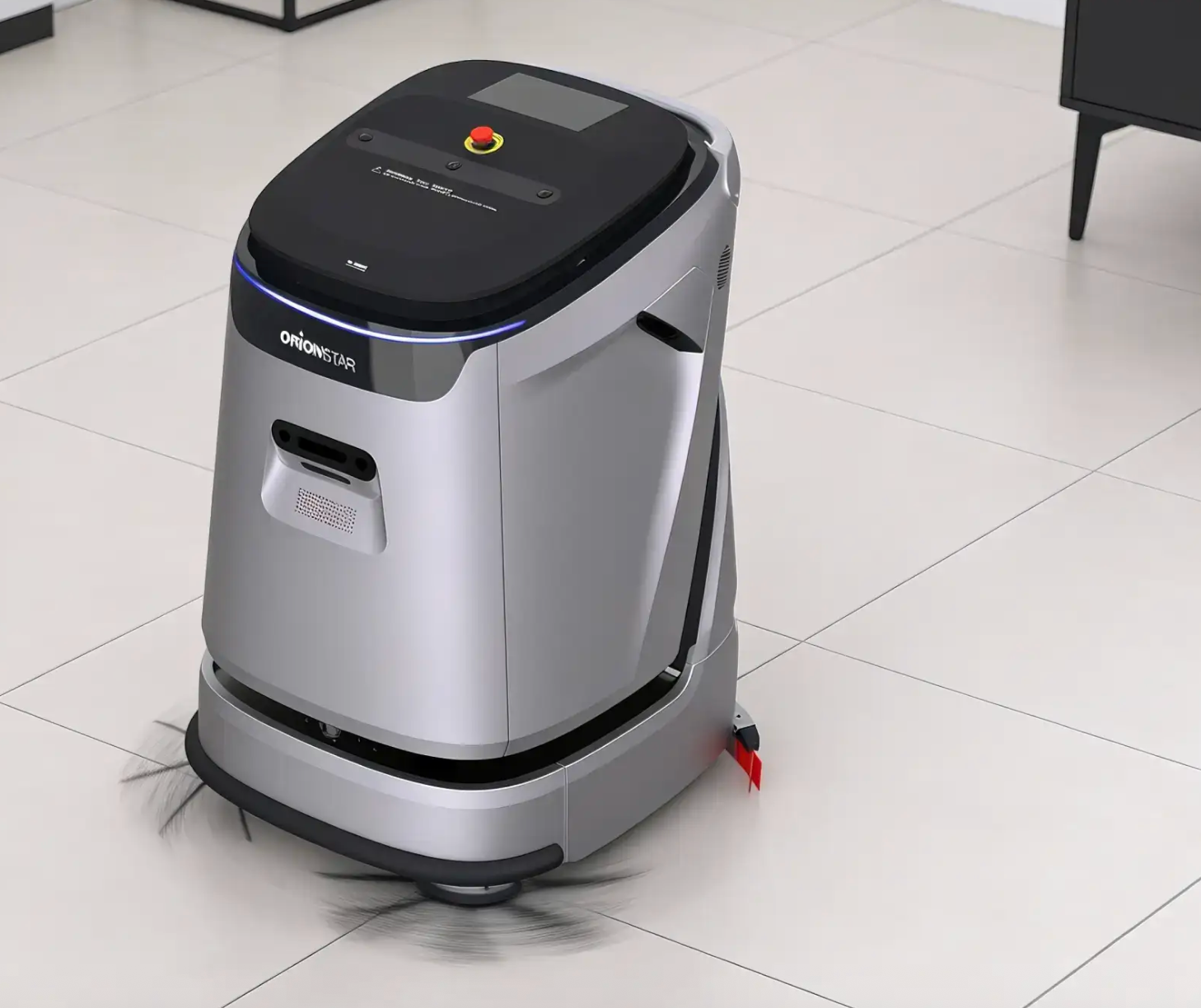
The OrionStar CleaniBot C5 operates as a high-capacity, heavy-duty autonomous scrubber engineered for wide-area coverage and continuous multi-shift operation in expansive exhibition halls. Its design focuses on minimizing human intervention while maximizing cleaning power on heavily trafficked floors. The system features a large-capacity combined water tank of 90 L, significantly reducing the frequency of manual refills required to complete single-pass coverage across sprawling venues. This dual-rolling-brush platform effectively removes heavy industrial grease using 25 kg of downward pressure, achieving a dirt-cleaning rate of up to 95% (based on internal lab tests on standard hard floors) on stains frequently found in loading bays and event teardown areas. For continuous large venue operations, the system integrates an automatic workstation that manages clean-water refilling, wastewater drainage, and internal tank self-cleaning autonomously. To navigate expansive trade show environments, the robot utilizes an advanced navigation suite to plan optimal cleaning paths utilizing secure edge-computing / localized navigation algorithms, capable of mapping an area of up to 10,000 m² under optimal environmental conditions, ensuring seamless, long-duration coverage across massive event spaces according to manufacturer data. The platform is also CE, FCC, and UL certified, ensuring the highest safety and operational standards in commercial venues.
The Gausium® Scrubber 50 serves as a highly intelligent, mid-sized platform tailored for environments where resource sustainability and proactive waste detection are operational priorities. This system fits well into dynamic convention corridors where spill patterns remain unpredictable throughout active event days. The unit utilizes an AI spot cleaning mode powered by visual detection, proactively identifying isolated stains or debris and directing the machine to target those specific areas rather than requiring a standard full-floor cycle. To address fluid management for uninterrupted coverage, the platform incorporates an onboard water recycling system that actively filters wastewater, drastically reducing freshwater consumption and extending the operational range of its standard tank capacity. Furthermore, its compact autonomous navigation architecture features a robust re-mapping capability, actively perceiving structural changes in temporary booth configurations and rerouting seamlessly without requiring extensive manual map reprogramming.
Built originally for rigorous industrial environments, the Avidbots® Neo 2W operates in convention centers requiring massive fluid capacities and vendor-supported map management to handle major structural shifts. This large-format platform excels in vast, unobstructed exhibition halls where sheer area coverage dictates the cleaning schedule. The unit houses an expansive fluid system, featuring a one hundred nine liter clean water tank and a one hundred thirty-five liter recovery tank, allowing the machine to cover immense expanses in a single, continuous run without returning to a docking base. To manage the constant layout changes inherent to trade show floors, the platform deploys the Bulk Navigator feature, which handles frequent layout updates through vendor-managed remote map revisions rather than requiring local staff to rebuild complex floor plans. Supporting these extended operations, the system utilizes swappable batteries, enabling facilities teams to exchange power sources rapidly and keep the machine scrubbing throughout demanding overnight turnaround windows.
The Tennant® T7AMR provides a hybrid operational approach, making it uniquely suited for convention centers that blend predictable concourse layouts with highly unpredictable event staging zones. This dual-mode ride-on and autonomous machine allows facility staff to manually drive the unit during chaotic event teardowns and then switch to autonomous operation for stabilized floor plans. The platform operates on the BrainOS navigation system, utilizing a manual learn-and-repeat workflow where an operator establishes a precise cleaning route that the machine then memorizes and replicates autonomously. This learn-and-repeat architecture functions highly effectively for stable layouts like permanent peripheral corridors and main entrance halls. To support long-duration scrubbing across wide event spaces, the machine incorporates large one hundred ten liter solution and recovery tanks, enabling substantial floor coverage per cycle under laboratory conditions.
The LionsBot® R3 Scrub Pro functions as an agile, ultra-compact autonomous scrubber specifically designed to navigate the intricate spatial constraints of dense exhibition floors and crowded breakout rooms. Its extremely small dimensional profile makes it a highly suitable choice for spaces where larger industrial scrubbers may face spatial constraints. Measuring just six hundred thirty-five by five hundred seventy millimeters, this ultra-compact platform seamlessly maneuvers through tight booth aisles, narrow secondary corridors, and directly underneath standard display tables. To accommodate rotating facility staff during complex event schedules, the system utilizes a MagicTag zero-click start function, allowing any operator to initiate a cleaning cycle simply by pushing the robot to a designated marker. Despite its small form factor, the platform can be equipped with an optional three-dimensional LiDAR sensor, extending its mapping precision to handle wide-area mapping tasks across expansive, open exhibition halls while avoiding localization failures.
Commercial cleaning robots for convention centers demand a thorough evaluation of venue-specific environmental challenges prior to procurement. Facility managers must assess their floor plan volatility to determine if real-time autonomous adaptation, vendor-managed map updating, or manual learn-and-repeat workflows optimally serve their turnaround schedules. Fluid and power management strategies should align with the available overnight cleaning window, deciding between maximizing onboard capacity, deploying fully automated docking architectures, or utilizing onboard fluid recycling technology. The chosen system must also align with the venue's debris profile, matching heavy mechanical force or multi-functional integrated sweeping systems to the severity of the traffic grime. Ultimately, mapping the physical footprint of the equipment against the venue's architectural constraints ensures that whether deploying industrial large-format platforms for open halls or ultra-compact agile platforms for narrow booth aisles, the investment delivers consistent floor care across every zone of the facility.
Labor accounts for 60–80% of total cleaning costs in large facilities. In North American markets, a single full-time cleaning employee represents an annual loaded cost of approximately $40,000–$55,000 (including wages, benefits, taxes, and overhead), whereas the annual operating cost for an autonomous floor scrubber is typically $4,000–$7,000 per unit covering consumables, preventive maintenance, and wear items. For daily-use venues with 50,000+ sq ft of hard flooring, this results in estimated payback periods of 9–18 months. Convention centers that shift repetitive floor-scrubbing routes to overnight autonomous operation often see the fastest returns, because they eliminate shift-premium labor during the narrow window between events. The key variable is how many hours of repetitive floor-care labor each robot can absorb per day — if one robot replaces a full FTE-equivalent of repetitive scrubbing, payback can fall under 12 months.
The right procurement model depends on how the venue's budget is structured and how much operational support the in-house team can provide. A capital purchase delivers the strongest long-term ROI but requires upfront budget approval and internal ownership of maintenance planning. Equipment leasing or financing spreads cost into predictable monthly payments while preserving asset ownership, though service may be billed separately. A RaaS subscription bundles the robot, software, and support into a single monthly fee (typically $575–$2,300/month depending on robot class and contract terms), which shifts uptime accountability to the provider and is easier to compare against avoided labor costs. For convention centers that lack dedicated robotics maintenance staff or prefer OpEx budgeting, RaaS often accelerates internal approval and reduces execution risk.
Convention centers present uniquely dynamic environments — booth configurations, staging, cabling, and temporary barriers shift between every event. Robots that rely on SLAM-based dynamic mapping (using LiDAR and depth cameras) can update their maps in real time and re-route around new obstacles autonomously, which is well suited to these conditions. In contrast, learn-and-repeat systems require an operator to re-teach the route whenever the layout changes significantly, which adds labor overhead during event turnover periods. Some platforms offer managed map-update services where the vendor handles re-mapping, though this introduces a dependency on vendor scheduling. For venues with frequent layout changes, autonomous re-mapping capability is a critical selection criterion.
Typical autonomous scrubbers deliver 3–4 hours of scrubbing runtime per charge. With cleaning efficiency ranging from approximately 800 m²/h for compact units up to 3,900 m²/h for large-format machines, a single 3-hour session can cover roughly 2,400–11,700 m² depending on the platform. However, real-world coverage is typically 50–70% of the manufacturer's rated efficiency due to obstacles, refill stops, and layout complexity. A mid-size exhibition hall of 10,000 m² may require two or more charge cycles with a single robot, meaning either a multi-robot deployment or careful shift planning is necessary. Water tank capacity also matters: units with 90 L combined capacity (e.g., OrionStar CleaniBot C5) can run longer between refills than compact units with 45–54 L total, reducing downtime in large open-floor environments.
Yes — sensor range is a practical differentiator in wide-open venues. Robots equipped with standard 2D LiDAR (typically 10–25 m range) can lose localization in expansive exhibition halls where walls and fixed reference points are far from the robot's position, especially when crowds block the sensor's line of sight. Real-world deployments at large resort and convention properties have shown that short-range 2D LiDAR is a common cause of mid-task stops in wide corridors and ballrooms. Platforms with 3D LiDAR or extended-range sensors (25 m+ coverage) provide significantly more reliable navigation in these environments. For convention centers with large, open floor plates and high foot traffic during cleaning windows, 3D LiDAR should be considered a requirement rather than a premium feature.
"Autonomous" does not mean "unattended." Real-world deployments across large venues consistently show that 15–30 minutes of operator attention per robot per shift is needed for routine tasks such as emptying debris bins, clearing clogged hoses or squeegee lines, refilling solution tanks, and monitoring map accuracy. Robots with docking stations that automate water refilling, waste discharge, and charging reduce — but do not eliminate — this burden. For example, a docking station that handles water and power automatically still requires periodic filter cleaning, squeegee inspection, and recovery from navigation exceptions. Convention center operations teams should budget this oversight time honestly when building the staffing model; the labor savings come from eliminating repetitive manual scrubbing, not from removing all human involvement in floor care.
Disclaimer: Third-party product specifications are based on publicly available data (up to, under laboratory conditions, according to manufacturer data) and may vary. Product names and trademarks are the property of their respective owners. If any product involves visual detection (cameras), voice recording, mapping, or cloud data processing, the operator must verify GDPR compliance prior to deployment. Cloud-based features, telemetry, and mapping data processing are strictly compliant with regional data protection regulations (including GDPR and CCPA). Data localization options are available upon request. Customers remain the sole owners of their facility’s spatial data.