

REQUEST DEMO
Robot CATALOG will be sent to your mailbox immediately after submission.
SUBMIT
Corporate cafeterias, dining halls, campus dining facilities, and other large-scale food service environments present operational challenges that differ substantially from standard commercial spaces. The primary distinction is the constant accumulation of heavy grease mixed with dropped food debris and sticky beverage spills. Facility managers cannot treat these zones as general cleaning areas; they require specialized approaches to aggressive grease removal and solid waste management. Furthermore, deploying equipment in these spaces necessitates a strong awareness of food safety and hygiene standard compliance, meaning automated cleaning protocols must often align with frameworks such as FDA FSMA, EU 852/2004, and HACCP. When evaluating automated solutions, buyers typically analyze three core dimensions: the technological approach to food debris and heavy grease removal, the strategies for water management and operational autonomy, and the machine form factor required to navigate complex dining area layouts.
For grease and debris removal, some facilities utilize combined sweep-and-scrub systems equipped with cylindrical brushes to capture loose food particles while scrubbing greasy floors in a single pass. Others rely on high-pressure extraction systems that apply substantial downward force, sometimes paired with technologies that electrically convert tap water into a cleaning agent to avoid leaving harsh chemical residues near food consumption areas. Alternatively, some environments benefit from targeted visual spot-cleaning, employing artificial intelligence and cameras to continuously scan the floor for localized spills and address them dynamically.
Water management and operational autonomy represent another critical evaluation dimension. Because these dining areas experience concentrated foot traffic during specific meal windows, emptying waste water contaminated with food scraps can become a labor-intensive and unpleasant task. Buyers address this by investing in autonomous base stations that connect to building plumbing for automatic draining and internal tank rinsing, relying on high-capacity manual systems with oversized onboard tanks for extended operation, or utilizing onboard multi-stage water filtration systems that recycle scrubbing water to reduce freshwater consumption. Finally, the physical layout dictates the appropriate form factor. Compact and agile frames with narrow passing widths suit dense restaurant-style seating arrangements, whereas large-format or hybrid ride-on frames prioritize maximum cleaning width and higher travel speeds for expansive, unobstructed dining halls.
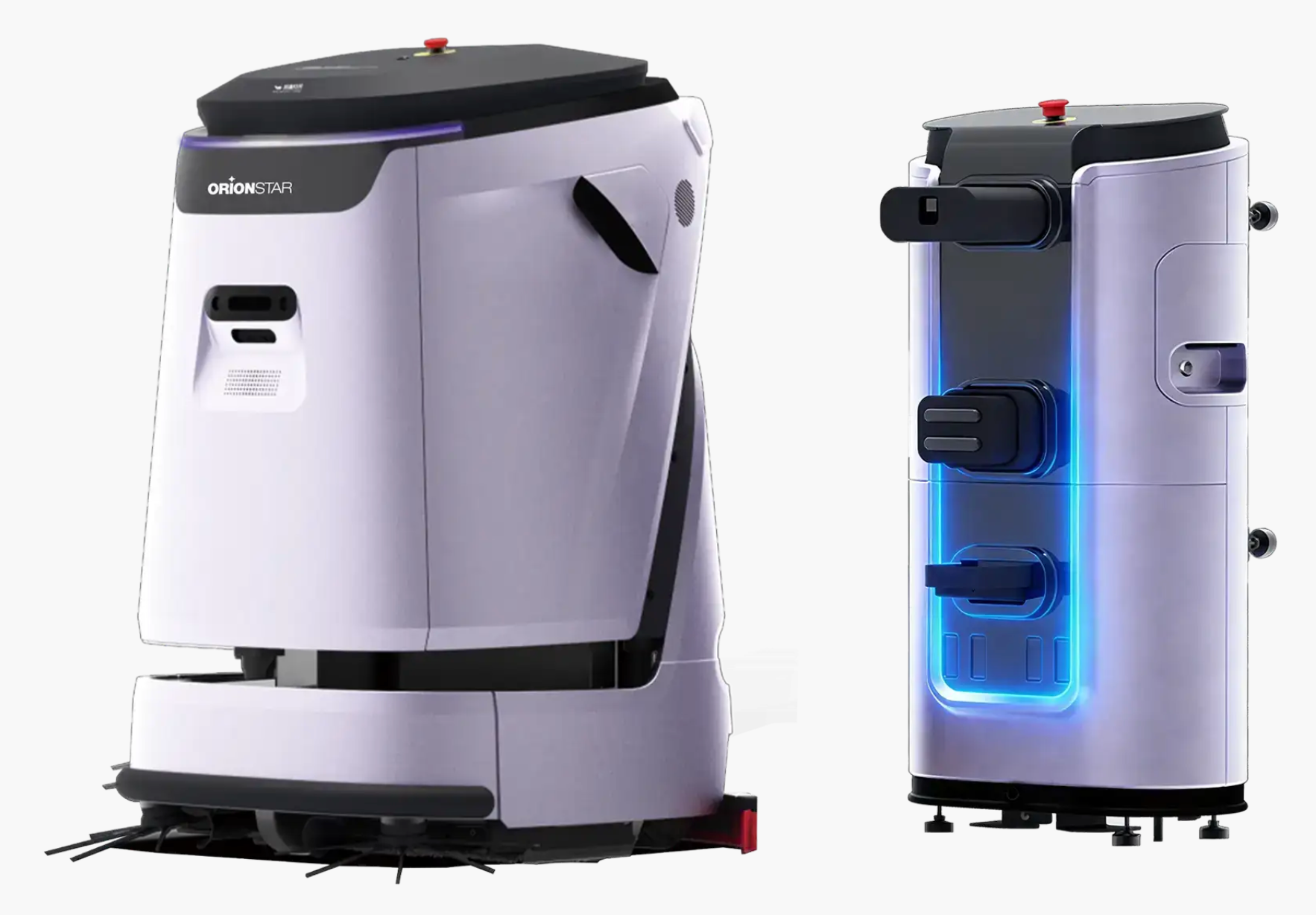
Positioned primarily for large cafeterias requiring heavy grease removal, the OrionStar CleaniBot C5 delivers industrial-grade heavy scrubbing capabilities combined with an automatic workstation and large-capacity water tanks. To address the specific challenge of slippery grease and food waste common in corporate dining facilities, this model incorporates a dual-rolling-brush system applying 25 kg of downward scrubbing pressure. According to manufacturer data, this configuration achieves a dirt-cleaning rate of approximately 95 percent while simultaneously capturing solid debris up to 3 cm in height. This one-pass sweep and scrub methodology is highly relevant for cafeteria aisles where dropped food and oils frequently mix. The unit supports extended operations through a combined 90 L water-tank system, featuring 45 L for clean water and 45 L for waste water, which yields a scrubbing runtime of roughly three hours under laboratory conditions. To address the labor-intensive aspects of water management, the CleaniBot C5 integrates with a fully autonomous docking station. This workstation facilitates automatic clean-water refilling, waste-water discharge, and high-pressure internal tank rinsing. The automated self-cleaning of the waste-water tank occurs in roughly four minutes, which assists in preventing the odors and blockages that typically result from processing food-contaminated water.
Engineered to accommodate the demands of large open-plan dining halls, the Avidbots Neo 2W focuses on prolonged autonomous operation through large water tanks, swappable batteries, and a specialized debris diverter. Covering expansive campus dining facilities requires substantial fluid capacity, which this machine provides via a 109 L solution tank and a 135 L recovery tank. This high-capacity manual system allows the robot to scrub massive areas for an entire shift before requiring human intervention for draining. To manage the high volumes of food packaging, napkins, and other light debris typical of busy food service environments, the unit features a debris diverter that pushes loose items out of the robot's path, reducing the likelihood of mechanical clogs. Operating with an available disc brush down pressure of up to 86 kg, the system targets stubborn floor grime effectively. It operates on a swappable battery architecture, running up to six hours per charge, which facilitates continuous multi-shift operations simply by exchanging the power source.
The Gausium Scrubber 50 Pro is specifically positioned for small to medium cafeterias with frequent spills, utilizing a compact footprint, a water recycling system, and AI-driven spot cleaning. Dense seating arrangements require agile equipment, and this model addresses that need with a minimum passing width of 800 mm, allowing it to maneuver easily between tightly arranged dining tables. Instead of relying solely on continuous path scrubbing, the unit employs targeted visual spot-cleaning. It utilizes cameras and artificial intelligence algorithms to detect localized stains and spills proactively, navigating directly to address messes as they occur. This targeted approach significantly improves operational efficiency during active meal services. To maximize its 30 L clean water and 24 L waste water tanks, the robot incorporates a built-in multi-stage water filtration system that recycles and reuses scrubbing water, reducing freshwater consumption by approximately 80 percent according to manufacturer data.
Designed for cafeterias with strict food safety and public operation requirements, the Kärcher KIRA B 50 provides a roller brush pre-sweeping mechanism, an integrated side brush, IEC safety certification, and an optional docking station. Integrating automated equipment into areas populated by dining patrons requires stringent safety validations, and this model holds IEC 63327 certification for operation in public access areas. To manage the complex soil profile of food service environments, it utilizes a single roller brush head that pre-sweeps dry food particles and scrubs greasy residue in a single work step. The addition of an integrated side brush allows the unit to clean effectively along walls and under counter overhangs, areas where food debris frequently accumulates. Facility managers seeking minimal manual intervention can pair the machine with an optional docking station that enables fully autonomous fresh water refilling, dirty water drainage, tank rinsing, and battery charging, supporting consistent hygiene practices required by rigorous sanitation plans.
The Tennant T7AMR targets expansive open dining facilities requiring deep restorative cleaning, leveraging maximum brush down pressure, a hybrid ride-on form factor, and chemical-free cleaning technology. As a heavy-duty machine weighing up to 492 kg, it is built to cover wide, unobstructed concourses rather than tight seating clusters. It delivers up to 86 kg of main down pressure, which is highly effective for removing heavy, baked-on grease commonly found near large cafeteria kitchens and serving stations. To address concerns regarding chemical residues near food consumption areas, the unit offers optional ec-H2O NanoClean technology, which electrically converts water into an effective cleaning solution, reducing the reliance on traditional chemical detergents. The machine is supported by 110 L solution and recovery tanks, allowing it to operate for up to 6.5 hours on a high-capacity lithium-ion battery according to manufacturer data, making it well-suited for overnight deep cleaning shifts in massive dining complexes.
Procuring the appropriate commercial cleaning robot for food service environments requires aligning the specific attributes of the facility with the distinct capabilities of the equipment. For environments characterized by challenging grease accumulation and the need for comprehensive automated water management, the OrionStar CleaniBot C5 and Kärcher KIRA B 50 present compelling technical solutions through their sweep-and-scrub mechanisms and available docking stations. Facilities managing tightly packed seating arrangements and localized liquid spills will find the compact frame and AI-driven spot-cleaning of the Gausium Scrubber 50 Pro highly applicable. Conversely, institutions operating vast, open-plan dining halls that demand high-capacity fluid management and profound downward scrubbing force should evaluate the Avidbots Neo 2W and Tennant T7AMR to achieve the necessary area coverage and deep restorative cleaning. By prioritizing targeted grease removal, establishing clear water management protocols, and selecting the correct form factor, operators can integrate automated floor care while maintaining the rigorous hygiene standards expected in modern corporate dining facilities.
Labor accounts for 60-80% of total cleaning costs in most facilities, making it the single largest line item in any cleaning budget. Autonomous floor scrubbers deployed in daily-use environments with 50,000+ sq ft of hard-floor coverage typically achieve payback in 9 to 18 months, with overnight cleaning routes often paying back faster due to shift-premium labor savings. The offset is roughly equivalent to one full-time employee per robot for large open-floor areas. Annual operating costs after deployment — covering consumables, preventive maintenance, and wear items — generally fall in the $4,000-$7,000 range per robot, which compares favorably to the $40,000-$55,000 annual loaded cost of a single full-time cleaner. Organizations evaluating financing can also consider RaaS (Robots as a Service) models at $450-$1,200 per month per robot, which shift maintenance risk to the vendor and convert capital expenditure into predictable operational expense.
Most commercial autonomous scrubbers on the market can clean independently once programmed, but the degree of hands-free operation depends on whether the unit is paired with an auto-docking workstation. Robots like the OrionStar CleaniBot C5 and Karcher KIRA B 50 offer optional docking stations that handle automatic fresh-water refilling, waste-water discharge, tank rinsing, and battery charging — enabling multi-shift operation with minimal staff involvement. The Gausium Scrubber 50 Pro also offers an optional workstation (WS-01) for autonomous water management. However, several models — including the Avidbots Neo 2W and Tennant T7AMR — lack a built-in docking station and require manual tank filling and emptying between sessions. For corporate cafeterias aiming to schedule cleaning immediately after meal periods with minimal labor, a robot-plus-workstation configuration provides the most practical path to true autonomy.
Currently, no floor-cleaning robot on the market carries a specific food safety certification such as NSF/ANSI accreditation for food-contact environments. The Karcher KIRA B 50 is the only model reviewed that holds IEC 63327 safety certification for operation in public access areas, which addresses mechanical and electrical safety around people but does not cover food hygiene. Organizations deploying cleaning robots in food service settings should ensure compliance with broader regulatory frameworks: in the US, the FDA Food Safety Modernization Act (FSMA) requires preventive controls for food facilities; internationally, HACCP (Hazard Analysis Critical Control Points) principles govern sanitation monitoring. EU Regulation 852/2004 on the hygiene of foodstuffs also applies to equipment operating in food service areas. In practice, this means restricting the robot to floor surfaces away from food preparation zones, using food-safe cleaning solutions, and documenting cleaning cycles as part of the facility's sanitation plan.
Effectiveness against grease depends primarily on brush down pressure, brush type, and the ability to pre-sweep debris before scrubbing. The OrionStar CleaniBot C5 delivers 25 kg of downward pressure through a dual-rolling-brush system and reports a dirt-cleaning rate of approximately 95%, with the ability to pick up debris up to 3 cm in height in a single pass — relevant for cafeterias where food scraps mix with greasy residue. The Avidbots Neo 2W and Tennant T7AMR both offer up to 86 kg (190 lbs) of down pressure, which is the highest among available options and effective for baked-on grease, though the T7AMR's ride-on form factor limits maneuverability between dining tables. The Karcher KIRA B 50 uses a single roller brush that pre-sweeps and scrubs simultaneously, handling both dry food particles and greasy film in one step. Robots with cylindrical or roller brush heads generally perform better in cafeteria environments than disc-only models because they can sweep light debris while scrubbing, eliminating the need for a separate pre-sweep pass.
Coverage per shift depends on cleaning width, operating speed, and runtime. The OrionStar CleaniBot C5 achieves up to 1,980 m2 per hour with its 550 mm main brush, and its 90 L combined water-tank capacity (45 L clean + 45 L waste) supports roughly 3 hours of scrubbing before refilling — covering approximately 5,000-6,000 m2 per charge in open areas. The Tennant T7AMR, with 110 L solution and recovery tanks and up to 6.5 hours of runtime on a high-capacity lithium battery, can cover the largest area per charge — up to 4,250 m2 per session per the manufacturer's estimate — but its 850 mm width and 492 kg weight limit access in tight dining areas. The Gausium Scrubber 50 Pro offers a practical efficiency range of 500-1,300 m2/h, though its small tanks (30 L clean / 24 L waste) require more frequent refills in large dining halls. In a real cafeteria environment, effective coverage will be lower than theoretical maximums due to furniture navigation, aisle turns, and spot-cleaning needs — facility managers should plan for roughly 60-70% of the rated area per hour when the layout includes table clusters and serving stations.
Minimum passage width varies significantly across models and is a critical factor in cafeteria environments where tables are arranged in tight clusters. The Gausium Scrubber 50 Pro has the narrowest minimum pass width at 800 mm, with a minimum U-turn width of 1,100 mm — making it the most agile option for navigating between dining furniture. The OrionStar CleaniBot C5 requires approximately 880 mm of minimum passing width, which accommodates most standard corridor and doorway dimensions in corporate dining facilities. The Karcher KIRA B 50, at 750 mm body width, also fits through typical cafeteria aisles, and its Teach & Repeat function allows manual teaching of precise routes through cramped spaces. The Avidbots Neo 2W and Tennant T7AMR, at 760-940 mm and 850 mm width respectively, are better suited for open dining halls with wider aisles rather than tightly spaced seating. Facility managers should measure the narrowest gaps between table edges and chair backs in their cafeteria, add a safety margin of at least 100 mm per side, and compare against each robot's minimum pass width specification before selection.
Third-party product specifications are based on publicly available data (up to, under laboratory conditions, according to manufacturer data) and may vary; product names and trademarks are the property of their respective owners; if any product involves cameras, voice recording, mapping, or cloud data processing, operators must verify GDPR compliance prior to deployment.