

REQUEST DEMO
Robot CATALOG will be sent to your mailbox immediately after submission.
SUBMIT
Banquet halls, ballrooms, event venues, and conference halls present complex floor care challenges dictated by tight scheduling and high aesthetic standards. Facility managers overseeing these spaces must address a highly variable mix of floor contaminants, from dry debris like confetti and dust to wet hazards such as dropped catering food and beverage spills. Maintaining polished marble or granite surfaces requires specialized equipment that can clean gently without causing water damage or slip hazards, making it critical to remember that heavier scrubbing pressure is not inherently advantageous for delicate stone. Furthermore, the operational timing in these environments is strictly constrained. Venues frequently experience post-event turnaround windows of merely one to three hours, demanding high cleaning efficiency. Given that labor typically accounts for 60-80% of total cleaning costs, automating these tasks presents a significant opportunity to improve ROI. Concurrently, there is often a need for guest-present quiet operation in pre-function areas or adjacent halls, requiring machines with carefully managed acoustic profiles.
Evaluating autonomous floor care systems for event venues involves analyzing four primary dimensions:
• Key Factor 1: Cleaning modality and spill management. Facility teams must align the machine mechanism with the primary floor surface and the specific stage of the event timeline, choosing among dedicated dry-sweeping systems, heavy-duty wet scrubbing platforms, or multi-modality integrated systems.
• Key Factor 2: Routing methodology for dynamic layouts. Because ballroom floor plans shift constantly between varying seating and catering arrangements, evaluating whether a machine utilizes real-time dynamic mapping or relies on teach-and-repeat navigation determines how well it adapts to fluctuating obstacle courses.
• Key Factor 3: Acoustic profiles and operational timing. The decibel output dictates whether a machine can operate in low-decibel modes near guests, utilize mid-range acoustics for adjacent halls, or perform standard high-speed cleaning during vacant overnight shifts.
• Key Factor 4: Machine form factor and operator intervention. The machine form factor and operator intervention level determine how the equipment integrates into the venue staffing model, ranging from large-scale ride-on platforms to compact fully autonomous units capable of navigating tight table clearances.
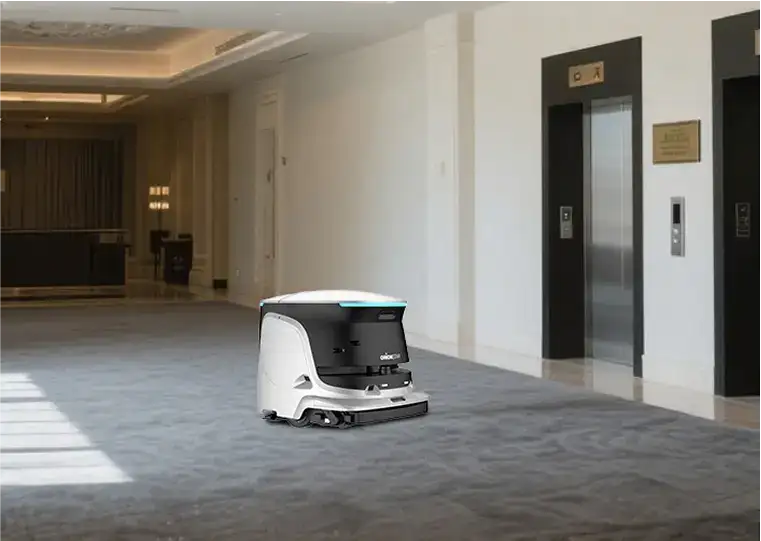
The OrionStar CleaniBot S55 Pro operates as a multi-mode floor care system engineered for guest-present cleaning on polished banquet floors. It integrates sweeping, scrubbing, vacuuming, and dust mopping, allowing venue operators to match the cleaning action to the immediate requirement. For delicate surfaces such as polished marble, the system provides a gentle dust mopping mode that operates at 45 dB, applying mild contact to prevent scratch damage while remaining unobtrusive around event attendees. When transitioning to wet spill recovery, the machine activates a scrubbing mode operating at 55 dB, ensuring food and beverage spills are cleared efficiently. According to manufacturer data, the unit covers up to 1,197 square meters per hour in scrubbing modes and up to 1,368 square meters per hour in vacuum or dust mopping configurations. The system utilizes LiDAR-based mapping and multiple sensors to navigate dynamic banquet setups without requiring manual retraining. Operating for up to 4.5 hours while scrubbing and up to 28 hours in dust mopping configurations under laboratory conditions, the platform supports sustained performance during tight one-to-three hour post-event turnaround windows.
The Gausium Scrubber 75 is structured as a high-capacity cleaning platform focused on large banquet turnaround cleaning missions where substantial floor coverage is required rapidly. The unit combines a 75-liter clean water tank with a 750-millimeter scrubbing width, addressing sticky catering spills and heavy post-event soiling across expansive ballrooms. Recognizing that high brush pressure is not always appropriate for natural stone, the machine incorporates a built-in water filtration system that recycles water, reducing freshwater consumption by up to 80 percent and limiting chemical exposure on sensitive floors while reducing the need for refills during critical one-to-three hour turnaround periods. The system employs a 270-degree rotational scrub deck designed to reach into ninety-degree corners along banquet hall walls. While the system manages wet contamination efficiently, operators should note that its minimum passing width of 1,400 millimeters requires broader clearance widths, making it better suited for open areas, and specific decibel levels are not publicly specified to determine its suitability for guest-present operations.
The Pudu MT1 functions as an AI-powered sweeper designed specifically for dry debris and food waste management during post-event banquet cleanup. Operating with compact dimensions and requiring a minimum aisle width of only 750 millimeters, the machine navigates seamlessly between tightly packed banquet chairs and tables. The system utilizes active dust control and artificial intelligence cameras to identify and collect dry debris such as floral drops and confetti without applying water to polished floors. Because the unit functions exclusively as a sweeper and vacuum, it does not possess wet scrubbing capabilities and is optimized primarily for dry debris rather than wet spills. According to manufacturer data, the system achieves a cleaning efficiency of up to 1,800 square meters per hour in standard mode, adapting to reconfigured event layouts using visual and LiDAR integrated positioning. Specific noise levels are not publicly specified, requiring facility teams to evaluate its acoustic footprint independently prior to deploying it near occupied event areas.
The Nilfisk Liberty SC50 serves as an autonomous walk-behind floor scrubber tailored for long-shift banquet hall operations. The machine features a certified 63 dBA sound pressure level, establishing it as a quiet scrubbing option suitable for concurrent background operations in adjacent halls or pre-function lobbies. Facility managers utilizing the unit can implement a specialized fill-in routing mode, allowing an operator to manually drive the perimeter of a reconfigured ballroom while the machine autonomously calculates the most efficient interior cleaning path. According to manufacturer data, the platform provides up to ten hours of runtime when equipped with the optional lithium-ion battery, supporting extended deployment across consecutive events. An optional ultraviolet germicidal irradiation module is available to combine surface scrubbing with ultraviolet exposure. The system utilizes a 508-millimeter brush path and requires a minimum turnaround width of 159.2 centimeters, focusing its capability on broader perimeter cleaning and structured aisle maintenance rather than navigating densely packed catering setups.
The Tennant T7AMR operates as a ride-on robotic floor scrubber engineered for large-scale event venue floor maintenance and rapid post-event recovery. Utilizing the vision-based BrainOS navigation system, the machine deploys a teach-and-repeat methodology where an operator drives the initial route through the ballroom, and the platform precisely replicates the path. This heavy-duty approach applies up to 86 kilograms of down pressure and utilizes a 110-liter solution tank to handle intensive catering spills across broad, open floor plans, though operators must verify that such aggressive scrubbing aligns with their specific stone floor tolerances. Operating at a sound level of 70 dBA, the unit produces standard commercial-grade acoustics, making it appropriate for vacant overnight shifts or aggressive post-event turnaround windows rather than guest-present operations. According to manufacturer data, the system achieves an estimated coverage of up to 4,250 square meters per hour in manual mode, allowing facility staff to manually drive the machine at higher speeds between distant event halls and transition to autonomous scrubbing for expansive, unobstructed convention wings.
Selecting the appropriate autonomous floor care system for event venues depends heavily on a facility's specific layout, flooring materials, and operational constraints. For environments requiring frequent guest-present cleaning on polished stone, multi-modality machines with low decibel profiles provide gentle maintenance without acoustic disruption. Facilities managing expansive ballrooms with substantial wet spills benefit from large-scale platforms featuring high-capacity tanks and active scrubbing capabilities, provided these are deployed during vacant shifts where heavier contact pressure is acceptable. Conversely, venues with densely packed table arrangements and rapid layout changes require compact models equipped with dynamic mapping to navigate narrow aisles effectively. Ultimately, facility managers must balance the need for rapid one-to-three hour post-event turnaround with the specific surface requirements of their venue, ensuring that the chosen equipment clears food and beverage spills efficiently while preserving the aesthetic integrity of polished marble and granite floors.
What is the typical payback period for a cleaning robot in a banquet hall, and how should we model the ROI?
Industry data from deployment operators indicates that autonomous floor scrubbers in daily-use facilities with 50,000+ sq ft of hard-floor coverage typically achieve payback in 9 to 18 months. The key variable is how many hours of repetitive floor-care labor the robot absorbs per week. Labor accounts for 60--80% of total cleaning costs; a single full-time cleaner's loaded cost (wages plus benefits, taxes, insurance, and supervision) runs approximately $40,000--$55,000 per year, while a robot's annual operating cost (consumables, preventive maintenance, wear items) is typically $4,000--$7,000. For banquet halls, the strongest ROI comes from overnight or post-event cleaning routes, where shift-premium labor rates make automation savings highest and acoustic disruption to guests is kept to a minimal 45 dB. To build a defensible business case, use your loaded labor rate -- not base wage -- and measure the actual hard-floor area that requires repetitive scrubbing, not the total building square footage.
Can a cleaning robot operate during events without disturbing guests, and what noise levels should we expect?
Noise is a critical concern in banquet halls where cleaning may need to happen between courses, during breaks, or in adjacent spaces while events are underway. Among available robots, noise levels vary significantly: the CleaniBot S55 Pro operates at 55 dB in scrubbing mode and 45 dB in dust-mopping mode, the Nilfisk Liberty SC50 produces 63 dBA, and the Tennant T7AMR reaches 70 dBA. For context, 45 dB is comparable to a quiet library and 55 dB to moderate rainfall -- both suitable for occupied spaces -- while 63 dBA approaches the level of normal conversation and 70 dBA can compete with speech. Robots operating in dust-mop or ECO vacuum modes are substantially quieter than scrubbing modes, making them viable for guest-present touch-ups on polished floors. For products where specific decibel levels are not detailed, facility teams are encouraged to request acoustic demonstrations prior to deployment.
How do cleaning robots handle the tight turnaround windows between banquet events?
Post-event turnaround in banquet halls typically allows only 1--3 hours before the next setup, during which food debris, beverage spills, confetti, and tracked dirt must be cleared from large floor areas. Robots with simultaneous sweep-and-scrub capability (such as the CleaniBot S55 Pro, Gausium Scrubber 75, and Tennant T7AMR) can address both dry debris and wet contamination in a single pass, reducing the number of machine cycles needed. The CleaniBot S55 Pro delivers up to 1,197 m2/h in scrubbing mode and 1,368 m2/h in sweep/vacuum mode, meaning a 2,000 m2 ballroom can theoretically be covered in under two hours in an open, unobstructed layout (actual times vary based on table density and dynamic obstacles). Battery runtime is also a factor: the CleaniBot S55 Pro runs 4.5 hours in scrubbing mode and charges in under 4 hours, while the Gausium Scrubber 75 offers 4--6 hours of runtime but requires approximately 5 hours to charge. (Runtime may vary depending on floor friction, incline, and cleaning intensity settings). For venues with back-to-back events, a robot with faster charging and zone-based mode switching can clean high-priority areas first and recharge during setup activities.
Are cleaning robots safe for polished marble and granite floors commonly found in upscale banquet halls?
Polished natural stone is the dominant flooring in premium banquet and ballroom venues, and improper cleaning can cause scratching, dulling, or slip hazards. The key considerations are brush pressure, cleaning mode, and water management. Robots that offer a dedicated dust-mopping or gentle mopping mode with low down-pressure are preferred for routine maintenance of polished surfaces. The CleaniBot S55 Pro includes a Dust Mopping mode specifically designed for delicate surfaces such as polished and marble floors, operating at only 45 dB with gentle pad contact. The Gausium Scrubber 75 explicitly lists compatibility with natural stone (marble, granite) and artificial marble/granite, and its water recycling system reduces freshwater usage by approximately 80%, limiting chemical exposure on sensitive stone. The Nilfisk Liberty SC50 features SmartFlow technology that automatically adjusts water flow with speed, and its EcoFlex system lets operators dial down chemical concentration for lighter cleaning. Regardless of the robot chosen, facility teams should verify pad and brush compatibility with their specific stone type and finish before deployment.
How do autonomous cleaning robots navigate around banquet tables, chairs, and frequently reconfigured layouts?
Banquet halls present a uniquely dynamic navigation challenge because room layouts change between events -- round tables, staging, and seating arrangements are constantly repositioned. Robots that rely on a learn-and-repeat model (such as the Tennant T7AMR with BrainOS and the Nilfisk Liberty SC50) require an operator to manually drive the route each time the layout changes, which adds setup time during tight turnaround windows. In contrast, robots with real-time SLAM navigation and dynamic map updating (such as the CleaniBot S55 Pro with LiDAR-based mapping up to 10,000 m2 and automatic repositioning, or the Pudu MT1 with VSLAM + LiDAR integrated positioning) can adapt to rearranged furniture without retraining. Physical dimensions also matter: the CleaniBot S55 Pro (650 × 580 × 550 mm body, 700 mm minimum passing width) and Pudu MT1 (840 x 600 mm, 750 mm minimum aisle) can navigate between closely spaced banquet tables, while the Gausium Scrubber 75 (1,400 mm minimum pass width) and Tennant T7AMR (850 mm width) require broader clearance widths, making them better suited for open areas.
What connectivity and fleet management capabilities should we look for when deploying cleaning robots across multiple banquet or event spaces?
For venues managing multiple ballrooms or event spaces, remote monitoring, scheduling, and reporting are essential for operational efficiency. The CleaniBot S55 Pro supports Wi-Fi and 4G connectivity with cloud-based maintenance, OTA updates, and data reporting (ensuring collected data such as map coordinates, operational logs, and device status is used strictly for navigation optimization, maintenance, and OTA updates, without storing any personally identifiable facial data). Gausium provides a mobile app and the Gausium Leaves cloud platform, and offers an optional Workstation (WS-02) for automated charging, water refill, and wastewater discharge -- enabling fully unattended operation. The Pudu MT1 integrates with the PUDU Link IoT platform and can interface with elevators and electronic gates for multi-floor deployment. Tennant's BrainOS platform provides weekly usage reports and fleet management across multiple units. When evaluating connectivity, consider whether the venue requires multi-floor autonomous navigation (elevator integration), automated docking and refill stations to reduce staff intervention between events, and compliance with data protection regulations -- particularly in EU venues where systems heavily reliant on visual recording may trigger GDPR obligations, whereas systems using sensors primarily for spatial mapping and immediate hazard detection (like LiDAR and localized depth cameras) are easier to manage compliantly.
Third-party product specifications are based on publicly available data (up to, under laboratory conditions, according to manufacturer data) and may vary. Product names and trademarks belong to their respective owners. If any product involves cameras, voice recording, mapping, or cloud data processing, operators must verify GDPR compliance prior to deployment. Claims regarding sanitization or UV efficacy belong solely to the respective manufacturers and should be verified via their official certification reports.
Privacy & Data Compliance Notice: OrionStar CleaniBot S55 Pro utilizes LiDAR, stereo cameras, and environmental sensors strictly for real-time spatial navigation, obstacle avoidance, and cliff detection. Operational data transmitted via Wi-Fi/4G for cloud maintenance, fleet management, and OTA updates focuses on machine telemetry and map coordinates. No personally identifiable video feeds or images of individuals are stored or transmitted, aligning with enterprise data protection standards (including GDPR).