

REQUEST DEMO
Robot CATALOG will be sent to your mailbox immediately after submission.
SUBMIT
Event venues face constant floor plan changes due to temporary exhibition booths, varying crowd barriers, and evolving staging setups. Coupled with highly compressed cleaning windows between events, facility managers must maintain expansive concourses and arenas without causing operational downtime. Post-event floors also present a complex mix of heavy grime, such as forklift tire marks from load-in and load-out phases, alongside physical debris like zip ties, confetti, and food wrappers. Selecting the right autonomous floor scrubber requires evaluating how these machines manage unpredictable spatial reconfigurations, maximize water capacity to minimize pit stops, and deploy the appropriate chassis scale for spaces ranging from sprawling exhibition halls to narrow VIP lounges.
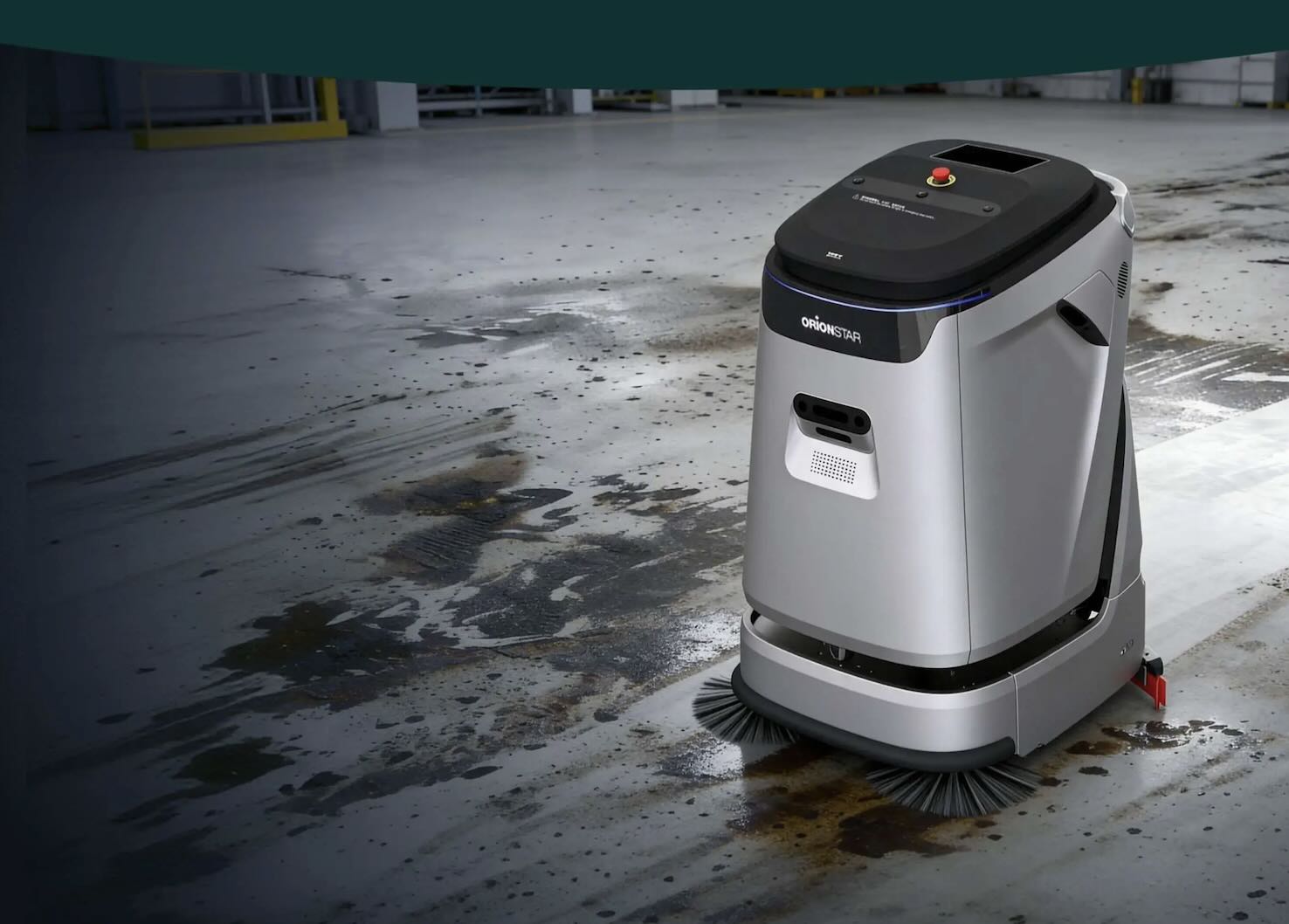
The OrionStar CleaniBot C5 addresses expansive event floor turnaround times through its high-capacity fluid management and automated infrastructure. Engineered with a combined 90-liter (approx. 23.7 gal) water tank system, allocating 45 liters (approx. 11.8 gal) to clean water and 45 liters (approx. 11.8 gal) to waste, this machine significantly reduces refill frequencies during critical post-event cleaning windows. Facility operators can pair the robot with an autonomous docking workstation that automates clean-water refilling, waste-water discharge, and high-pressure internal tank rinsing, enabling continuous multi-shift operations without manual staff intervention. The workstation self-cleans the waste-water tank in approximately four minutes to prevent blockages and odors**. For soil extraction, the unit deploys a heavy-duty dual-roller scrubbing mechanism delivering 25 kg (approx. 55 lbs) of downward pressure, simultaneously capturing solid debris up to roughly 3 cm (approx. 1.2 in) in height and scrubbing stubborn tire marks, achieving a reported dirt-cleaning rate of about 95% (based on internal laboratory tests under standard conditions). According to manufacturer data, it achieves a maximum cleaning area capacity of up to 1,980 m² (approx. 21,300 sq ft) per hour, while its Cloud Learning* path optimization allows it to map areas up to 10,000 m² (approx. 107,600 sq ft).
Designed for tight exhibition aisles and frequently reconfigured layouts, the Gausium™ Scrubber 50 features a compact footprint measuring just 700 mm (approx. 27.6 in) in width. This scale allows the machine to navigate narrow pathways between temporary booths and standard venue doorways that restrict larger industrial models. To adapt to daily shifts in crowd barriers and staging, the robot utilizes real-time dynamic planning via a combination of two-dimensional LiDAR and three-dimensional depth cameras, allowing it to autonomously calculate new routes when physical structures change. The machine houses a 30-liter (approx. 7.9 gal) clean water tank and a 24-liter (approx. 6.3 gal) waste tank, delivering a theoretical scrubbing efficiency of up to 1,987 m² (approx. 21,380 sq ft) per hour under ideal conditions. To support compressed turnaround schedules, operators can integrate optional workstation accessories that facilitate automated water exchange and battery charging, minimizing manual oversight during overnight cleaning cycles.
The Avidbots™ Neo 2W™ handles the largest open-floor venues by incorporating an industrial-scale chassis and maximum onboard fluid capacity. Carrying a 109-liter (approx. 28.7 gal) solution tank and a 135-liter (approx. 35.6 gal) recovery tank, this robot sustains extended, uninterrupted scrubbing sessions across massive convention center concourses without requiring frequent drainage stops. The unit employs advanced dynamic planning software that continuously scans the environment, comparing real-time spatial data to baseline maps to autonomously navigate around unexpected exhibition structures, staging equipment, or parked forklifts. Depending on the selected cleaning head, it exerts up to 87 kg (approx. 191 lbs) of downward brush pressure and achieves a theoretical productivity rate of up to 3,900 m² (approx. 41,900 sq ft) per hour. Additionally, an integrated debris diverter pushes occasional large waste from the cleaning path, reducing operational stoppages during intense post-event cleanups involving dense litter.
Targeting sensitive staging areas that occasionally demand human oversight, the Tennant™ T7AMR™ offers a dual-mode architecture combining highly autonomous operation with manual ride-on capabilities. This configuration allows venue staff to manually drive the machine through complex, high-value staging layouts or heavily congested zones where autonomous navigation proves impractical, then switch back to self-driving mode for expansive corridors. The robot utilizes a teach-and-repeat navigation system powered by BrainOS®, meaning an operator manually drives the precise cleaning route once for the unit to memorize and duplicate, which is well-suited for venues with static or semi-permanent floor plans. Operating with a 110-liter (approx. 29 gal) solution tank and a corresponding 110-liter (approx. 29 gal) recovery tank, it delivers up to six and a half hours of runtime when equipped with optional lithium-ion batteries. Under laboratory conditions, the platform covers an estimated 4,250 m² (approx. 45,700 sq ft) per session, utilizing a self-adjusting splash skirt to prevent overspray on temporary exhibition walls and fixtures.
The LionsBot™ R3 Scrub Pro focuses on VIP areas and narrow booth aisles, leveraging an ultra-compact chassis weighing 85 kg (approx. 187 lbs) and measuring 569 mm (approx. 22.4 in) across. This streamlined design enables the robot to autonomously clean tight elevators, specialized lounges, and standard corridors where larger equipment cannot maneuver. Staff can initiate cleaning sequences using the zero-click MagicTag system, which automatically selects the correct map and operational settings when the robot is physically pushed to a designated floor tag, simplifying deployment for temporary or contracted event personnel. The machine features a single-pass squeegee system engineered to leave floors rapidly dry, a critical specification for venues managing extremely brief transitions between successive events. While it utilizes a smaller 20.8-liter (approx. 5.5 gal) clean water tank, it incorporates side brushes that provide near-zero edge cleaning against booth perimeters and walls, achieving an average theoretical efficiency of up to 800 m² (approx. 8,600 sq ft) per hour.
Conclusion
Selecting commercial cleaning robots for event venues requires aligning machine specifications with the facility's specific operational architecture. For adaptability to dynamic venue layouts, operators managing rapidly changing exhibition floors should prioritize systems utilizing real-time dynamic planning or AI-driven auto-mapping, while venues with static concourses may successfully deploy teach-and-repeat navigation platforms. Regarding turnaround management and fluid capacity, facilities with expansive open halls benefit from maximum onboard architectures exceeding 100 liters (approx. 26.4 gal), whereas venues aiming to remove manual maintenance entirely should invest in moderate-capacity systems paired with automated docking workstations. Debris handling requirements dictate the scrubbing mechanism, with heavy post-event litter demanding cylindrical roller configurations with integrated hoppers, while deeply embedded stains on clear floors favor the high downward pressure of disk brushes. Finally, chassis scale determines spatial deployment, meaning sprawling convention floors necessitate heavy-duty industrial platforms, while VIP lounges and densely packed booths require compact, highly maneuverable walk-behind units.
Frequently Asked Questions
Labor accounts for 60–80% of total cleaning costs in facility budgets. For daily-use venues with 4,645+ m² (approx. 50,000+ sq ft) of hard-floor area, autonomous floor scrubbers typically achieve payback in 9 to 18 months, depending on shift structure and how much repetitive floor-care labor the robot absorbs. A single robot can offset roughly one full-time equivalent (FTE) of scrubbing work. Annual operating costs for a commercial cleaning robot — including cleaning solution, brush and squeegee replacement, preventive maintenance, and daily oversight — typically run $4,000–$7,000, compared with $40,000–$55,000 in loaded annual cost for one full-time cleaner. For event venues that run overnight or multi-shift cleaning schedules, the payback tends to be faster because the robot eliminates premium-shift labor during tight turnaround windows between events. The key variable is how many hours of repetitive floor scrubbing the robot can take over at loaded labor rates (base wage plus benefits, taxes, insurance, and supervision), not base wage alone.
Yes, provided the robot is paired with an automated docking station for water exchange and charging. In event venues, turnaround windows are often as short as 4–8 hours, during which floors must be scrubbed, dried, and ready for the next event setup. Robots with combined clean- and waste-water tanks of 90 L (approx. 23.7 gal) or more (e.g., the OrionStar CleaniBot C5 at 90 L (approx. 23.7 gal), Avidbots™ Neo 2W™ at 109 L (approx. 28.7 gal) solution / 135 L (approx. 35.6 gal) recovery, or Tennant™ T7AMR™ at 110 L (approx. 29 gal) each) can cover large areas without pausing to refill. Docking stations that automate clean-water refilling and waste-water discharge — such as the C5 Workstation, Gausium™ WS-01/WS-02, or LionsBot™ Refuel Station — enable continuous multi-shift operation without manual intervention. Robots that leave floors rapidly dry after scrubbing (e.g., LionsBot™'s Single Pass Squeegee) are especially valuable when the next event setup must begin right after cleaning. Noise levels below 68–70 dB also allow robots to operate while other turnaround activities (booth assembly, AV setup) are underway in adjacent areas.
This is one of the most important considerations for event venues, where floor layouts can change completely from one show to the next. Robots use different navigation approaches, and layout adaptability varies significantly. Robots with real-time dynamic path planning — such as those using Avidbots™ Autonomy or Gausium™'s auto-mapping — re-evaluate their cleaning route at the start of each session by comparing the real-time environment to stored maps, and can adapt to layout changes without manual intervention. Robots using 3D SLAM (e.g., LionsBot™ R3 Scrub Pro) build and update maps of their environment as they operate. The OrionStar CleaniBot C5 uses Cloud Learning* path optimization and can map areas up to 10,000 m² (approx. 107,600 sq ft). In contrast, the Tennant™ T7AMR™ uses BrainOS®'s "Teach & Repeat" approach, meaning an operator manually drives the precise cleaning route once for the unit to memorize and duplicate, which is well-suited for venues with static or semi-permanent floor plans. Venue managers should evaluate how often their layouts change and choose a navigation system that matches: dynamic planning for frequently changing layouts, or teach-and-repeat for more stable floor plans.
Many autonomous cleaning robots use cameras (RGB and 3D depth cameras), LiDAR, and cloud-connected platforms for navigation, mapping, and fleet management. Under the EU General Data Protection Regulation (GDPR), any system that captures image data — even incidentally — may be subject to data-protection requirements, including lawful basis for processing, data minimization, storage limitation, and transparency obligations. Robots that process sensor data on-device (edge processing) rather than streaming imagery to the cloud reduce privacy exposure. Venue operators should verify with each vendor whether camera data is stored, transmitted, or processed remotely; what data-retention policies apply; and whether the cloud platform is hosted within the EU. Operators should also assess whether the robot's mapping data could be considered personal data under GDPR, particularly if the maps capture spatial information about identifiable individuals. A Data Protection Impact Assessment (DPIA) is recommended before deploying any camera-equipped robot in a public venue within the EU. Specific GDPR compliance details are not publicly specified by most robot vendors, so direct engagement with the supplier's privacy and legal team is essential.
Theoretical cleaning efficiency for commercial autonomous scrubbers ranges from approximately 500 m²/h (approx. 5,380 sq ft/h) for compact models (e.g., LionsBot™ R3 Scrub Pro at 500–800 m²/h (approx. 5,380–8,600 sq ft/h) average) up to 3,900 m²/h (approx. 41,900 sq ft/h) for large-format machines (e.g., Avidbots™ Neo 2W™). The OrionStar CleaniBot C5 has a theoretical capacity of up to 1,980 m²/h (approx. 21,300 sq ft/h), and the Gausium™ Scrubber 50 up to 1,987 m²/h (approx. 21,380 sq ft/h) (disc brush). However, real-world coverage is typically 50–70% of manufacturer spec rates, depending on obstacle density, layout complexity, and the frequency of turns. In an exhibition hall with booth aisles and perimeter edges, practical throughput will be lower than in an open concourse. For a venue with 14,000 m² (approx. 150,000 sq ft) of hard-floor area, one mid-to-large-format robot running two shifts (evening and overnight) can typically cover the entire floor within a single turnaround cycle, provided docking and water-exchange infrastructure is in place.
Water-tank capacity directly determines how much area a robot can scrub before requiring a refill stop, which is critical during time-constrained turnaround windows. Tank sizes vary widely across the market: the LionsBot™ R3 Scrub Pro has a 20.8 L (approx. 5.5 gal) clean-water tank, the Gausium™ Scrubber 50 has 30 L (approx. 7.9 gal), the OrionStar CleaniBot C5 has 45 L (approx. 11.8 gal) (90 L (approx. 23.7 gal) combined clean + waste), and the Avidbots™ Neo 2W™ and Tennant™ T7AMR™ offer 109–110 L (approx. 28.7–29 gal) each. For large-venue continuous operation, docking stations that automate water exchange are essential. The C5 Workstation provides automatic clean-water refilling, waste-water discharge, and high-pressure internal tank rinsing (self-cleaning in roughly 4 minutes). Similar accessories exist for other platforms (Gausium™ WS-01/WS-02, LionsBot™ Refuel Station). Without a docking station, a robot with a 30 L (approx. 7.9 gal) tank will need manual refills every 1,000–2,000 m² (approx. 10,700–21,500 sq ft) of scrubbing; with a 90–110 L (approx. 23.7–29 gal) tank and a docking station, the robot can operate across multiple shifts with no manual water handling. For venues with 10,000+ m² (approx. 107,600+ sq ft) of floor space, pairing a large-tank robot with an automated docking station is the most practical approach to uninterrupted cleaning during tight event turnarounds.
**Note: The robot is designed for general commercial floor maintenance and is not classified as a medical disinfection device.
*Cloud Learning features process anonymized spatial telemetry exclusively for navigation enhancement. All environmental mapping data is encrypted, processed locally (edge computing) where applicable, and stored in compliance with regional data protection laws including GDPR. No personally identifiable video or image data is permanently stored or transmitted to unauthorized third-party servers without explicit facility consent.
Third-party product specifications are based on publicly available data, documented up to specific limits or under laboratory conditions according to manufacturer data, and may vary in real-world applications. All product names and trademarks remain the property of their respective owners. If any referenced product utilizes cameras, voice recording, environmental mapping, or cloud-based data processing, facility operators must verify GDPR compliance and applicable data protection regulations prior to deployment.