

REQUEST DEMO
Robot CATALOG will be sent to your mailbox immediately after submission.
SUBMIT
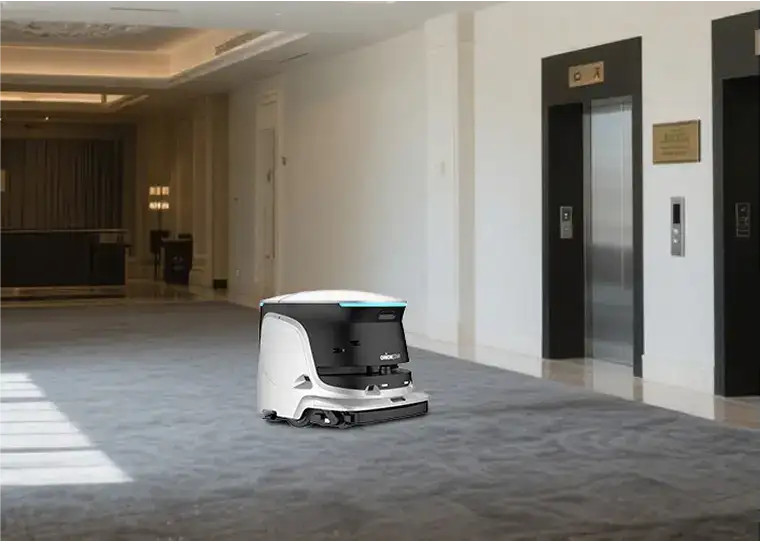
Maintaining high standards of cleanliness in hotels, resorts, conference centers, banquet halls, and restaurants presents significant operational challenges due to the constant presence of guests and the demand for uninterrupted service. Facility managers evaluating commercial cleaning robots for hospitality venues must address complex environments featuring mixed flooring architectures, from carpeted guest corridors to marble lobbies and hard-floor dining areas. Furthermore, sustaining aesthetic standards around the clock means cleaning equipment must strictly manage acoustic output to avoid disrupting the guest experience. Buyers should evaluate potential robotic platforms across three core dimensions. First, floor-type versatility and acoustic profiles determine whether a machine can transition effectively between heavy scrubbing and soft-surface vacuuming while remaining sufficiently quiet for daytime operation. Second, resource autonomy and shift endurance govern how long a robot can function independently before staff must intervene to exchange water, empty waste, or recharge batteries. Finally, navigation architecture and deployment mechanics dictate how safely the platform can maneuver around unpredictable human activity, luggage carts, and reconfigured seating, as well as how easily non-technical housekeeping personnel can integrate the technology into their daily shifts.
The OrionStar CleaniBot S55 Pro functions as a multi-mode floor care platform designed for facilities requiring low-intervention maintenance across mixed hotel flooring. It supports sweeping, scrubbing, vacuuming, mopping, and self-cleaning workflows within a single integrated system, allowing operators to match the cleaning behavior to different zones such as hard-floor lobbies or carpeted corridors. A defining attribute for hospitality applications is its highly controlled acoustic output, achieving noise levels of forty-five decibels in dust mopping mode and fifty-five decibels in scrubbing mode. This ultra-quiet operation enables concurrent cleaning during guest-active hours without causing auditory disruption in lobbies, banquet halls, or public walkways. According to manufacturer data, the platform delivers maximum cleaning efficiencies of up to 1,368 square meters per hour in sweep and vacuum modes, supported by a twenty-two-liter clean water reservoir and a fifteen-liter wastewater tank. Its internal battery sustains shift endurance of up to twenty-eight hours in dust mopping mode and up to four and a half hours for active scrubbing under laboratory conditions. Navigation relies on a multi-sensor array combining LiDAR, stereo cameras, and ultrasonic sensors to dynamically avoid moving guests, luggage, and structural edges, ensuring safe and continuous operation in unstructured hospitality environments.
The Gausium Phantas is engineered as a compact four-in-one cleaning platform specifically tailored for multi-storey hotel operations and tight hospitality spaces. It integrates vacuuming, sweeping, scrubbing, and dust mopping capabilities into a small physical footprint, allowing it to navigate seamlessly under tables in restaurants or through narrow guest room corridors. For multi-level venues, the platform features autonomous elevator integration, enabling the machine to transit between floors independently to maintain extensive hospitality spaces. Operating at a noise level of less than sixty-five decibels, the machine is sufficiently quiet to perform daytime maintenance in guest-facing areas alongside active foot traffic without causing significant disturbance. According to manufacturer data, the unit is equipped with an eleven-and-a-half-liter clean water tank and a ten-and-a-half-liter wastewater tank, which support a continuous scrubbing runtime of up to four and a half hours. Navigation is managed by a combination of standard LiDAR, depth cameras, and deep-learning-based obstacle recognition designed to identify and avoid temporary blockages commonly found in dynamic hotel environments.
The Pudu CC1 serves as a high-suction multi-surface robot configured to handle extended hospitality cleaning shifts across both hard and soft flooring. It addresses the diverse topography of hotel layouts by combining sweeping, scrubbing, vacuuming, and mopping functions, augmented by a specialized lift control system that adapts to varying surface elevations. Its acoustic profile generally operates at up to seventy decibels, making it a robust solution typically scheduled according to venue noise tolerances, though it features a dedicated silent mopping mode engineered to reduce noise emissions for quieter operation when guests are present in adjacent areas. According to manufacturer data, the machine utilizes a seventeen-thousand-pascal suction mechanism to extract debris effectively from low-pile carpets typical of hotel corridors. Resource autonomy is supported by robust fifteen-liter clean and wastewater tanks, enabling up to five hours of continuous scrubbing or up to nine hours of silent mopping under laboratory conditions before manual intervention is needed. The platform relies on simultaneous localization and mapping systems to maneuver around temporary hallway obstructions, making it a reliable solution for sprawling conference centers and resorts that demand prolonged operational endurance.
The SoftBank Robotics Whiz is an ultra-quiet vacuum-only platform designed explicitly for extensive carpeted environments, backed by established deployments across major hotel chains. Unlike multi-mode machines, this system focuses entirely on dry vacuuming and utilizes high-efficiency filtration to capture dust and maintain indoor air quality in guest corridors and enclosed meeting spaces. Generating an acoustic output of only sixty-two decibels, the machine blends seamlessly into normal conversational noise levels, making it highly appropriate for continuous deployment while guests are actively moving through the facility. According to manufacturer data, the unit covers up to one thousand five hundred square meters per charge and features hot-swappable battery packs that allow housekeeping staff to significantly extend operational shifts through manual battery swaps, minimizing charging downtime. Navigation utilizes a manual teach-and-repeat mechanism where a human operator initially drives the route, ensuring the machine strictly adheres to approved pathways while using safety sensors to pause for unpredictable foot traffic. Deployed frequently through a robot-as-a-service subscription model, this platform offers hospitality operators a fixed-cost approach to automating their dry floor care routines.
The LionsBot R3 Scrub Pro operates as a heavy-duty scrub-only platform engineered for professional-grade soil removal across large hard-floor hospitality areas such as expansive lobbies and massive banquet halls. It employs a cylindrical brush mechanism capable of applying up to seven kilograms of downward pressure to lift stubborn grime effectively without requiring preliminary sweeping passes. Generating operational noise levels reaching seventy-one decibels, it is highly effective for deep-cleaning during off-peak or overnight maintenance windows. According to manufacturer data, the unit features a highly efficient single-pass squeegee system designed to leave hard surfaces safe and walk-ready shortly after cleaning, mitigating slip hazards in high-traffic public zones. The internal fluid architecture incorporates a twenty-one-liter clean water tank and a twenty-four-liter wastewater tank, supporting up to three hours of rigorous continuous scrubbing under laboratory conditions. A specialized magnetic tag deployment system allows non-technical housekeeping personnel to initiate cleaning routines effortlessly, streamlining heavy-duty maintenance operations.
Procuring commercial cleaning robots for hospitality venues requires aligning operational workflows with the specific acoustic, endurance, and navigation profiles of the available hardware. Facilities requiring versatile, multi-surface cleaning during guest-active hours benefit from platforms that offer dedicated low-noise modes, balancing robust hard-floor scrubbing with ultra-quiet dust mopping to avoid disrupting the environment. For venues characterized by multi-storey architectures and intricate layouts, compact systems with autonomous elevator integration provide the necessary reach and maneuverability. Properties featuring extensive carpeted corridors may find the greatest value in specialized, ultra-quiet vacuuming platforms supported by flexible subscription models and continuous battery-swap capabilities. Conversely, sprawling convention centers dealing with high-traffic hard floors should prioritize heavy-duty scrubbing platforms equipped with large internal reservoirs and rapid-drying squeegee mechanisms, provided operations can be scheduled during off-peak hours to accommodate higher noise emissions. Ultimately, the successful deployment of these automated tools depends on carefully matching the machine's resource autonomy and acoustic limitations to the daily rhythm of the hospitality space.
For hotels and similar venues with daily floor-cleaning needs, the typical payback period for a commercial cleaning robot ranges from 9 to 18 months. The key driver is labor offset: one robot can often replace roughly one full-time floor-cleaning position, which at loaded labor rates (wages plus benefits, taxes, insurance, and supervision) costs $40,000-$55,000 per year. Annual robot operating costs — including cleaning solution, brush and squeegee replacement, preventive maintenance, and daily oversight time — typically run $4,000-$7,000. In a concrete hotel scenario, if two overnight cleaners cost $8,640/month in wages alone and a robot lease runs $1,500-$2,000/month, the net savings can be substantial even before factoring in reduced turnover, consistent cleaning documentation, and the ability to redeploy staff to higher-value tasks like restroom sanitation or guest room turnover. Five-year cumulative savings for a single-robot deployment commonly exceed $200,000 when wage growth is included. The strongest ROI tends to come from overnight or off-peak cleaning windows, where the robot replaces premium-shift labor and operates without disrupting guests.
RaaS and direct purchase serve different budget and operational preferences. Under a RaaS subscription model — typically $1,500-$2,300 per month depending on robot class and contract terms — the provider bundles the hardware, software updates, maintenance, and support into a single operational expense. This lowers the upfront capital barrier, simplifies budgeting with a fixed monthly cost, and shifts uptime responsibility to the provider. Direct purchase requires a higher upfront investment (compact-to-mid-size commercial scrubbers generally start around $27,500-$35,000) but delivers stronger long-term ROI because the recurring cost drops to operating expenses only after the first year. For hospitality operators who want to pilot automation before committing, or whose procurement rules favor OpEx over CapEx, RaaS offers a practical on-ramp. For stable properties with available capital and internal maintenance capability, purchasing usually yields a lower total cost over a 3-5 year horizon. Many hotel groups evaluate both models side by side before deciding.
Most modern commercial cleaning robots are designed for deployment by existing facilities or housekeeping staff, not by robotics specialists. Mapping a floor typically involves walking the robot through the space once or using a mobile app to define zones, after which the robot autonomously repeats the route on schedule. Models like the CleaniBot S55 Pro support zone-based mode switching, allowing operators to assign different cleaning behaviors (e.g., scrubbing for lobby tiles, dust mopping for polished corridors, vacuuming for carpeted hallways) to different areas without manual intervention between zones. Daily operational requirements are modest: a 15-30 minute routine for solution refill, tank emptying, and a quick inspection is typical. The more common integration challenge is not technical but organizational — deciding how to redeploy the staff hours freed up by the robot. Properties that treat the robot as part of the cleaning team, with a designated staff member handling oversight and exception management, report smoother adoption than those that try to run it entirely unattended from day one.
Noise levels vary significantly across models and cleaning modes, and this is a critical selection factor for hospitality venues where guest comfort is paramount. The CleaniBot S55 Pro produces 55 dB in scrubbing mode and only 45 dB in dust mopping mode — the latter is comparable to a quiet library and well suited for daytime use in occupied areas. Among competitors, the SoftBank Whiz operates at 62 dB (normal conversation level), the Gausium Phantas at under 65 dB, while the Pudu CC1 reaches up to 70 dB and the LionsBot R3 Scrub Pro up to 71 dB — models operating above 70 dB are generally best utilized during overnight or off-peak windows to maintain a tranquil guest environment. The practical implication is that robots with lower noise outputs, especially those offering dedicated quiet modes like dust mopping or ECO vacuuming, can be scheduled for daytime maintenance in lobbies, banquet halls, and corridors without disturbing guests, while louder models are better reserved for overnight or off-peak windows.
Mixed flooring — carpeted corridors alongside tiled lobbies and banquet halls — is one of the defining challenges of hotel floor care. Multi-mode robots like the CleaniBot S55 Pro, Gausium Phantas, and Pudu CC1 offer both wet scrubbing for hard floors and vacuuming for carpets in a single machine. The CleaniBot S55 Pro supports a dedicated Sweep & Vacuum mode with a 550 mm cleaning width for low-pile carpet, while its scrubbing and dust mopping modes handle hard surfaces; its ECO Vacuum mode delivers quiet dust removal at 1,368 m2/h efficiency. The Pudu CC1 adds 17,000 Pa suction for deep carpet cleaning but requires a separately purchased carpet assembly. The Gausium Phantas covers both floor types in its compact form factor. However, not all robots are equally versatile: the SoftBank Whiz is vacuum-only and cannot scrub or mop, and the LionsBot R3 Scrub Pro is scrub-only with no carpet capability. Hotels with significant mixed-flooring areas should prioritize multi-mode robots or plan for a two-machine strategy.
Current commercial cleaning robots rely on multi-sensor navigation systems to operate safely in occupied public spaces. The CleaniBot S55 Pro, for example, combines LiDAR for mapping (up to 10,000 m2), a stereo camera for cliff and step detection, ultrasonic sensors for obstacle avoidance, and line lasers for close-to-wall cleaning — 15 sensors in total providing 360-degree coverage. The Gausium Phantas adds deep-learning-based obstacle recognition trained on millions of real-world images, while the LionsBot R3 Scrub Pro offers an optional 3D LiDAR upgrade for more precise mapping in complex environments. The SoftBank Whiz takes a different approach with BrainOS's "teach and repeat" paradigm, where a human walks the route once and the robot repeats it, adapting in real time to people and objects along the way. For hospitality venues, the practical difference matters: SLAM-based robots (CleaniBot S55 Pro, Phantas, CC1) can dynamically reroute around unexpected obstacles like luggage carts and banquet setups, while teach-and-repeat systems are simpler to set up but less flexible when layouts change frequently. All models include emergency stop buttons and safety sensors to reduce collision risk around guests and staff.
Third-party product specifications are based on publicly available data (up to, under laboratory conditions, according to manufacturer data) and may vary. Product names and trademarks are the property of their respective owners. If any product involves cameras, voice recording, mapping, or cloud-based data processing, operators must verify GDPR compliance prior to deployment.