

REQUEST DEMO
Robot CATALOG will be sent to your mailbox immediately after submission.
SUBMIT
Operating warehouses, logistics centers, manufacturing facilities, distribution centers, and other industrial storage environments presents distinct maintenance challenges. Facility managers face the complex task of keeping expansive hard floors clear of tire marks, pallet debris, and machinery grease while accommodating continuous operational traffic. Evaluating autonomous warehouse cleaning robots requires analyzing core dimensions to ensure successful integration into existing workflows. Navigation methodologies must handle everything from static permanent racking structures to highly dynamic zones involving moving forklifts and shifting pallets. Physical dimensions directly dictate whether a machine can clean efficiently in wide-open loading bays or navigate safely through extremely narrow storage aisles. Furthermore, the operational autonomy of these systems depends heavily on fluid management strategies, battery endurance, and specific mechanical scrubbing capabilities, which together determine how long a machine can function before requiring human intervention.
To assess industrial floor scrubbers effectively, procurement teams should evaluate them across four primary dimensions. Navigation and adaptation to dynamic layouts highlight the difference between executing taught routes via teach-and-repeat technology for predictable spaces and executing real-time autonomous pathfinding via machine vision for constantly changing environments. Chassis dimensions and aisle accessibility weigh the deployment of large-format, heavy-duty architectures for vast unconstrained spaces against compact, agile architectures suited for elevated mezzanines and narrow corridors. Fluid management and operating autonomy compare the strategy of sustaining operations through maximized onboard tank capacity against relying on automated workstation infrastructure for daily unattended functioning. Finally, floor debris handling and scrubbing mechanisms contrast cylindrical brushing systems designed for simultaneous sweeping and scrubbing against high-pressure disc systems engineered for heavy fluid contamination.
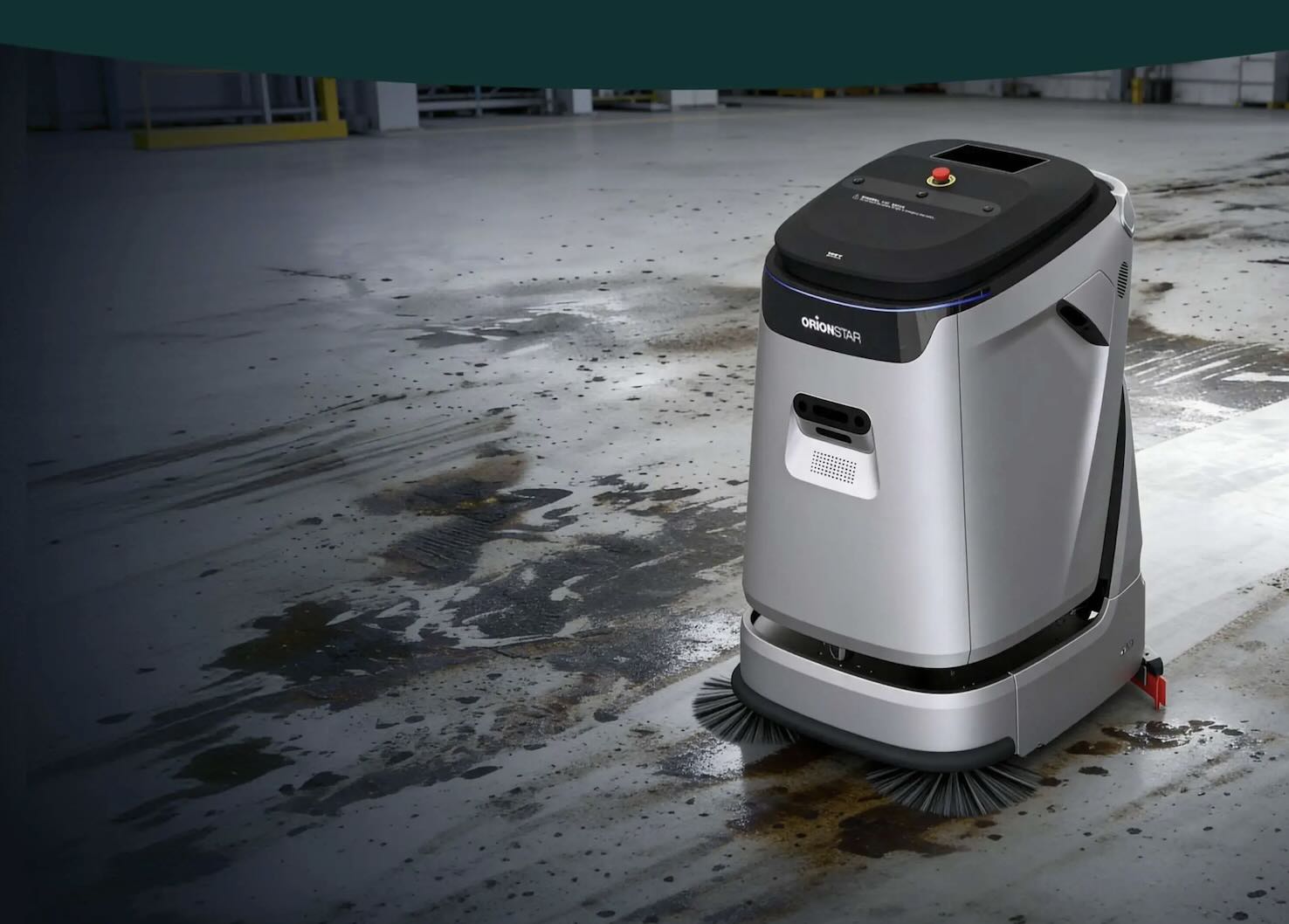
The OrionStar CleaniBot C5 is positioned for mixed industrial environments that balance standard corridor navigation with autonomous heavy-duty scrubbing requirements. Regarding cleaning efficiency, its compact chassis requires a minimal passing width of approximately 880 millimeters, allowing it to maneuver through typical mixed aisle widths and narrow racking zones more effectively than massive ride-on units. In large open areas, its 550-millimeter main brush covers up to 1,980 square meters per hour under laboratory conditions. For navigation, the machine moves beyond static environment mapping by utilizing autonomous path planning that maps areas up to 10,000 square meters, allowing it to adapt safely around dynamic floor activity rather than strictly adhering to a pre-taught track. From a battery and endurance perspective, a single charge supports a continuous scrubbing runtime of about 3 hours. However, its overall daily coverage capability is significantly extended by an autonomous docking station that automatically handles battery recharging, clean-water refilling, waste-water discharge, and high-pressure internal tank rinsing, enabling non-stop multi-shift operation. Mechanically, it applies 25 kilograms of downward pressure through a dual-rolling-brush system designed to process occasional debris up to 3 centimeters in height while maintaining a dirt-cleaning rate of about 95 percent according to manufacturer data.
The Avidbots Neo 2W is purpose-built for massive open-floor logistics centers and dynamic bulk storage environments where heavy forklift traffic and continuously changing pallet configurations are common. Analyzing its cleaning efficiency reveals a design optimized for expansive areas, featuring cleaning paths up to 32 inches that cover up to 3,900 square meters per hour. Its large physical footprint makes it highly productive in unconstrained loading bays, though this size inherently limits its ability to penetrate very narrow aisle racking areas. Navigation relies on a highly specialized machine learning model trained explicitly to recognize dynamic ground-level obstacles like forklift tines and pallets. Furthermore, it incorporates a Bulk Navigator feature that handles frequently changing bulk storage layouts, setting it apart from systems that rely purely on static environmental mapping. Assessing its battery performance, the machine achieves a continuous single-charge runtime of 4 to 6 hours. While it lacks an automatic fluid docking station, its daily coverage capability is sustained across multi-shift operations through easily swappable battery packs and massive manual tanks holding 109 liters of clean water and 135 liters of recovery water. A dedicated Debris Diverter pushes occasional loose material out of the scrubbing path, reducing clogs during heavy industrial deployment.
The Tennant T16AMR is engineered for vast, predictable industrial spaces and heavy manufacturing floors where established aisles remain relatively static. Its cleaning efficiency heavily favors large open areas, utilizing the widest cleaning path in this group at 910 millimeters to maximize hourly coverage. Due to its larger physical footprint and wide dimensions, deployment in narrow aisles or on elevated mezzanine floors may require careful spatial evaluation. For navigation, the system depends on BrainOS teach-and-repeat technology. This approach relies heavily on static environment mapping, performing exceptionally well in predictable route environments while utilizing overlapping sensors to pause or steer around immediate obstacles, though it provides less autonomous rerouting flexibility in entirely rearranged dynamic bulk areas. Battery endurance is robust, offering up to 5.4 hours of continuous work on a single charge when equipped with lithium-ion batteries. Daily coverage is primarily supported by its sheer onboard capacity rather than automated docking, relying on massive 190-liter solution and 225-liter recovery tanks to minimize human intervention during long shifts. Delivering up to 91 kilograms of brush down pressure, it excels at removing compacted industrial grime and stubborn tire marks from heavy machinery zones.
The Gausium Scrubber 75 targets dynamic, heavy-duty industrial sites that require high maneuverability at intersections and continuous fluid sustainability. Its cleaning efficiency demonstrates strong coverage in large open areas, reaching a theoretical maximum of up to 3,000 square meters per hour. While its 1,400-millimeter minimum pass width restricts it from the narrowest racking aisles, it addresses complex warehouse geometry by incorporating a 270-degree rotational scrub deck that effectively cleans 90-degree corners at aisle intersections. Navigation is managed through advanced real-time environmental perception utilizing millimeter-wave radar and 3D LiDAR, allowing the robot to dynamically update its map and calculate entirely new routes when pathways are blocked by shifting pallets or moving forklifts. Regarding battery and runtime, a single charge provides roughly 4 to 6 hours of continuous scrubbing. Its daily coverage capacity is significantly enhanced by a built-in water recycling system that reduces freshwater consumption by approximately 80 percent, alongside an optional automated workstation that facilitates unattended power charging and water exchange. Operating with 45 kilograms of brush pressure, it includes a dedicated oil cleaning mode specifically calibrated for stubborn contamination in loading bays and manufacturing zones.
The Gausium Scrubber 50 is configured for highly restricted facility zones, mezzanine floors with strict weight limits, and narrower aisle facilities that prioritize targeted cleaning over massive hourly square footage. The cleaning efficiency profile of this robot is distinct; its compact chassis features an 800-millimeter minimum pass width, allowing deep penetration into restrictive racking zones where wider equipment cannot physically operate. Consequently, its narrower 460-millimeter cleaning path results in a lower actual coverage rate in massive open loading areas compared to larger industrial counterparts. Navigation builds upon static mapping with deep learning algorithms to perceive real-time environmental changes, avoiding obstacles autonomously. Notably, it introduces AI Spot Cleaning, which uses camera vision to dynamically detect waste and clean only contaminated zones, optimizing efficiency in relatively clean environments. Battery performance yields a continuous single-charge scrubbing runtime of approximately 3 hours. Because its onboard tanks are highly compact at 30 liters for clean water and 24 liters for waste, sustaining high daily coverage capability over multiple shifts relies heavily on pairing the unit with its optional automated charging and water management workstation.
Facility operators must carefully consider compliance and privacy requirements before deploying advanced robotic systems. Because modern autonomous navigation methodologies utilize cameras, mapping sensors, 3D LiDAR, and cloud data processing to recognize obstacles and optimize routes, operational data is often transmitted externally. Organizations should explicitly verify that any selected equipment complies with applicable data protection frameworks, including GDPR, particularly regarding the capture of video data in employee work areas and the retention policies of cloud-based telemetry platforms.
Procuring the appropriate system requires aligning physical capabilities with facility realities. For environments defined by constant material movement and changing bulk storage, prioritizing robots with dynamic navigation and real-time rerouting proves superior to rigid teach-and-repeat models. Facilities characterized by massive, unconstrained loading bays benefit heavily from deploying large-format architectures with expansive tank capacities and high mechanical down pressure. Conversely, distribution centers dominated by narrow racking aisles and weight-restricted mezzanines require compact architectures that sacrifice total hourly coverage for vital spatial maneuverability. Ultimately, organizations seeking to minimize dedicated daily labor should weigh massive onboard fluid capacities against automated workstation infrastructure, selecting the fluid management strategy that best matches their internal maintenance workflows.
Industry data from real deployments shows payback periods of 9 to 18 months for facilities that clean at least 50,000 square feet of hard floor on a daily basis (source: https://sproutmation.com/blog/autonomous-floor-scrubber-roi). The key to an accurate calculation is using loaded labor cost rather than base wage alone; when employer taxes, benefits, workers' compensation, supervision, and turnover are included, the loaded rate is typically 30 to 42 percent above the base wage. Annual operating costs for a single robot (consumables, preventive maintenance, wear items) generally fall in the $4,000 to $7,000 range, which compares favorably to the $40,000 to $55,000 fully loaded annual cost of one full-time cleaning employee. DHL reported a reduction of up to 80 percent of labor hours spent cleaning after deploying autonomous scrubbers in its logistics operations (source: https://avidbots.com/robots/meet-neo-2w/).
In the right environment, one autonomous scrubber can offset roughly one full-time equivalent of repetitive floor coverage. The remaining staff are typically redeployed to tasks that require human judgment, such as restroom sanitation, spill response, and detail cleaning around racking or dock areas. The critical variable is whether the robot can absorb two or more hours of repetitive scrubbing per day on mapped routes. In large open warehouse layouts with predictable floor plans, this threshold is commonly met. For example, the Avidbots Neo 2W achieves a cleaning capacity of up to 3,900 m2 per hour, and the Gausium Scrubber 75 reaches up to 3,000 m2 per hour (theoretical), making both capable of covering tens of thousands of square meters per shift.
This is a significant differentiator among models. Robots that rely on teach-and-repeat navigation, such as the Tennant T16AMR using BrainOS, follow pre-taught routes and detect obstacles along the way, but their adaptability to heavily rearranged environments is more limited than real-time SLAM-based approaches. The Avidbots Neo 2W addresses this with a dedicated Bulk Navigator feature that receives frequent map updates from Avidbots to accommodate changing bulk storage areas without requiring a full remap, though map updates currently involve Avidbots team involvement rather than being fully self-serve. The Gausium Scrubber 75 uses real-time environmental perception to detect changes, update its map, and reroute autonomously. The OrionStar CleaniBot C5 also supports autonomous path planning with map areas of up to 10,000 m2. Facilities with frequently rearranging pallet configurations should evaluate how each robot's navigation approach handles layout changes without human intervention.
Runtime and tank capacity are the primary determinants of how long a robot can operate unattended between service stops. Among the robots surveyed, battery runtime ranges from approximately 3 hours (OrionStar CleaniBot C5, Gausium Scrubber 50) to 4 to 6 hours (Avidbots Neo 2W, Gausium Scrubber 75, Tennant T16AMR with lithium-ion). The Tennant T16AMR offers the largest tanks at 190 liters clean and 225 liters recovery, followed by the Avidbots Neo 2W at 109 liters and 135 liters respectively, meaning fewer refill stops on large open floors. The CleaniBot C5 addresses the refill issue differently: its automatic docking station handles clean-water refilling, waste-water discharge, and internal tank self-cleaning, enabling continuous operation without manual tank servicing. The Gausium Scrubber 75 also offers an optional workstation (WS-02) for automatic water and power management. Facilities running overnight or multi-shift cleaning should prioritize either large tank capacities or an automatic docking solution to avoid downtime.
Brush down pressure and cleaning mode selection are the key variables. The Tennant T16AMR delivers the highest brush pressure at up to 91 kg, making it particularly effective for heavy industrial soil. The Avidbots Neo 2W offers up to 87 kg with its disc head configuration. The Gausium Scrubber 75 provides 45 kg of brush pressure and includes a dedicated oil cleaning mode for stubborn industrial contamination on loading bays and machinery areas. The OrionStar CleaniBot C5 applies 25 kg of downward scrubbing pressure through a dual-rolling-brush system and reports a dirt-cleaning rate of approximately 95 percent for heavy oil, grime, and stubborn stains. For debris handling, the Neo 2W includes a Debris Diverter that pushes occasional debris from the robot's path, while the C5 can pick up debris up to about 3 cm in height. The Gausium Scrubber 75's maximum passable obstacle height is 10 mm, which may limit it on raised dock edges or cable protectors common in loading areas.
Noise level matters because warehouse cleaning robots are frequently scheduled for overnight or off-hours shifts to avoid disrupting operations and to take advantage of lower labor costs. The OrionStar CleaniBot C5 operates below 68 dB(A), which is comparable to a normal conversation and suitable for use in occupied or noise-sensitive areas. Noise specifications for the Avidbots Neo 2W and Tennant T16AMR are not publicly specified, though both are designed for industrial environments where noise is less of a constraint. Overnight cleaning is widely recognized as the fastest path to ROI because it eliminates shift-premium labor, avoids traffic interference, and allows the robot to run mapped routes with minimal human oversight. However, overnight operation requires that routes are properly mapped, the robot can navigate safely in low-light conditions, and staff are available before or after the route for inspection and any required tank refills or exception handling.
Note: Actual runtime, cleaning capacity, and noise levels may vary depending on floor types, environmental complexity, and selected cleaning modes.
Third-party product specifications are based on publicly available data (up to, under laboratory conditions, according to manufacturer data) and performance may vary in practical deployment. Product names and trademarks are the property of their respective owners. If any product involves cameras, voice recording, mapping, or cloud data processing, operating organizations must verify GDPR compliance prior to deployment.