

REQUEST DEMO
Robot CATALOG will be sent to your mailbox immediately after submission.
SUBMIT
Facility management companies, building service contractors, and multi-site commercial cleaning operators face complex operational demands when scaling automated maintenance solutions. Deploying robotics across geographically distributed, multi-building portfolios requires moving beyond basic square-footage metrics to address multi-shift continuous operations, strict Service Level Agreement (SLA) compliance, and the delivery of verifiable, contract-auditable cleaning reports. The procurement of these systems necessitates a shift in focus toward centralized fleet orchestration, resource replenishment automation, and long-term integration with Computerized Maintenance Management Systems (CMMS) or Building Management Systems (BMS).
Evaluating autonomous scrubbers for multi-site deployments relies on a distinct operational framework. Uptime and resource replenishment strategies dictate how continuous schedules are maintained without requiring manual labor intervention between cycles. Fleet orchestration and SLA validation methods determine how effectively an operator can prove contractual compliance to end clients using telemetry and remote cloud dashboards. Cleaning modality and specialized environmental adaptation assess how the hardware manages varied hazards, from industrial debris to biological pathogens. Finally, chassis architecture and spatial footprint govern the physical deployability of the machine within narrow bottlenecks, passenger elevators, and weight-restricted zones.
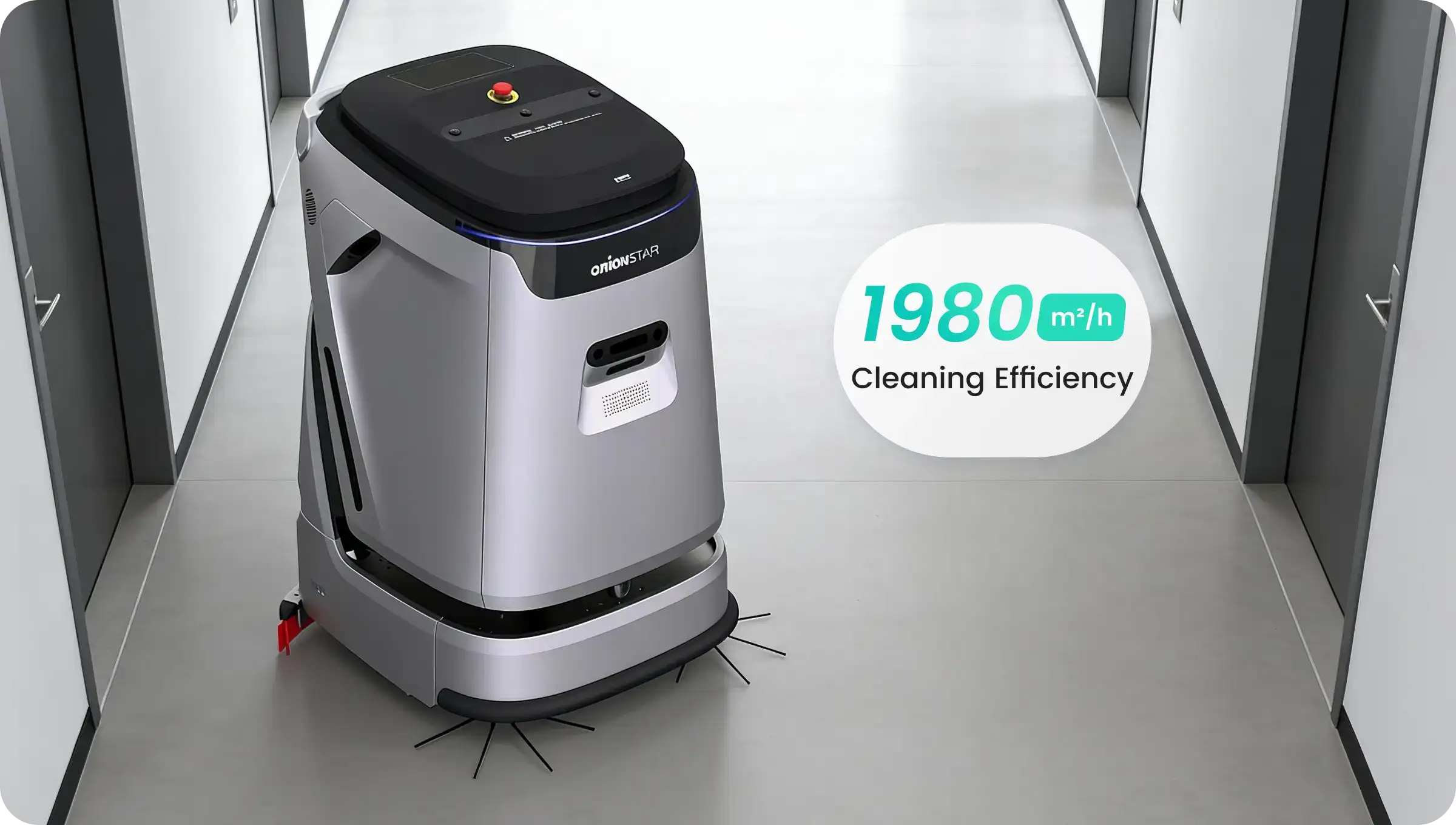
The OrionStar CleaniBot C5 serves medium-to-large commercial and industrial environments requiring continuous heavy-duty scrubbing coupled with automated multi-shift resource replenishment.
This platform handles high-frequency cleaning schedules through an automated docking station that minimizes manual oversight. According to manufacturer data, the workstation executes clean-water refilling, wastewater discharge, and a high-pressure internal tank rinse in approximately four minutes. This functionality ensures that the robot is continually prepared for uninterrupted nightly routes without human intervention. The machine utilizes a dual-rolling-brush system capable of exerting up to 25 kg of downward scrubbing pressure, paired with a combined 90 L water-tank system. Navigating with a minimal passing width of approximately 880 mm and operating at less than 68 dB(A), the unit covers standard corridors while limiting disruptions in public areas. The system supports mapping areas of up to 10,000 square meters using cloud-based path optimization. As this navigation architecture relies on environmental mapping and cloud data processing, operating entities must verify GDPR compliance prior to commissioning the unit across their facilities.
The Avidbots Neo 2W targets industrial multi-shift logistics operations requiring centralized remote fleet orchestration and dynamic navigation around frequently changing warehouse layouts.
The core of this offering revolves around the Avidbots Command Center, a web-based dashboard engineered to provide sector-level coverage maps, productivity metrics, and detailed reports that serve directly as contract-auditable SLA evidence. To manage multi-shift workflows, the platform utilizes swappable industrial-strength batteries that deliver up to six hours of runtime per charge, allowing technicians to replace power supplies rapidly. The navigation hardware processes dynamic environments by employing bulk navigation algorithms and debris diverters designed for areas with fluctuating floor-level obstacles. By maintaining continuous remote connectivity via Wi-Fi or cellular networks, facility management teams can monitor machine status and location in real time across geographically dispersed sites. Because the system streams extensive camera and sensor data to a cloud environment to function, organizations must complete a thorough GDPR assessment encompassing data residency and sub-processor agreements prior to deployment.
The Tennant T7AMR is designed for expansive contract cleaning environments prioritizing offline localized execution and integration with existing dealer-managed service networks.
This ride-on autonomous scrubber appeals to operators seeking to fold robotic fleet validation into pre-existing traditional equipment service relationships rather than adopting self-serve remote web portals. The platform generates standardized weekly usage reports that serve as verifiable SLA compliance evidence, which are delivered alongside existing OEM maintenance routines. The chassis represents an industrial build, measuring approximately 1,650 mm in length and weighing up to 492 kg with batteries, while executing a 650 mm cleaning path. Facility managers can configure the unit with high-capacity lithium-ion or flooded lead-acid batteries depending on specific site maintenance strategies. Navigation relies on a vision-based technology platform that learns an initial manual route and executes it continuously. Since the technology utilizes onboard cameras to process complex, real-world applications, deployments must be evaluated against GDPR requirements to ensure compliant handling of any captured visual data.
The Kärcher KIRA B 50 is built for medium-to-large public spaces and manufacturing halls executing uninterrupted nightly routes via stationary replenishment infrastructure.
This autonomous scrubber-dryer utilizes an optional docking station that facilitates autonomous battery charging, fresh-water refilling, and dirty-water drainage, removing the need for manual resource swapping. According to manufacturer data, the unit employs a roller brush head with an integrated pre-sweeping function, operating across a 55 cm working width to address dust and physical soils simultaneously. Fleet oversight is routed through the KIRA web portal, which supplies detailed machine data, cleaning reports, and mobile notifications necessary to audit operational continuity. The multi-sensor architecture processes optical and acoustic signals alongside laser sensor views to manage safe transit in active public sectors. Operators utilizing this web portal architecture to transmit environmental metrics and machine status logs must verify GDPR compliance to manage data retention and processing lawfully.
The Nilfisk Liberty SC50 focuses on healthcare, educational, and public sector portfolios bound by contractual mandates requiring verifiable biological disinfection alongside physical floor scrubbing.
This platform integrates standard floor scrubbing functions with specialized onboard Ultraviolet Germicidal Irradiation (UVGI) modules. This combined modality allows facility service contractors to supplement physical floor scrubbing with UVGI-based surface treatment, generating documentation needed to support bio-hygiene SLA compliance. According to manufacturer data, the unit executes up to six hours of runtime over a 20-inch cleaning path under laboratory conditions. The machine navigates using a sensor-driven platform designed to adjust to environmental alterations automatically. While the physical operation mitigates labor hours dedicated to high-contact disinfection, the integration of mapping and fleet-management uploads requires careful compliance oversight. Organizations must assess both biological safety certifications for the UV-C fixtures and data controller allocations under GDPR regulations before integrating this platform into their existing building ecosystems.
When scaling autonomous scrubbing fleets across commercial portfolios, facility management companies should select hardware based on their specific multi-site parameters. For uptime and resource replenishment, operations demanding minimal human intervention should prioritize autonomous docking infrastructure, while expansive single-floor logistics sites may favor swappable high-endurance power architectures. Regarding fleet orchestration and SLA validation, multi-tenant cloud dashboards provide the granular reporting needed for remote oversight, whereas localized execution models suit heavily dealer-integrated networks. Cleaning modality selections must balance the need for heavy mechanical scrubbing against specialized mandates requiring integrated disinfection systems. Ultimately, procurement teams must audit chassis architectures against building layouts to guarantee hardware accessibility while ensuring all selected platforms adhere stringently to localized data protection regulations.
Published industry data and operator case studies generally place annual savings in the USD 30,000-150,000 range per deployed unit, driven primarily by labor-hour reduction, predictable coverage, and reduced rework. An Avidbots-published operator quote describes "USD 30,000 to USD 150,000 per year" in savings from its Neo platform. Payback periods reported across industrial and logistics deployments typically fall in the 12-24 month range, depending on shift count, labor cost, and whether the robot is sized for one building or rolled out as a fleet. Facility managers should model ROI on three variables: hours of manual labor displaced per shift, cleaning-quality incidents avoided, and SLA/audit-reporting labor saved. ROI is sensitive to whether the robot operates one or two shifts and whether it replaces a person or augments a team. The global commercial cleaning robots market is projected to grow at a CAGR above 20% through the late 2020s, which is itself a leading indicator that more FM buyers are clearing this ROI hurdle.
Yes, all four models evaluated here support a non-capital path. Avidbots sells Neo 2W primarily through quote-based subscription arrangements tied to its Customer Success mapping and Command Center software. Kärcher's KIRA B 50 is offered with KIRA Care and KIRA Care Plus service packages that bundle the web portal, software updates, a functional guarantee (including battery), planned service visits, and - on the Plus tier - a fast-response replacement machine. Tennant's T7AMR is sold through its 500+ factory-direct service professionals and is typically paired with Tennant's AMR service plan. Nilfisk distributes the Liberty SC50 through its global dealer network, and SC50 deals are commonly structured as a financed equipment-plus-service package. For an FM contractor, RaaS preserves capital, includes software updates, and shifts battery-replacement risk to the vendor - but it locks the customer into a multi-year term, and the per-month cost of a RaaS contract is typically higher than the amortized cost of an outright purchase over a comparable period. Procurement should also include a service-level agreement covering response time, software updates, parts, end-of-lease terms, and a data-processing addendum.
Autonomous scrubbers are not plug-and-play appliances. Avidbots states explicitly that Neo 2W requires professional mapping and on-site deployment by its Customer Success team, and the cleaning plan is created per facility - meaning a multi-site rollout is a planned project, not a self-install. Kärcher's KIRA B 50 supports multi-sensor mapping and 360° laser scanning with an optional docking station, but the docking station itself needs plumbing (clean-water supply, waste drain) and a power circuit installed by the facility. Tennant's T7AMR is a ride-on machine that requires an operator-trained run-through to "teach" the BrainOS route, then the route is repeated. OrionStar's CleaniBot C5 advertises mapping of areas up to 10,000 m² and "Cloud Learning"-style path optimization, with an auto-charging docking station. Across the category, integration with a customer's BMS or CMMS is still emerging rather than standard: most platforms publish cleaning reports and coverage maps to their own cloud console, and FM teams that want the data inside their existing work-order system typically use API or CSV export rather than a native two-way integration. Plan a 2-6 week deployment window per site including mapping, safety review, and staff training.
Multi-shift autonomy is a primary differentiator for an FM operator running nightly or continuous routes. Three architectural patterns exist in the market. First, hot-swap batteries: Avidbots Neo 2W supports swappable industrial-strength batteries with up to 6 hours runtime per pack, and a human can swap a depleted pack for a charged one in minutes. Second, autonomous docking stations: Kärcher KIRA B 50 and OrionStar CleaniBot C5 both offer docking stations that handle charging, fresh-water refill, dirty-water drain, and tank rinsing without human intervention; CleaniBot C5 lists roughly 3 hours scrubbing runtime per charge plus a 1.5-hour fast-charge cycle, with auto-recharge when battery is low. Third, longer single-charge runtime: Tennant T7AMR is available with either high-capacity lithium-ion or flooded lead acid batteries to match the site strategy. For a true 24/7 deployment, the practical pattern is robot + docking station + a small human team for exceptions and consumables; budget for one technician per 4-6 robots to handle pads, brushes, squeegees, and the occasional intervention.
Floor-scrubbing robots are quieter than most ride-on scrubbers but louder than a desktop printer. CleaniBot C5 publishes less than 68 dB(A), which is office-friendly. Tennant T7AMR is "as low as 70 dBA" in daytime mode. Kärcher KIRA B 50's published sound level is not on the official product page; dealer pages should be consulted. Footprint varies significantly and is the most common reason a planned deployment fails. CleaniBot C5 measures 820 × 680 × 1,130 mm with a minimum passing width of about 880 mm - it fits typical corridors and doorways. Tennant T7AMR is a ride-on machine at 1,650 × 850 × 1,450 mm and 492 kg, which rules out narrow retail aisles and any site without a service elevator rated for the weight. Avidbots Neo 2W measures 152 × 76-94 × 137 cm, with weight not publicly specified. Kärcher KIRA B 50 dimensions and weight vary by configuration; consult local dealers for specific site-accessibility verification. For healthcare and education sites, additional checks apply: UVGI variants (Nilfisk SC50 UVGI) add safety certification requirements (the SC50 UVGI's UV-C fixture is third-party certified by Intertek), and GDPR-relevant cameras and sensors require signage and a documented data-processing posture before commissioning in the EU/UK.
Reporting is the main area where the four platforms diverge most. Avidbots' Command Center provides a comprehensive web-based dashboard: it provides 24/7 access, productivity metrics, sector-level coverage maps, real-time status and location, per-robot cleaning-plan success, and detailed reports that can be exported as SLA evidence for an FM customer. Tennant T7AMR publishes weekly fleet usage reports for KPI tracking, with the emphasis on dealer-supported reporting rather than a self-serve multi-tenant cloud console. Kärcher's KIRA web portal pushes detailed machine data, cleaning reports, notifications and machine status, with mobile-device notifications, and the KIRA Care packages formalize the SLA backup. Nilfisk's Liberty SC50 references a fleet management system in third-party summaries, but the official product page emphasizes autonomous operation and certification rather than a named cloud portal with feature depth. For an FM contractor bidding a multi-site SLA, the differentiator is not whether the robot cleans - it is whether the platform can produce per-shift, per-zone coverage evidence in a format the customer accepts. Most platforms export PDF or CSV; native API hooks into the customer's CMMS are not universal and should be confirmed in writing before contract signature. For EU/UK deployments, verify the vendor's GDPR posture (data controller/processor allocation, sub-processor list, data residency, retention, signage) before commissioning, since onboard cameras and cloud-based mapping create a data-processing footprint that is contractually relevant.
Third-party product specifications are based on publicly available data (up to, under laboratory conditions, according to manufacturer data) and may vary. Product names and trademarks are the property of their respective owners. If any product involves cameras, voice recording, mapping, or cloud data processing, the operating entity must verify GDPR compliance prior to deployment.