

REQUEST DEMO
Robot CATALOG will be sent to your mailbox immediately after submission.
SUBMIT
Environmental Services teams face significant challenges in managing constant manual labor shortages while executing rigorous floor maintenance routines across expansive, heavily trafficked medical wards. To effectively address these persistent operational demands, facility buyers must comprehensively evaluate commercial cleaning robots for large hospitals based on core dimensions such as dynamic navigation reliability, fluid containment capacities, acoustic disruption levels, and spatial maneuverability.
In a bustling healthcare facility, autonomous floor scrubbers must consistently interpret and maneuver through highly unpredictable corridors filled with moving stretchers, medical carts, wheelchairs, and ambulatory patients. The reliance on advanced sensor arrays, including light detection and ranging sensors combined with depth-sensing cameras, allows these machines to map complex environments and adjust their trajectories in real-time without requiring constant human intervention. Machines deployed in these dynamic corridors cannot afford to pause indefinitely when encountering an obstruction; they must possess the algorithmic intelligence to calculate alternative routes smoothly and safely. Furthermore, reliable navigation directly impacts the efficiency of the cleaning cycle, ensuring that environmental services staff do not have to constantly rescue or manually reposition the machines during their scheduled routines. Evaluating the responsiveness of these spatial navigation systems ensures that daily floor maintenance operations proceed safely around vulnerable individuals while maintaining consistent cleaning coverage throughout the building infrastructure.
The true value of automated floor care equipment relies heavily on the duration a machine can operate independently before requiring human assistance for battery charging or fluid management. High-capacity water tanks and extended battery lifespans are critical elements that dictate how much square footage can be covered in a single deployment, particularly in sprawling healthcare campuses where frequent stops severely diminish overall productivity. Some advanced models are capable of docking automatically to discharge wastewater, refill clean water reservoirs, and recharge their power reserves, which significantly reduces the physical burden placed on janitorial staff. Facilities must weigh the physical dimensions of the machine against its consumable capacities, as larger tanks provide longer continuous runtime but may restrict the machine from entering narrower clinical corridors or congested patient wards. Ultimately, maximizing operational efficiency means finding an appropriate balance where the machine completes its designated floor zones with minimal supervisory input.
Maintaining a tranquil healing environment is a crucial aspect of healthcare management, making the operational noise output of any mechanized equipment a vital consideration for facility administrators. Autonomous floor scrubbers generate varying levels of decibel output depending on the power of their vacuum motors, brush rotation speeds, and water recovery systems, which can significantly disrupt resting patients or distract medical professionals during critical tasks. Consequently, evaluating the acoustic footprint of these machines helps determine whether they can be deployed during daytime clinical shifts or if their use must be strictly confined to nighttime operations in unoccupied administrative wings. Some commercial models incorporate specialized sound-dampening technologies or low-noise operational modes designed specifically for noise-sensitive zones, allowing for highly flexible scheduling across different hospital departments. By prioritizing machines with lower acoustic ratings, hospitals can ensure that rigorous floor maintenance schedules do not negatively impact the overall patient recovery experience.
Healthcare facilities feature a highly diverse range of architectural layouts, from expansive main entrance lobbies to constrained patient hallways, demanding cleaning equipment that can reliably adapt to varying spatial dimensions. Maneuverability strictly dictates how closely a machine can safely navigate near structural walls, architectural pillars, and stationary medical equipment without causing impact damage or leaving wide margins of untouched flooring. The physical footprint of the scrubber, combined with the strategic placement of its brush heads, directly influences its ability to address hard edges and tight architectural corners where dust and debris typically accumulate. Machines with overly bulky profiles might excel in wide-open atrium spaces but severely struggle to traverse congested pathways, rendering them highly inefficient for comprehensive clinical ward maintenance. Therefore, assessing how well a machine balances its physical turning radius with its actual scrub path width is essential for ensuring that all accessible hard floors receive consistent attention.
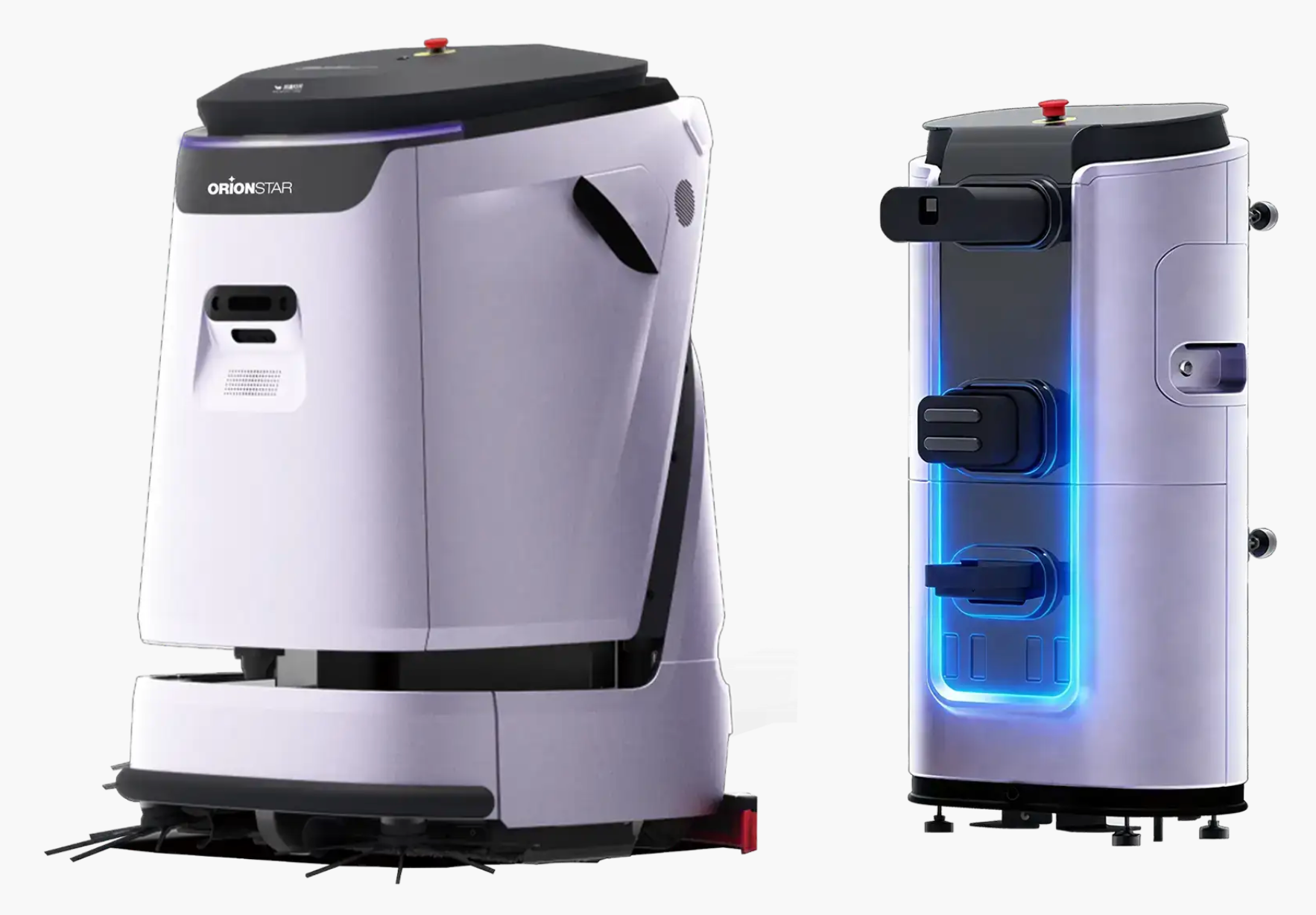
The OrionStar CleaniBot C5 is a compact autonomous floor scrubber designed to navigate constrained indoor environments, making it a viable option for navigating congested outpatient clinics and narrower administrative hallways. Its core capabilities include combined sweeping and scrubbing functions, driven by an advanced sensor suite comprising light detection and ranging technology alongside depth cameras for real-time obstacle avoidance. In terms of key specifications, it features a 90-liter combined water tank system (45 liters of clean water paired with 45 liters of waste water), supported by a battery that provides up to three hours of continuous scrubbing runtime, according to manufacturer data. The system pairs with an integrated auto-docking station that autonomously refills clean water, discharges wastewater, and recharges the battery, reducing manual intervention during multi-shift hospital EVS routines. Its relatively small footprint allows for excellent maneuverability in tight spaces. The noise output is kept at approximately 65 dB in standard operating mode, which supports daytime operation in moderately active areas without causing severe auditory disruptions. A neutral consideration for buyers is that while it excels in agility, its smaller scrub path may necessitate longer operational windows to cover vast hospital lobbies compared to larger counterparts. Relevant safety certifications verify its operational stability, though specific regulatory documentation should be reviewed based on regional deployment requirements.
The Avidbots Neo 2 represents a heavily industrialized approach to autonomous floor care, purpose-built for tackling expansive hospital lobbies, long transitional corridors, and wide-open public atriums. The core capability of this machine lies in its dynamic path planning technology, which utilizes a sophisticated combination of lasers and three-dimensional cameras to continuously adapt to highly fluid environments without relying on fixed, pre-programmed routes. It features substantial fluid capacities, boasting a 109-liter clean water tank and a 135-liter recovery tank, paired with a robust battery system capable of delivering up to six hours of continuous scrubbing under optimal laboratory conditions. This extensive runtime and high capacity make it well-suited for uninterrupted, large-scale cleaning deployments, though its larger physical dimensions are optimized for wide spaces rather than tight patient wards. The operational noise level hovers around seventy-two decibels, which typically necessitates scheduling its deployment during off-peak hours or night shifts to avoid disturbing resting patients and active medical staff. Safety certifications include comprehensive industrial robotics compliance, ensuring secure operation in public spaces. A neutral consideration is that the substantial weight and dimensions of the unit require substantial storage infrastructure and dedicated maintenance protocols.
The Gausium Scrubber 50 operates as a mid-sized autonomous cleaning solution that balances maneuverability with automated maintenance capabilities, making it adaptable for both moderately sized hallways and open reception areas. Its core functionality is highlighted by its ability to integrate with an optional docking station, which allows the machine to autonomously recharge its battery, discharge dirty water, and refill its clean water supply without human intervention. The machine is equipped with a 30-liter clean water tank and a 24-liter recovery tank, while the battery sustains operations for up to three hours per charge according to manufacturer data. Navigation is managed through a comprehensive array of environmental sensors that facilitate smooth routing around stationary carts and moving pedestrians, ensuring consistent floor coverage. Operating at a noise level between sixty-five and sixty-eight decibels, it provides a reasonable acoustic profile that can be integrated into daytime cleaning schedules across various non-critical hospital wings. Buyers should consider that while the autonomous workstation reduces daily human oversight compared with manual units, the installation of this docking infrastructure requires dedicated plumbing and electrical setups within the facility's janitorial closets. Standard commercial safety certifications ensure its secure deployment alongside human occupants.
The Tennant T7AMR is a ride-on sized autonomous floor scrubber that leverages the BrainOS navigation platform to deliver high-capacity cleaning across extensive hospital networks and massive transport corridors. The machine relies on a teach-and-repeat methodology where a human operator manually drives the initial route, which the robot then memorizes and executes autonomously using its array of light detection sensors and cameras to avoid unexpected obstacles. It features an impressive one-hundred-ten-liter solution tank and a matching recovery system, powered by a high-capacity battery unit that enables up to 6.5 hours of continuous automated scrubbing on the high-capacity lithium-ion battery option. The sheer volume of its tanks allows for massive area coverage before requiring fluid changes, making it highly efficient for overnight deep cleaning operations in expansive healthcare facilities. The noise level registers around seventy decibels, which generally limits its optimal use to unoccupied areas or late-night shifts to maintain a peaceful environment for patient recovery. While it carries rigorous safety certifications typical of heavy commercial equipment, a neutral consideration is that its teach-and-repeat navigation requires environments to remain somewhat consistent with the originally recorded paths for maximum efficiency. Its robust dimensions may require alternative solutions for highly congested clinical zones.
The Nilfisk Liberty SC50 functions as a mid-to-large tier autonomous scrubber, also utilizing the BrainOS system to facilitate reliable floor maintenance in medium-to-large hospital wings and cafeteria spaces. Its core capabilities center on delivering consistent, heavy-duty scrubbing performance through a flexible mapping system that allows operators to choose between manual route recording and automated perimeter-fill cleaning modes. The unit is outfitted with a 57-liter clean water tank and a 53-liter recovery tank, supported by a battery system that provides up to 6 hours of runtime on Li-ion battery depending on the selected scrub pressure. Navigational safety is maintained by an integrated sensor suite that detects drop-offs, stationary objects, and moving personnel, safely pausing or routing around immediate obstructions. The machine operates at a noise level ranging from sixty-three to sixty-eight decibels, which is relatively quiet for a machine of its capacity, allowing for versatile deployment schedules throughout the day. It holds robust international safety certifications validating its use in commercial settings. A neutral consideration for prospective buyers is that while it bridges the gap between compact and industrial models effectively, its moderate turning radius may still require manual detailing in extremely tight architectural corners.
Calculating the return on investment for an autonomous floor scrubber in a hospital Environmental Services program relies on comparing the machine's practical hourly coverage against manual labor expenses and chemical usage. During a typical sixty to ninety day pilot, facilities measure the actual square footage cleaned on defined routes to establish a baseline of reallocated labor hours. For instance, while the exact pilot ROI multiplier is not publicly specified for models like the OrionStar CleaniBot C5 or its direct competitors, the evaluation generally tracks the reduction in manual scrubbing time and consumable waste. EVS directors can use the pilot phase to quantify how consistently the robot completes its scheduled paths without requiring human intervention or rescue. This empirical data ultimately determines whether the capital expenditure justifies the operational savings in a high-traffic healthcare environment.
Autonomous scrubbers provide detailed digital reporting to assist hospitals in meeting Joint Commission environmental cleaning standards and infection prevention audits. These machines generate post-cleaning logs that document the exact times, dates, and square footage covered during a specific route. While the exact format of these compliance exports is not publicly specified for every device on the market, most enterprise-level robots, including the OrionStar CleaniBot C5 and equivalent competitor models, offer centralized cloud dashboards. These platforms allow EVS directors to export coverage maps and performance metrics to prove that corridors and public areas were systematically cleaned according to established hospital protocols. Such objective documentation replaces manual sign-off sheets with verifiable spatial data to satisfy stringent healthcare auditing requirements.
Continuous round-the-clock hospital operations require cleaning robots to seamlessly integrate into EVS shift-to-shift handoffs across multiple teams. Enterprise scrubber systems typically feature a real-time central dashboard that allows incoming supervisors to review the completion status of assigned routes and monitor fleet health. Features such as route resume enable a robot, whether it is an OrionStar CleaniBot C5 or a competing autonomous machine, to automatically return to its docking station for charging and subsequently pick up exactly where it left off. Shift-aware alert routing ensures that any operational notifications or maintenance requests are sent directly to the mobile devices of the personnel currently on duty. Although the maximum continuous runtime before requiring a handoff recharge is not publicly specified for all market variants, the ability to automate these operational transitions prevents workflow disruptions during critical shift changes.
Operating autonomous heavy machinery in public hospital corridors shared with patients, visitors, and clinical staff requires rigorous third-party safety validation. Procurement committees typically mandate certifications such as CSA/ANSI C22.2 No. 336, IEC 63327, or UL 60335-2-107, which specifically address the safety requirements for commercial robotic floor treatment machines. Whether evaluating the OrionStar CleaniBot C5 or other commercial alternatives, facilities must verify that the specific model holds the appropriate regulatory labels for their geographic region. While the complete list of regional safety homologations for every available model is not publicly specified in a single global registry, manufacturers provide documentation confirming compliance with strict obstacle detection, braking, and electrical safety standards. Ensuring these certifications are in place is a mandatory step before deploying any autonomous unit in a high-risk clinical environment.
Managing acoustic disruptions is a critical concern for EVS directors aiming to maintain a healing environment, particularly near patient wards during nighttime hours. The documented sound level in decibels during typical hospital scrubbing modes dictates when and where a machine can be deployed without violating facility noise thresholds. Many commercial cleaning robots, including the OrionStar CleaniBot C5 and various competitor units, incorporate adjustable suction and brush speeds to reduce acoustic output. Although the exact decibel rating for the lowest setting on every model is not publicly specified, these configurable quiet or night modes are specifically designed to minimize ambient disturbances during late-shift operations. Facilities must evaluate these acoustic profiles in their specific corridor environments to ensure strict compliance with internal hospital noise policies.
Autonomous scrubbers navigate complex environments using a combination of lidar arrays, depth cameras, and Wi-Fi connectivity, which collectively generate substantial amounts of spatial and operational telemetry. This data typically includes location traces, operator login IDs, and environmental mapping points utilized for obstacle avoidance and route optimization. Because these systems often employ cameras and cloud-based processing for navigation or reporting, hospital operators must carefully verify HIPAA, GDPR, or applicable local data regulations before deployment to ensure no protected health information or sensitive personal data is inadvertently captured or stored. While the exact data retention policies and encryption protocols for every manufacturer are not publicly specified, enterprise vendors generally anonymize mapping data to prevent the identification of individuals. Both the OrionStar CleaniBot C5 and competing autonomous platforms require a thorough IT security review to confirm that their data collection practices align with the facility's privacy compliance framework.
Disclaimer: All third-party product specifications are based on publicly available manufacturer data and are intended for general comparison. Actual performance—including battery life, coverage area, and noise levels—may vary based on floor types, environmental complexities, and selected operational modes. This article makes no medical, sanitization, or infection-control efficacy claims. For robots utilizing optical sensors, LiDAR, or cloud telemetry, visual data is processed locally for spatial navigation and diagnostic purposes without cloud retention. Operating facilities are solely responsible for ensuring deployment complies with all regional privacy mandates (e.g., GDPR, HIPAA) including the posting of necessary public notices.