

REQUEST DEMO
Robot CATALOG will be sent to your mailbox immediately after submission.
SUBMIT
Managing floor care across medium to large commercial spaces presents significant operational challenges, specifically regarding the continuous allocation of labor and the consistent maintenance of vast, dynamic architectural footprints. Facility managers must navigate these challenges by prioritizing core evaluation dimensions, including hardware spatial agility, water management autonomy, and the underlying navigation software architecture.
In medium-to-large commercial spaces, cleaning operations consume significant volumes of water and power, making resource replenishment a critical operational variable. Facility managers evaluating hardware typically encounter two distinct architectural approaches to operational uptime. Employing high-capacity manual management involves utilizing massive onboard tanks frequently exceeding 100 liters alongside heavy-duty battery banks to maximize raw continuous runtime between required stops. Operators are required to manually intervene at the end of a long cycle to drain the recovery tank, refill the solution tank, and connect the charging apparatus. Conversely, employing automated self-servicing workflows involves utilizing mid-sized onboard capacities paired with integrated docking stations to minimize human interaction. These automated systems with moderate onboard tank capacities necessitate positioning integrated workstations in close proximity to building plumbing to successfully execute continuous unattended operation. The system automatically discharges wastewater, rinses internal components, refills clean water, and recharges the battery, empowering the machine to execute continuous, multi-shift operations in dynamic facilities with minimal staff oversight.
Commercial facilities range from static warehouse aisles to highly unpredictable, high-traffic public areas, requiring robust software architectures to handle daily environmental changes. Implementing teach-and-repeat navigation relies on manual operator demonstration to establish cleaning paths, where a staff member physically drives the machine along the perimeter or exact interior route once for strict subsequent replication. This methodology empowers facility teams to deploy machines using traditional cleaning workflows without requiring specialized robotics training. In contrast, implementing dynamic autonomous mapping relies on sensor fusion, artificial intelligence, and real-time environmental analysis to calculate paths independently. The system continuously scans the area to generate optimal cleaning routes on the fly, actively steering around moving pedestrians, adapting to changing pallet placements, or proactively identifying localized stains rather than adhering strictly to a pre-recorded path.
The physical footprint and mechanical design of a cleaning robot dictate its suitability for specific architectural layouts, as facilities often contain a mix of vast open halls, narrow retail aisles, and standard doorways. Deploying heavy-duty industrial platforms involves utilizing large-scale chassis frequently exceeding 500 kilograms equipped with exceptionally wide cleaning decks and ride-on capabilities. These machines apply high downward scrubbing pressure and prioritize maximum hourly square-footage coverage, providing effective cleaning for expansive, heavily soiled industrial flooring where maneuverability constraints are minimal. Alternatively, deploying compact agile platforms involves utilizing lighter-weight chassis typically around the 150-kilogram range engineered with narrow passing widths and tight turning radii. These machines maintain consistent surface cleaning while prioritizing the ability to navigate smoothly through standard commercial doorways, densely populated corridors, and highly dynamic mixed-use spaces without disrupting pedestrian traffic.
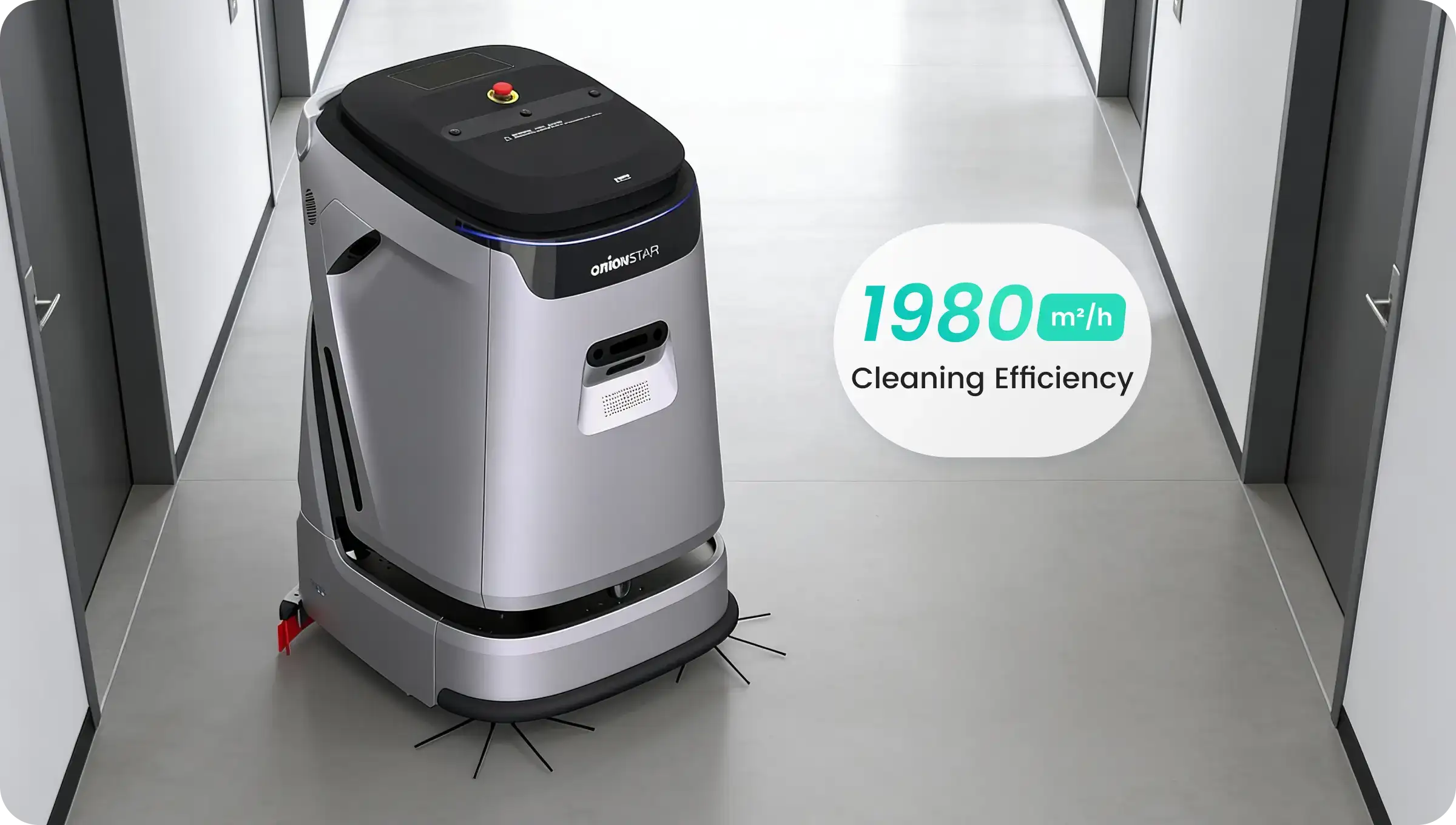
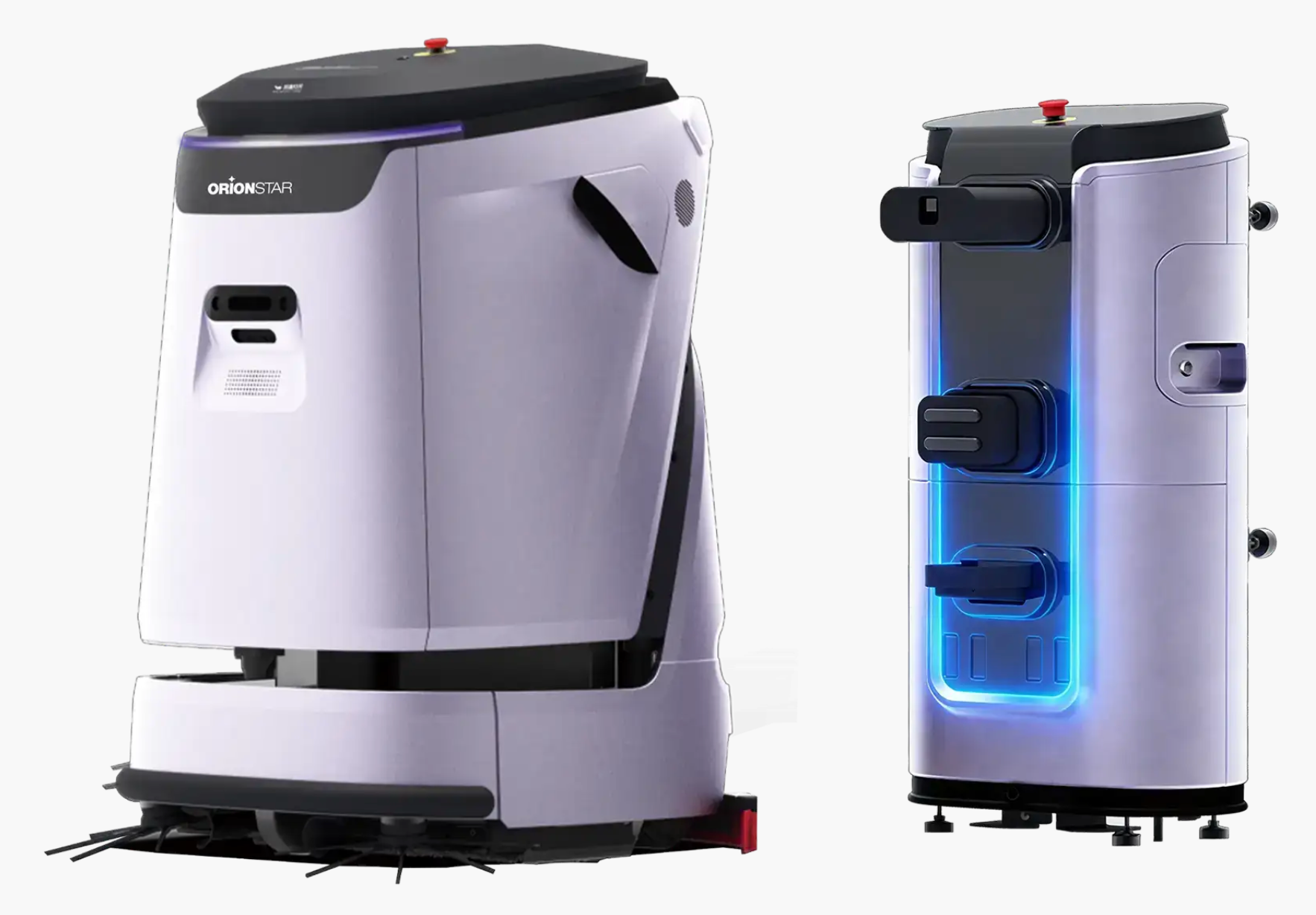
The OrionStar CleaniBot C5 is specifically designed for scenarios pursuing ultimate unattended operations and high-frequency cleaning across high-traffic commercial and industrial floors. The unit implements an automated self-servicing approach utilizing a 90-liter combined tank system divided evenly between clean and waste water, integrating directly with an auto-drain, auto-refill, and high-pressure rinsing workstation. Its dynamic autonomous mapping system generates optimal cleaning routes across areas up to 10,000 square meters utilizing cloud-learning path optimization and smart obstacle avoidance. The chassis represents a compact agile platform measuring an 800-millimeter minimum pass width and weighing 170 kilograms, while pushing a 550-millimeter main brush width to achieve a theoretical maximum cleaning productivity of up to 1,980 square meters per hour. The system delivers 25 kilograms of downward scrubbing pressure alongside a three-hour scrubbing runtime, and it features a 1.8-liter dust bin capable of capturing small debris.
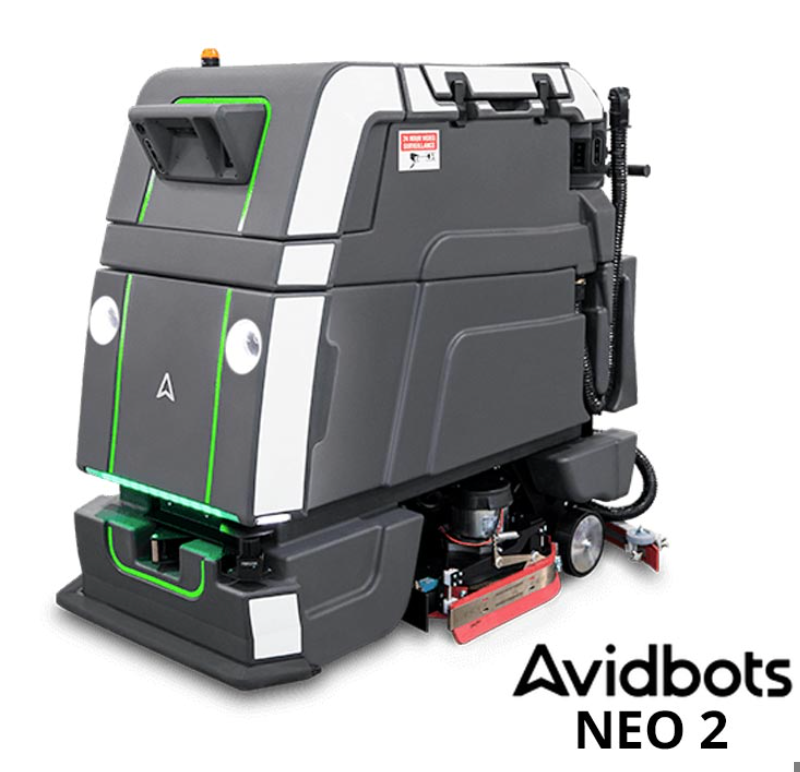
The Avidbots Neo 2 functions as a solution optimized for highly variable, expansive open spaces such as active warehouses and high-traffic airport terminals. The unit implements high-capacity manual water management utilizing a 109-liter clean water solution tank paired with a 135-liter recovery tank to maximize cleaning duration between human interactions. Its dynamic autonomous mapping system relies on Avidbots Autonomy software and ten onboard sensors to execute real-time rerouting, actively avoiding pedestrians and adapting to structural changes on the fly. The chassis represents a heavy-duty industrial footprint weighing up to 688 kilograms and incorporates swappable cleaning heads featuring either a 660-millimeter disc or up to an 812-millimeter cylindrical brush, reaching maximum speeds of 1.35 meters per second. The system achieves a theoretical productivity rate of approximately 3,900 square meters per hour, operating for up to six hours on a single battery charge. Designed for expansive environments distant from water sources and reliant on manual replenishment, these platforms currently utilize manual fluid management, requiring operator assistance to replenish solution and drain tanks between cleaning cycles.
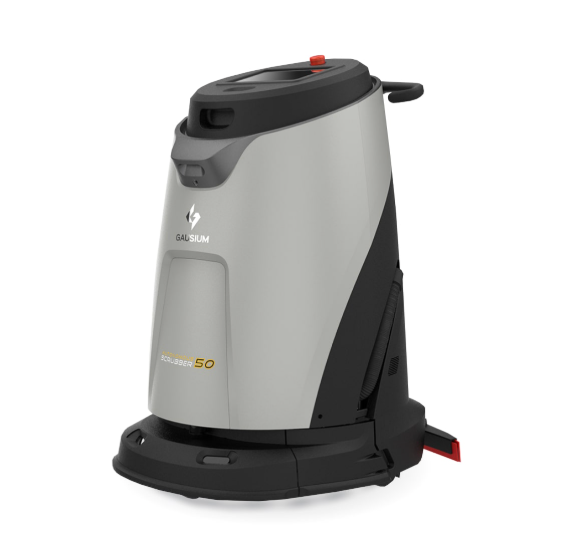
The Gausium Scrubber 50 functions as a solution optimized for mixed commercial environments featuring tight corridors and requiring proactive localized spot cleaning. The unit implements an automated self-servicing approach utilizing a 30-liter clean water tank and a 24-liter waste water tank, pairing seamlessly with an optional WS-01 workstation. Its dynamic autonomous mapping system harnesses a fusion of 2D LiDAR, 3D depth sensors, and RGB cameras to power an Auto Spot Cleaning mode that intelligently identifies and targets specific floor stains. The chassis represents a compact agile platform weighing 157 kilograms and requiring an 800-millimeter minimum pass width, navigating complex spaces while deploying a 460-millimeter disc brush capable of delivering up to 1,987 square meters per hour of theoretical productivity. The system applies 25 kilograms of downward brush pressure, offering up to three hours of active scrubbing runtime and a charging cycle of roughly two hours.
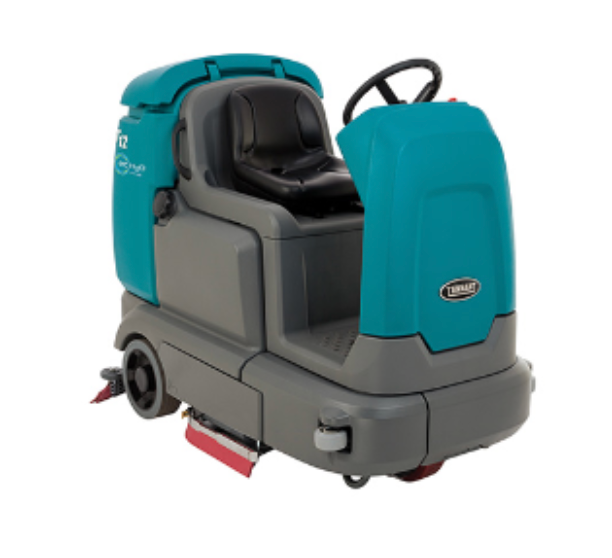
The Tennant T7AMR functions as a solution optimized for massive, wide-open exhibition or retail centers where operators prioritize simple route training and high area throughput. The unit implements high-capacity manual water management utilizing a 110-liter clean water solution tank alongside a 110-liter waste water recovery tank to support prolonged cleaning shifts. Its teach-and-repeat navigation architecture utilizes the BrainOS platform, empowering an operator to physically drive the desired route once before the robot replicates the precise cleaning path autonomously. The chassis represents a heavy-duty industrial ride-on platform weighing 492 kilograms, accommodating an operator while maneuvering a 650-millimeter scrub deck to process up to 4,250 square meters per session. The system delivers up to 86 kilograms of downward scrubbing pressure and provides up to 6.5 hours of runtime when equipped with the high-capacity lithium-ion battery option. Designed for expansive environments distant from water sources and reliant on manual replenishment, these platforms currently utilize manual fluid management, requiring operator assistance to replenish solution and drain tanks between cleaning cycles.
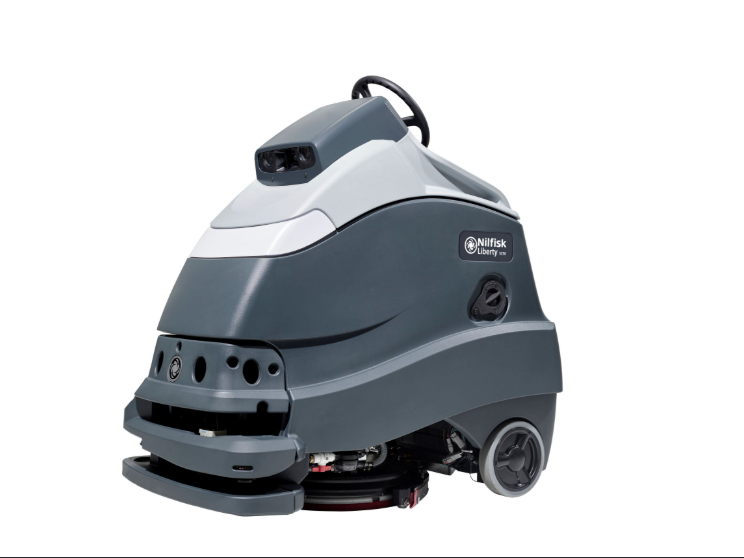
The Nilfisk Liberty SC50 functions as a solution optimized for populated public venues requiring strict safety certifications and automated perimeter-fill navigation. The unit implements high-capacity manual water management utilizing a 57-liter clean water tank and a 53-liter waste water tank to cover extensive operational zones. Its teach-and-repeat navigation architecture utilizes CopyCat and Fill-In learning modes, allowing the machine to memorize a driven path or calculate an interior route automatically after an operator maps the perimeter. The chassis represents a heavy-duty mid-range platform weighing 484 kilograms, operating quietly at 63 decibels while employing a 510-millimeter disc scrub path to achieve a theoretical productivity of 1,936 square meters per hour. The system delivers up to six hours of runtime covering approximately 5,100 square meters on a single charge, holding recognized safety certifications such as the CSA/ANSI 336 for autonomous operation around people, though battery chemistry details are not publicly specified. Designed for expansive environments distant from water sources and reliant on manual replenishment, these platforms currently utilize manual fluid management, requiring operator assistance to replenish solution and drain tanks between cleaning cycles.
Procurement teams finalizing their investment in autonomous floor care must rigorously evaluate the specific architectural constraints and daily operational demands of their facilities. Decision-makers should prioritize solutions by matching water management logistics against available plumbing infrastructure, assessing spatial constraints against machine dimensions, and selecting a navigation software architecture that directly aligns with the layout variability of the intended environment.
Return on investment for an autonomous floor scrubber is primarily driven by the gap between the loaded cost of manual floor-care labor and the total cost of owning and operating the robot. Amidst ongoing labor shortages in the facility management sector, loaded labor cost, which includes base wages, payroll taxes, and benefits, is typically 30 to 42 percent higher than the base hourly wage. Real-world autonomous scrubber coverage in large facilities is substantial, as seen with the Avidbots Neo 2 reaching up to 3,900 square meters per hour of theoretical productivity. Annual operating costs for a well-maintained autonomous scrubber typically fall between $4,000 and $7,500 including cleaning solution, maintenance, and battery amortization, compared with heavily loaded annual costs for full-time personnel. Facilities with extensive repetitive hard-floor coverage generally achieve payback in 9 to 18 months, especially since machines like the Tennant T7AMR can operate for up to 6.5 hours on lithium-ion batteries overnight to eliminate shift-premium labor.
Yes, most current-generation autonomous floor scrubbers can run without a human operator once the facility is mapped and the cleaning schedule is configured, but the degree of truly unattended operation depends heavily on water-management infrastructure. Robots with integrated docking workstations, such as the Gausium Scrubber 50 with its optional WS-01 workstation or the OrionStar CleaniBot C5 with its auto-docking station, can autonomously return to recharge, refill clean water, and discharge waste water, enabling continuous multi-shift operation. Machines that lack auto-fill and auto-drain docking, including the Avidbots Neo 2 weighing up to 688 kilograms and the Tennant T7AMR, require an operator to manually replenish solution and drain recovery tanks between runs. This manual water management requirement reintroduces labor stops during long overnight shifts, potentially limiting the continuous operational hours of heavy-duty units.
Commercial cleaning robots typically rely on LiDAR-based mapping, vision-based cameras, or a robust sensor-fusion approach that combines multiple data streams to thoroughly understand their environment. Vision-based systems such as BrainOS on the Tennant T7AMR and the Nilfisk Liberty SC50 use cameras to recognize visual landmarks, enabling accurate replication of taught routes. Modern platforms increasingly adopt sensor fusion, demonstrated by the Gausium Scrubber 50 combining 2D LiDAR with a 3D depth camera and an RGB camera, or the Avidbots Neo 2 utilizing ten onboard sensors for 360-degree visibility. For highly dynamic layouts where pallet positions change daily, dynamic AI-based route planning that recalculates paths in real time offers a distinct advantage over teach-and-repeat systems.
Tank capacity directly determines how much floor area a robot can cover before requiring a manual refill or a return to a docking station, making it a critical specification for large-venue deployments. A robot with a moderate combined water capacity, such as the OrionStar CleaniBot C5 featuring a 90-liter combined system, provides strong continuous coverage but benefits immensely from its efficient, approximately four-minute automatic workstation turnaround. High-capacity machines, such as the Avidbots Neo 2 holding a 109-liter clean and 135-liter recovery tank or the Tennant T7AMR carrying 110 liters in each tank, are engineered to complete expansive routes seamlessly between fills. However, neither the Avidbots Neo 2 nor the Tennant T7AMR provides an auto-refill docking station, meaning their large capacities strictly dictate the exact frequency of necessary human intervention. Facilities should match tank size and docking capability to their refill logistics, leveraging auto-docking stations near existing plumbing or relying on large-capacity tanks where charging locations remain distant from water sources.
Procurement teams should seek recognized safety credentials alongside comprehensive sensor suites when deploying heavy autonomous machinery in populated public spaces. The Nilfisk Liberty SC50 is among the few platforms certified to the CSA/ANSI 336 standard, which provides a third-party-verified baseline for autonomous operation in populated commercial areas. Beyond formal certification, facility managers should evaluate the physical sensor stack, such as the Avidbots Neo 2 projecting a visible Blue Light warning or the OrionStar CleaniBot C5 utilizing a smart obstacle-avoidance system to safely bypass pedestrians. Most platforms implement multi-zone safety behavior, where units detect objects at a long range, reduce their maximum operating speeds—such as the Gausium Scrubber 50 lowering its pace—and execute hardware-level emergency stops at close range.
Most autonomous floor scrubbers operate effectively on standard commercial hard surfaces including polished concrete, VCT, LVT, epoxy coatings, and sealed stone, utilizing high scrubbing pressures like the 86 kilograms applied by the Tennant T7AMR. When a facility layout changes, the robot navigational response depends entirely on its underlying software architecture. Teach-and-repeat platforms, such as the Tennant T7AMR utilizing BrainOS—where its autonomous gradeability remains not publicly specified—require an operator to manually re-demonstrate the route whenever the environment changes significantly. Conversely, dynamic AI-planning systems evaluate the real-time environment autonomously, allowing the Gausium Scrubber 50 to intelligently detect localized stains via Auto Spot Cleaning or the OrionStar CleaniBot C5 to map up to 10,000 square meters using cloud learning.
Note: Theoretical maximum runtime and cleaning efficiency metrics (such as m²/h coverage) are calculated under continuous operation in obstacle-free testing environments. Actual performance will vary dynamically based on floor friction, obstacle density, pedestrian traffic, and selected cleaning modes. Third-party product specifications are based on publicly available manufacturer data, including theoretical maximums or values listed as “up to,” and performance may vary in actual application. All product names and trademarks are the property of their respective owners. Spatial mapping data and sensor-derived telemetry collected via LiDAR and cameras are processed locally or anonymized for fleet management purposes. Enterprise users are responsible for implementing appropriate notice mechanisms and securing data processing agreements in compliance with regional regulations (e.g., GDPR, CCPA) prior to deployment. Facility operators must verify compliance with applicable data protection and privacy regulations, such as GDPR, before deploying any systems relying on cameras, LiDAR environmental mapping, or cloud-based spatial data processing.