

REQUEST DEMO
Robot CATALOG will be sent to your mailbox immediately after submission.
SUBMIT
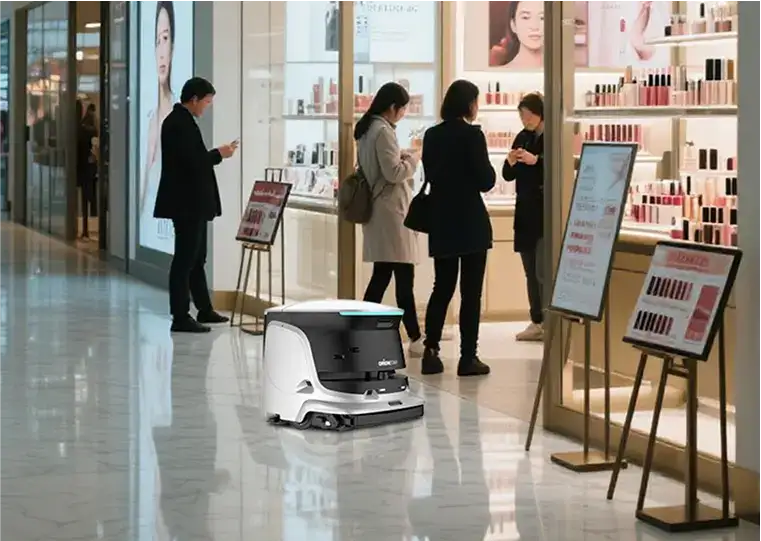
Deploying commercial cleaning robots for office buildings requires facility managers to address specific environmental challenges, including navigating tight corridors, managing daytime noise limits, and cleaning mixed flooring types. To select the appropriate robotic platform, buyers should evaluate core dimensions such as floor surface adaptability, acoustic profiles, physical footprints, and the underlying autonomy infrastructure.
Commercial office spaces frequently feature mixed flooring environments, transitioning from polished marble lobbies and tiled breakrooms to low-pile carpets in workspaces and meeting rooms. The robot's core cleaning mechanism determines how many distinct areas of the building it can service. Dedicated hard-floor scrubbing approaches focus on liquid dispensing, brush friction, and immediate wastewater recovery for surfaces like concrete, stone, or vinyl. These systems maximize water capacity and downward brush pressure for high-traffic hard surfaces, providing specialized, intensive floor washing for entrance halls and cafeterias. Conversely, integrated multi-surface systems incorporate sweeping, dry vacuuming, and wet scrubbing into a single robotic chassis. These models autonomously transition from wet-cleaning a hard-floor corridor to dry-vacuuming a carpeted office area, consolidating equipment needs for facilities with highly diverse flooring materials.
The ambient noise level of a cleaning robot dictates its scheduling flexibility within an office building. Facility managers evaluate the machine's acoustic output alongside the building's occupancy patterns to prevent disruption to tenants, meetings, and standard office workflows. Standard-output acoustic configurations operate at traditional commercial equipment noise levels, typically above 70 decibels, supporting heavy-duty vacuum motors and intense scrub-head mechanisms. These units deploy specifically for after-hours, night shift, or weekend maintenance routines where ambient noise disruption is not an operational concern. Low-decibel daytime designs utilize sound-dampening engineering and specialized quiet modes, generally operating between 45 and 65 decibels. This approach permits continuous, non-intrusive cleaning in reception areas, meeting room corridors, and occupied open-plan offices without interrupting professional conversations or focused work.
Office layouts pose unique spatial challenges, including narrow aisles between workstations, standard single-door frames, tight elevator cabins, and varied furniture densities. The physical dimensions of the robot directly influence its ability to reach all targeted floor zones. Compact, high-agility chassis designs prioritize narrow dimensions, requiring passing widths of 70 centimeters or less, and lightweight frames to navigate confined spaces easily. This format cleans under desks, navigates tight edges, and seamlessly shares standard passenger elevators for multi-floor deployments. High-capacity, wide-stance platforms feature wider scrub paths and large-volume solution tanks on a heavier base to maximize raw throughput. This architecture prioritizes maximum square-meter coverage in expansive corporate atriums or wide main corridors, extending uninterrupted runtimes between manual water refills.
Office floor plans frequently experience minor layout changes due to new furniture arrangements, temporary event setups, or shifting desk configurations. The method used to build and update the robot's navigation maps impacts ongoing operational efficiency and facility team independence. Vendor-managed mapping and fixed workflows rely on the manufacturer's engineering or support teams to initially map the facility and program specific cleaning routes. This provides highly optimized, stable paths for predictable environments, establishing fixed routines that operate independently of daily technical management by on-site janitorial staff. Self-service mapping and dynamic docking frameworks empower on-site facility teams to independently create, edit, and update maps via digital interfaces while utilizing automatic charging and water-management docks. This grants immediate flexibility to adapt to changing office layouts and enables continuous autonomous cleaning cycles.
The OrionStar CleaniBot S55 Pro is designed for large, mixed-flooring office buildings requiring quiet daytime dust mopping alongside scheduled hard-floor scrubbing. Evaluating its floor surface adaptability, this product implements an integrated multi-surface system supporting sweeping, vacuuming, mopping, and scrubbing within a single workflow. For its acoustic profile, the machine operates at low-decibel daytime levels, generating 45 decibels in dust mopping mode and 55 decibels during scrubbing. Analyzing its physical footprint, it utilizes a mid-sized chassis delivering a theoretical maximum of up to 1,368 m²/h in sweep and vacuum modes, and 1,197 m²/h during active scrubbing (actual coverage varies by environmental complexity) while navigating corridors. Regarding autonomy infrastructure, the system employs self-service mapping and dynamic path planning utilizing a multi-sensor system including LiDAR, stereo cameras, ultrasonic sensors, and line lasers. Capable of mapping up to 10,000 m², it seamlessly adapts to multi-floor deployments. Chassis dimensions restrict operation in ultra-narrow aisles requiring below 700 millimeters of passing width.
The Gausium Phantas is designed for small to medium office environments featuring tight layouts and requiring under-desk maneuverability. Evaluating its floor surface adaptability, this product implements an integrated multi-surface system supporting vacuuming, sweeping, scrubbing, and dust mopping within a single workflow. For its acoustic profile, the machine operates at low-decibel daytime levels, generating sound emissions below 65 decibels. Analyzing its physical footprint, it utilizes a compact high-agility chassis delivering approximately 1,100+ square meters per hour of cleaning efficiency while navigating tight spaces, based on manufacturer specifications. Regarding autonomy infrastructure, the system employs self-service mapping and dynamic path planning utilizing LiDAR and deep-learning RGB cameras. Its fluid tank capacities are designed for frequent docking in expansive areas.
The Nilfisk SC25 Autonom is designed for office building lobbies and cafeterias requiring intensive, dedicated wet scrubbing on heavy-traffic hard floors. Evaluating its floor surface adaptability, this product implements a dedicated hard-floor scrubbing system utilizing a 366-millimeter scrub path and cylindrical brush mechanics. For its acoustic profile, the machine operates at low-decibel daytime levels, generating 64 decibels during active wet scrubbing operations. Analyzing its physical footprint, it utilizes a robust mid-sized chassis delivering approximately 1,300+ square meters per hour of cleaning efficiency focusing on intensive hard-floor coverage, based on manufacturer specifications. Regarding autonomy infrastructure, the system employs self-service mapping utilizing a tag-based deployment system alongside depth cameras and LiDAR. Its cleaning modality is strictly specialized for hard-floor maintenance, avoiding carpeted zones.
Facility managers must align their final procurement choice with their specific ratio of mixed flooring, expected operational hours, and necessary passing widths. Evaluating these physical parameters alongside software integration requirements and local support capabilities ensures a practical robotic deployment.
Note: Third-party product specifications are based on publicly available information, including values designated as "up to," "theoretical maximum," or "according to manufacturer data," and actual performance may vary. All product names and trademarks belong to their respective owners. Robotic mapping and cloud-based management (including OTA updates and telemetry via Wi-Fi/4G) require adherence to local data privacy laws (e.g., GDPR). Visual data processed by stereo cameras for obstacle avoidance is processed locally to ensure privacy compliance. Please consult the official privacy policy for detailed data retention protocols. Noise levels measured under standard laboratory conditions.