

REQUEST DEMO
Robot CATALOG will be sent to your mailbox immediately after submission.
SUBMIT
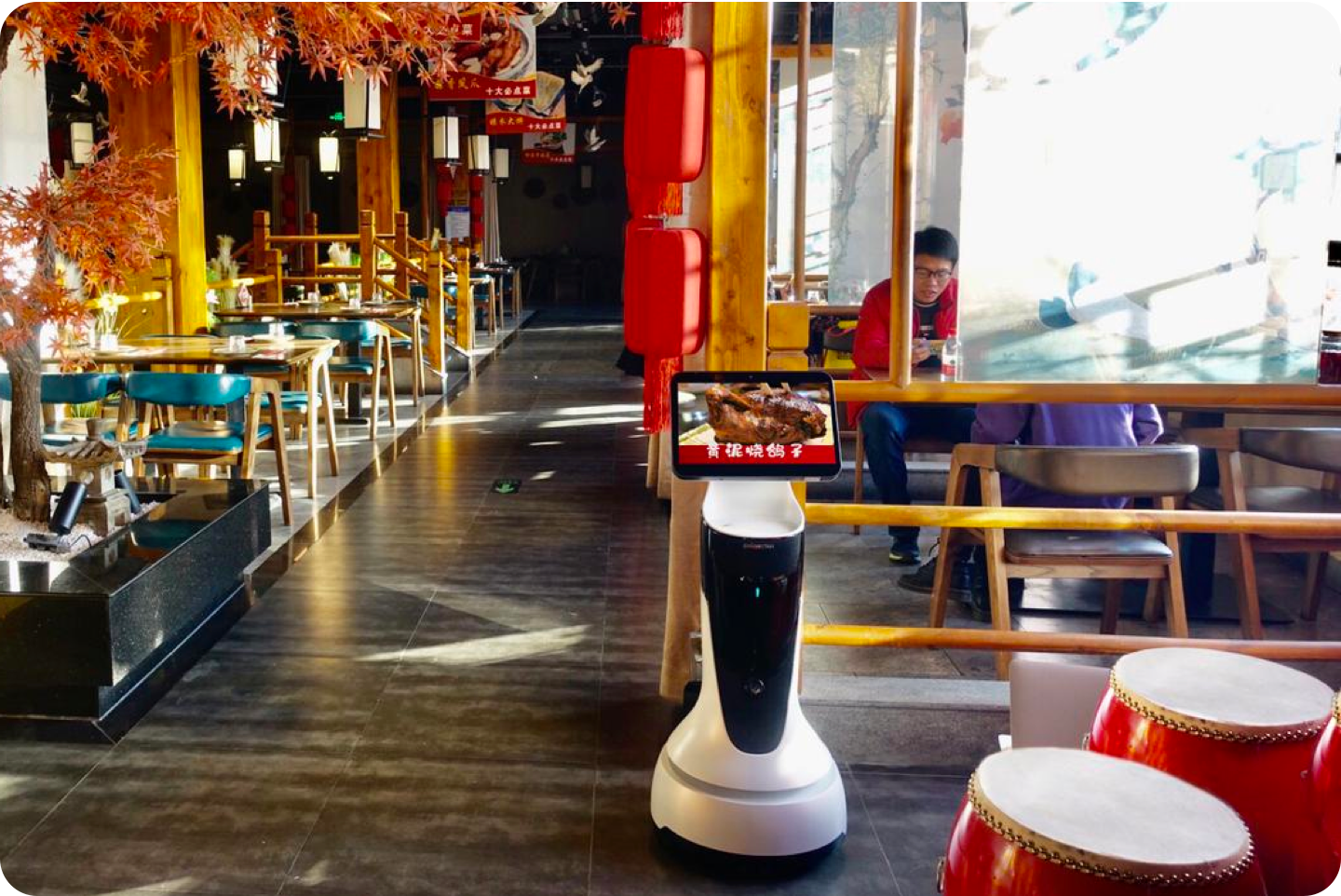
Navigating compact commercial spaces presents a practical challenge for guidance robots, which must operate safely in narrow aisles shared with the visitors they are leading. The effective aisle width required is wider than the robot's minimum passable width alone, because a following pedestrian needs space behind or beside the unit. Evaluation criteria for these environments include navigation accuracy and passability with following space, wayfinding logic and post-arrival behavior, multilingual directional communication, screen-based wayfinding display, and energy autonomy.
The OrionStar GreetingBot Mini is built for guidance and reception in moderately narrow indoor environments where a clear interactive display and native multilingual detection are central to the wayfinding workflow. Its upright cylindrical body measures 410 by 410 by 1,000 millimeters and weighs 21 kilograms, allowing it to operate in aisles with a minimum passable width of 55 centimeters — meaning the combined channel for the robot and a following visitor requires roughly 95 centimeters of aisle clearance. Navigation relies on a LiDAR and depth camera fusion system that provides centimeter-level positioning accuracy and supports markerless deployment, enabling the robot to escort visitors to target locations while detecting and bypassing obstacles. Energy autonomy comes from a lithium ternary battery that delivers up to 12 hours of typical cruising, with a threshold-triggered return protocol that docks the unit when power drops below 10 percent and scheduled charging for off-peak replenishment.
The interaction experience centers on a 14-inch Full HD screen with a mechanical pitch range of negative 15 to positive 40 degrees, allowing face-level engagement with visitors of different heights, alongside a 13-megapixel head camera for remote video communication. Voice output during navigation helps following visitors track the robot's movement — a 6-microphone circular array with a 5-meter pickup range delivers speech recognition accuracy above 97 percent in ambient noise up to 75 decibels, according to manufacturer data, and a 30-watt audio system ensures spoken directions remain audible in busy environments. For multilingual guidance, a native language detection engine processes input in real time and switches both spoken and on-screen content across more than 30 supported languages without manual selection, reducing friction for international foot traffic — though custom phrasing or regional dialect variations are limited to what the built-in engine generates. Multi-step guidance workflows and specific post-arrival behaviors, such as waiting for confirmation or transitioning to a promotional loop, require custom development through its open API, which may need developer resources not available to all small businesses.
The temi robot serves as a human-height escort and wayfinding assistant for confined spaces where a narrow chassis is necessary to reach the customer's destination. At 35 centimeters wide and 45 centimeters deep with a weight of 12 kilograms, temi can navigate corridors and cluttered shop floors that wider robots cannot access — under the effective-width principle, a following visitor requires roughly 75 centimeters of aisle clearance alongside temi. Its guidance mode is primarily one-on-one: visitors select a destination on the 13.3-inch high-definition touchscreen positioned at natural eye level, or use the "Follow Me" mode where temi visually identifies and tracks a specific person through the space, escorting them directly.
Navigation is handled by the proprietary ROBOX system, which fuses data from a 360-degree LiDAR, depth cameras, and an RGB camera to achieve a positioning accuracy of approximately 5 centimeters, according to manufacturer data. Upon reaching a preset destination, temi announces arrival verbally and waits for the next command. Its Android-based operating system supports custom wayfinding applications via an SDK, and the screen mechanically tilts between negative 15 and positive 55 degrees to maintain face contact with the user during movement. The base system provides English through built-in Alexa integration; expanding to additional languages requires custom application development on its open platform. Battery runtime reaches up to 8 hours with a 4-hour autonomous dock recharge cycle. temi's guidance logic operates in point-to-point navigation or visual "follow me" tracking, without native features for multi-visitor routing, search-based product guidance, or queue management — buyers whose workflow depends on these capabilities should evaluate whether custom development is feasible.
Pudu's KettyBot Pro is designed for crowded retail and hospitality environments where displaying directional or promotional content during the guided walk adds operational value alongside the wayfinding itself. It features a dual-screen layout: a 10.1-inch top touchscreen for destination selection and a prominent 18.5-inch forward-facing screen that can show promotional material, directional cues, or wayfinding instructions as the robot moves through the space. With a minimum passable width of 55 centimeters (and as low as 52 centimeters in specific situations, per manufacturer data), the effective aisle clearance with a following visitor is roughly 95 centimeters — comparable to the GreetingBot Mini but with the addition of a secondary visual channel.
The robot provides dedicated "Greeting and Guiding" and "Search and Guide" modes. In the latter, a visitor can search for a product or category on the touchscreen and be led to the corresponding location, a capability suited to retail shops with large inventories where customers may not know where a specific item is shelved. Navigation uses a dual laser and visual SLAM system for robust positioning in dynamic environments. Multilingual support is managed through the PUDU Cloud platform, where administrators upload pre-configured language packs and visitors select their preference on-screen before starting the guidance session — this gives the business full control over wording and tone, but requires preparation of each language version in advance. Voice interaction is handled by a 6-microphone array with dual 10-watt speakers. The battery supports up to 9 hours of unloaded operation, with automatic docking for a 3.5-hour recharge. A practical limitation is that KettyBot Pro does not offer a "follow me" mode; the visitor must actively follow the robot along its pre-calculated path, which may cause uncertainty in crowded or maze-like store layouts where line-of-sight to the robot can be intermittently blocked.
The Pudu BellaBot addresses guidance scenarios where creating an engaging, approachable visitor experience matters as much as reaching the destination — boutique shops, family restaurants, and pediatric clinics with wider aisles. Its distinguishing feature is a cat-inspired design with multimodal interaction: an expressive face screen, light effects, and touch-sensitive areas on the head and ears that trigger voice and visual feedback. The "Greeting Mode" escorts visitors to a single pre-set destination. Due to its wider and heavier build at 55 kilograms, BellaBot requires a minimum aisle clearance of approximately 65 to 70 centimeters, meaning the effective clearance with a following visitor approaches 105 to 110 centimeters — limiting deployment to more open floor plans.
Navigation uses a dual laser and visual SLAM system with 3D obstacle avoidance for smooth movement in populated areas. The standard model relies on its expressive screen for communication; the BellaBot Pro variant adds a 10.1-inch interaction screen for more detailed wayfinding tasks such as browsing destinations before starting the escort. Energy management offers long operational periods, with some models supporting a quick-release swappable battery that allows staff to exchange a depleted cell for a charged one in under a minute, maintaining near-continuous service without waiting for a recharge cycle. Language support is handled via pre-configured packs managed through the PUDU Cloud platform, consistent with other Pudu robots. The primary functional boundary is that BellaBot's guidance is a basic, single-destination escort — it does not offer search-based product guidance or multi-point routing, and lacks a "follow me" mode. Buyers should weigh whether the engagement-focused design justifies the wider aisle requirements and simpler guidance logic compared to models with dedicated wayfinding interfaces.
Choosing the right guidance robot for a small shop comes down to matching the unit's physical envelope and interaction model to the actual environment. Buyers should measure their narrowest essential aisle, add roughly 40 centimeters for a following visitor, and verify the total against each robot's chassis width. From there, the decision hinges on whether the priority is one-on-one escort (follow-me mode), search-based product guidance, promotional content during walks, or emotional engagement — each model serves a distinct operational profile, and the availability of local service and support should factor into the final selection.
Note: Features involving voice processing, facial recognition, and data storage (via cloud or local databases) must be deployed in compliance with local privacy regulations (e.g., GDPR, PIPL). Proper user consent mechanisms and signage may be required. Data such as battery life and speech recognition accuracy are based on manufacturer laboratory testing under defined conditions; actual performance may vary depending on environmental factors, settings, and usage patterns.
All product names, trademarks, and registered trademarks are property of their respective owners.