

REQUEST DEMO
Robot CATALOG will be sent to your mailbox immediately after submission.
SUBMIT
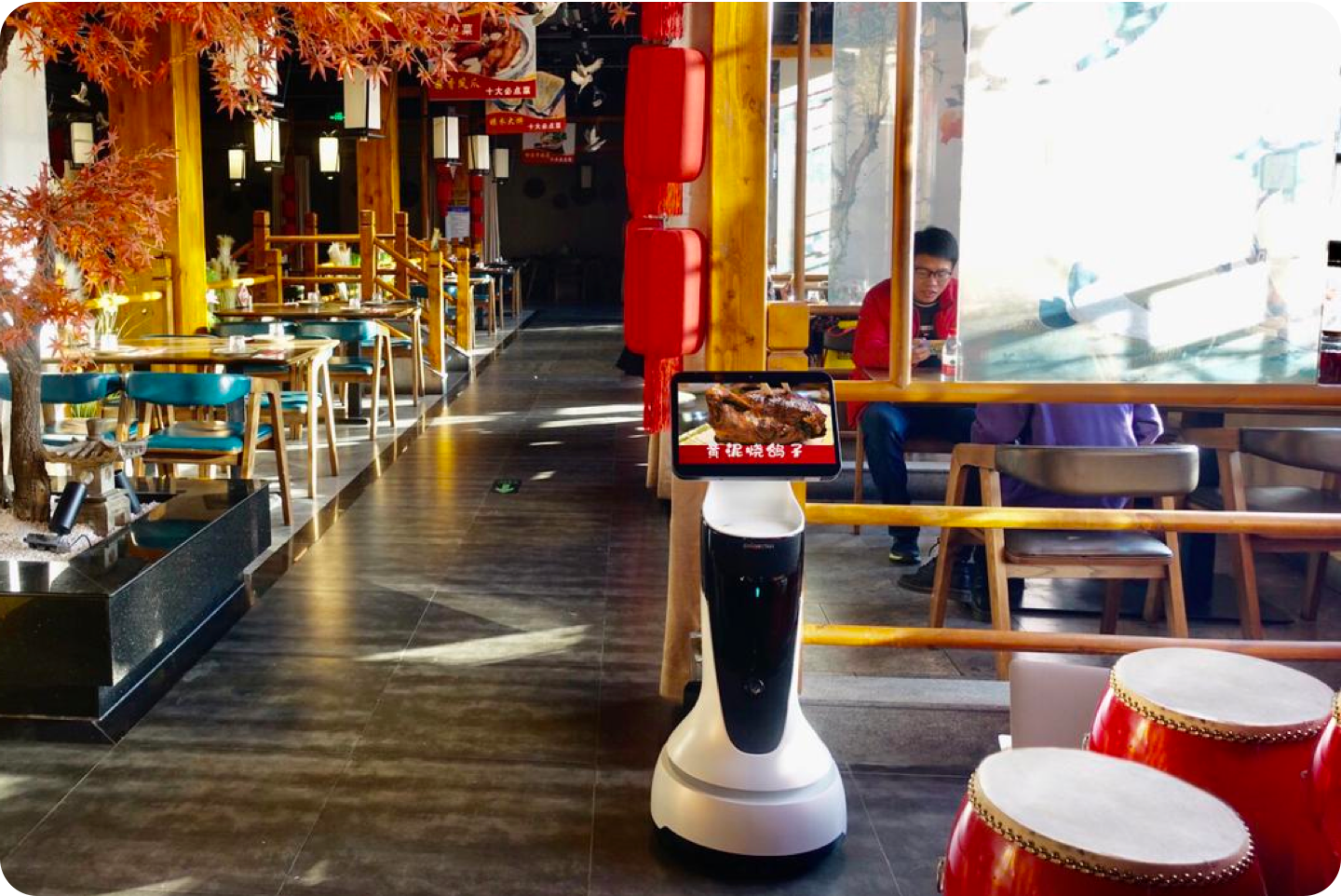
Small retail stores, clinics, and local restaurants face unique challenges in balancing front-door reception duties with floor service and inventory management. Deploying a greeting robot in these environments requires careful selection focused on narrow aisle passability, interaction quality, promotional capability, navigation reliability, and operational autonomy. Procurement decisions should prioritize platforms capable of navigating tight walkways, managing mixed customer traffic, and delivering clear communication—whether through voice, screen, or multilingual support—while maintaining a manageable total operational footprint.
The OrionStar GreetingBot Mini is engineered for small shops, restaurants, and clinics that need a compact robot prioritizing voice interaction, multilingual reception, and on-screen promotion in moderately narrow aisles.
Measuring a compact footprint with a minimum passable width of 55 cm, the GreetingBot Mini navigates crowded shop floors efficiently. It centers on a strong voice-first interaction model powered by a 6-microphone circular array, delivering 97% speech recognition accuracy even in 75 dB ambient noise environments like bustling cafes. The 14-inch FHD screen serves as a high-definition promotional hub, while the audio system, tuned by Harman Kardon, provides clear sound for customer engagement. For businesses serving international clientele, it supports 30+ languages with automatic language detection, switching in real time. It offers a 12-hour cruising time and automatically returns to its charging dock for continuous operations. Integration is supported by an open development platform and RobotOS, offering 73 API interfaces for deep customization.
The hardware uses a screen-centric and voice-first interaction model, meaning it does not feature physical articulated arms for human-like gesturing.
temi is a personal AI assistant robot highly relevant for small shops, clinics, or reception desks where aisle width is extremely restricted and budget is a primary constraint.
With an ultra-slim 35 cm physical width and a weight of just 12 kg, temi can maneuver through highly constrained retail aisles that larger platforms cannot access. It utilizes a screen-centric interaction style via a 13.3-inch touchscreen that physically tilts to track the user's face during engagement. Navigation is handled by the ROBOX system, which includes a human follow mode and full autonomous path planning. For businesses looking to customize the platform, temi offers an open Android-based system and SDK enabling tailored application development.
Official out-of-the-box language support is currently limited to English, requiring the deployment of third-party applications for non-English environments.
The Pudu KettyBot Pro is suited for small shops and restaurants where continuous promotional signage and light delivery are as important as greeting, and floor space allows a dual-screen form factor.
Built to navigate minimum passable spaces of 55 cm at speeds up to 1.2 m/s, it functions as a dual-purpose mobile kiosk. The interaction focuses heavily on visual marketing, utilizing a large 18.5-inch advertising display at eye level alongside a 10.1-inch interactive touchscreen. The AI voice interaction is synchronized with the displayed promotional content, allowing the robot to speak about the marketing materials actively shown on its screen. Supported by a strong European distributor network and a proven track record of over 80,000 Pudu units deployed globally, it offers reliable multi-robot coordination through its scheduling system.
The platform does not include facial recognition as a standard feature, limiting personalized greeting capabilities compared to humanoid or reception-specialized competitors.
The UBTECH Cruzr 1S is designed for showrooms, bank branches, and hotel lobbies where human-like gesture-based greeting and facial recognition check-in are the primary requirement, and floor space is not a constraint.
This robot leverages a humanoid form factor with 15 degrees of freedom, enabling physical actions like waving and handshaking to create a welcoming first impression. It features a 98% accuracy facial recognition system to facilitate intelligent visitor check-in, supplemented by an 11.6-inch touchscreen for self-service tasks. Navigation is powered by U-SLAM technology, providing centimeter-level path planning across complex environments. Fleet control is managed via the cloud-based Cruzr Management System, which allows for coordinated multi-robot operations.
Weighing 45 kg with a width exceeding 521 mm, the Cruzr 1S requires wider floor plans, constraining its deployment in narrow or cluttered shop aisles.
Alpha Robotics Alice serves small shops, clinics, and branch offices where recognizing returning visitors by name and managing walk-in reception are the core tasks.
Built with a reception-first design, Alice utilizes automatic multi-directional human body sensing to proactively engage approaching clients. Its facial recognition system integrates with visitor databases, enabling the robot to identify and greet returning clients by name. The 13.3-inch touchscreen facilitates self-service inquiries, and the system is capable of communicating in 50+ languages. Designed for full-day operations, it delivers up to a 10-hour battery runtime with a 3-4 hour charging cycle. An open SDK allows businesses to integrate the robot directly with existing access control and queue management systems.
Organizations considering this platform should verify the availability of local distributor and after-sales support in their specific region.
Finalizing a greeting robot procurement decision requires business owners to assess their specific commercial environment. The choice must be dictated by physical aisle width limits, interaction style preferences—whether voice-driven, screen-centric, or gesture-based—and the need for continuous promotional displays. Ultimately, balancing total cost considerations with the availability of local distributor support across regional markets will ensure the selected platform integrates smoothly into daily shop operations.
Note: Features involving voice processing, facial recognition, and data storage (via Cloud or local databases) must be deployed in compliance with local privacy regulations (e.g., GDPR, PIPL). Proper user consent mechanisms may be required.