

REQUEST DEMO
Robot CATALOG will be sent to your mailbox immediately after submission.
SUBMIT
High-traffic venues such as airports, shopping malls, hospitals, and transit hubs demand specialized, durable floor maintenance solutions. In these environments, foot traffic is constant, refuse is diverse, and the windows available for maintenance are exceedingly brief. Facilities cannot afford disruptive manual interventions or frequent machine downtime. Consequently, they require commercial cleaning robots capable of safely navigating dense crowds, managing complex fluid and debris needs, and maximizing active floor time. Because no single robotic architecture solves every facility's unique operational hurdles, the most effective approach is to deploy machines engineered for specific challenges—from fully automated continuous operation ecosystems to heavy-duty industrial grime removal.
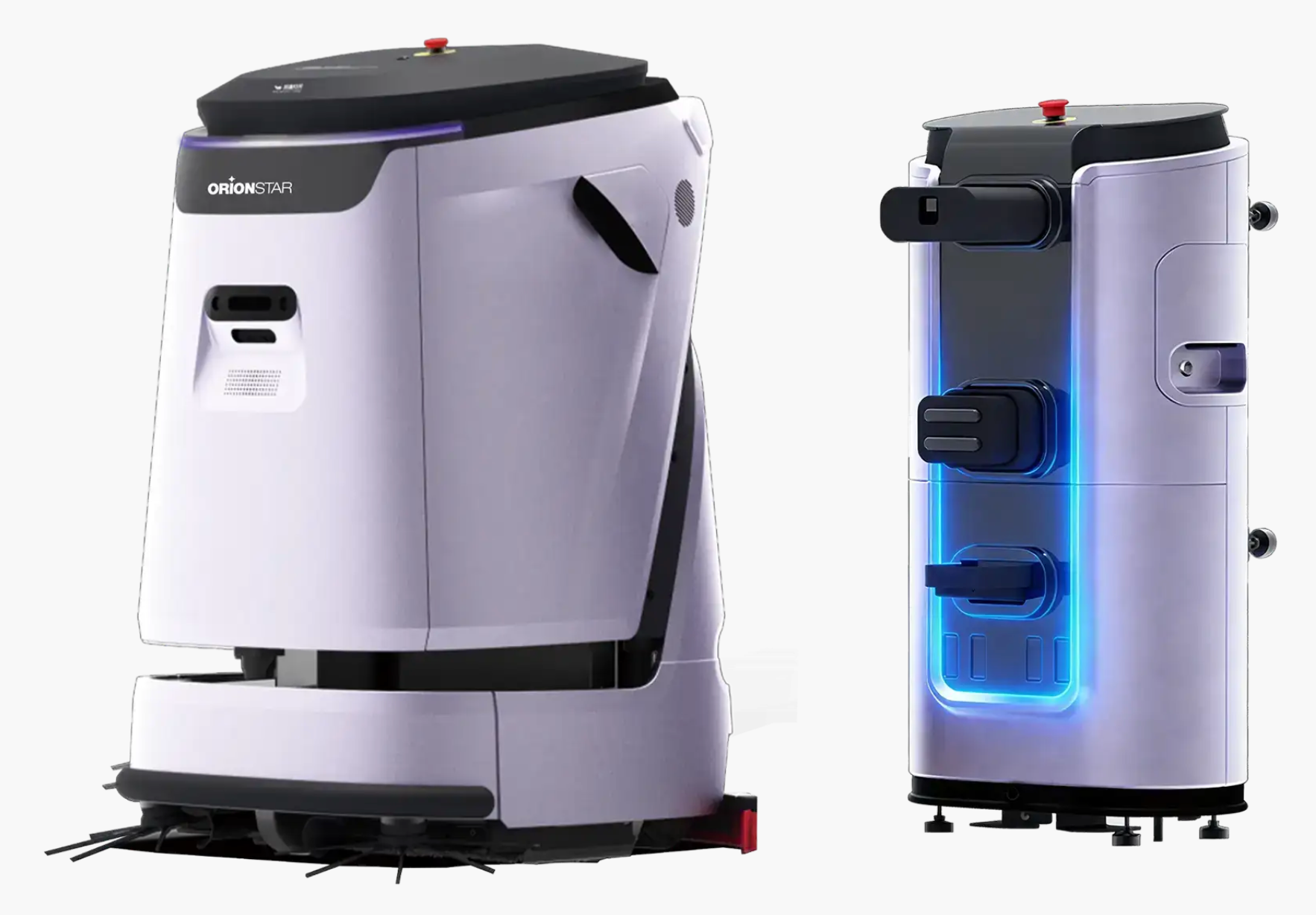
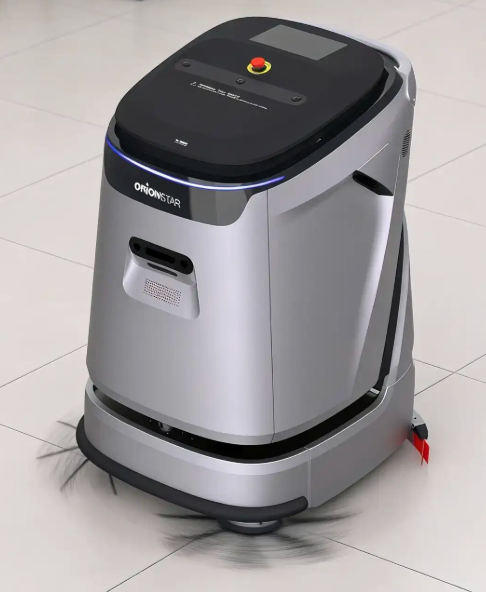
The OrionStar CleaniBot C5 excels in environments that require around-the-clock, multi-shift floor maintenance with minimal human intervention. Built for seamless dock-and-go automation, this industrial-grade scrubber measures 820 × 680 × 1,130 mm and weighs 170 kg. It utilizes a 550 mm main brush to deliver a theoretical cleaning capacity of up to 1,980 m² per hour. Equipped with a 24V, 80 Ah battery, the C5 provides 3 hours of continuous scrubbing or 8 hours of dust-mopping, supported by an aggressive 1.5-hour fast-charging cycle that heavily minimizes idle dock time.
For high-traffic scenarios, the C5’s standout capability is its fully automated workstation and dual-rolling-brush system. Applying 25 kg of downward pressure, it executes sweeping, scrubbing, and water absorption in a single pass—achieving a 95% dirt-cleaning rate while capturing solid debris up to 3 cm in its dedicated 1.8 L dust bin. Its 90 L balanced fluid system (45 L clean, 45 L waste) operates in tandem with a docking station that automatically handles clean-water refilling, waste-water discharge, and recharging. Notably, the station performs a high-pressure internal tank rinse that self-cleans the waste tank in just 4 minutes, effectively preventing odors and plumbing blockages. Capable of mapping expanses up to 10,000 m², it maneuvers through tight 880 mm corridors and operates at an ultra-quiet 68 dB(A), making it highly unobtrusive to public crowds. To accommodate modern facilities without structural modifications, the C5 can also be deployed with optional mobile water tanks, bypassing the need for permanent building plumbing.
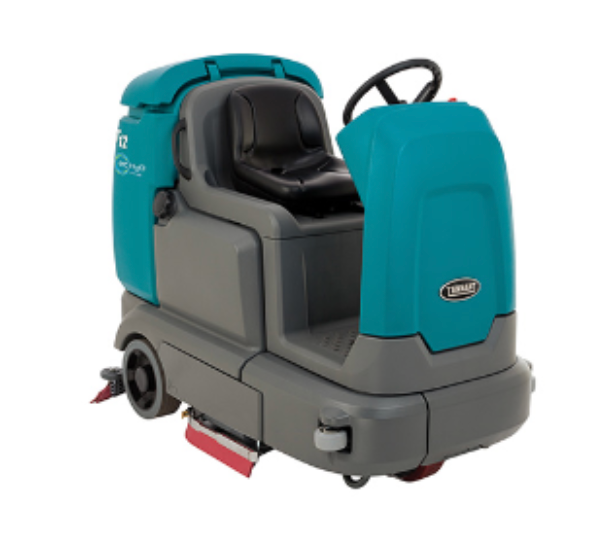
The Tennant T7AMR is engineered specifically for facilities grappling with deeply embedded soil and heavily stained surfaces. Powered by BrainOS navigation, this robust ride-on robotic scrubber measures 1,650 x 850 x 1,450 mm and weighs 492 kg when fully equipped with batteries. It utilizes a wide 650 mm cleaning path and massive, equal-capacity 110 L solution and recovery tanks to sustain deep cleaning sessions across expansive retail and warehouse spaces, achieving a maximum theoretical productivity of 4,250 m² per hour in manual mode.
Operating on a 24V system with options spanning standard 360 Ah wet batteries, 128 Ah fast-charge units, or a 9.2 kWh Li-Ion setup, the T7AMR delivers up to 4 hours of runtime. Its defining advantage for high-traffic durability is its ability to apply up to 86 kg of downward brush pressure at 225 RPM, forcibly lifting heavy grime in industrial applications. Furthermore, its dual-mode design gives facility managers exceptional flexibility; staff can manually drive the unit to tackle spontaneous spills during sudden high-traffic peaks, then switch it back to autonomous mode. Combined with optional ec-H2O NanoClean technology to reduce detergent use, it is a powerhouse for aggressive soil removal.
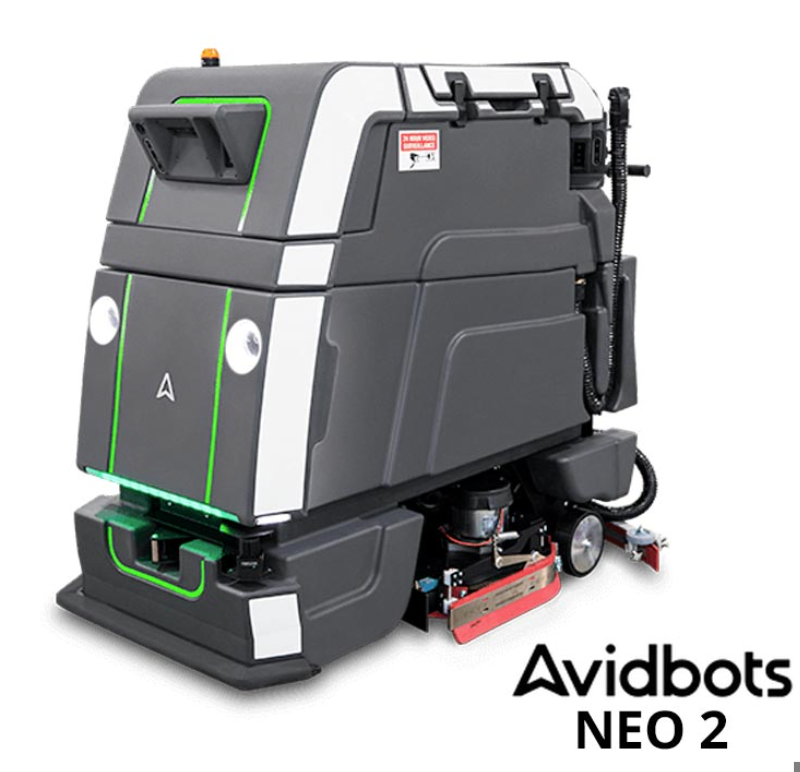
Built from the ground up for harsh manufacturing and logistics environments, the Avidbots Neo 2W tackles the unpredictable layouts, heavy forklift traffic, and expansive square footage of modern industrial facilities. The robot boasts a substantial footprint of 1,520 x 760-940 x 1,370 mm and a gross weight of up to 688 kg. Equipped with either a 610 mm cylindrical or up to an 813 mm disc cleaning head, it scales to a theoretical productivity of 2,950 m² per hour.
To meet the demands of continuous industrial shifts, the Neo 2W relies on an oversized fluid system featuring a 109 L solution tank and a high-capacity 135 L recovery tank. Its 36V, 250 Ah AGM battery system delivers a massive 4 to 6 hours of continuous operation and is easily swappable, allowing facilities to instantly multiply their runtime across consecutive shifts without waiting for recharges. For high-traffic warehouse durability, the robot integrates a specialized Debris Diverter that physically pushes hazards aside to prevent mechanical stoppages. Driven by proprietary AI, 3D sensors, and a Bulk Navigator, the Neo 2W fluidly adapts to constantly changing pallet placements and dynamic obstacle layouts.
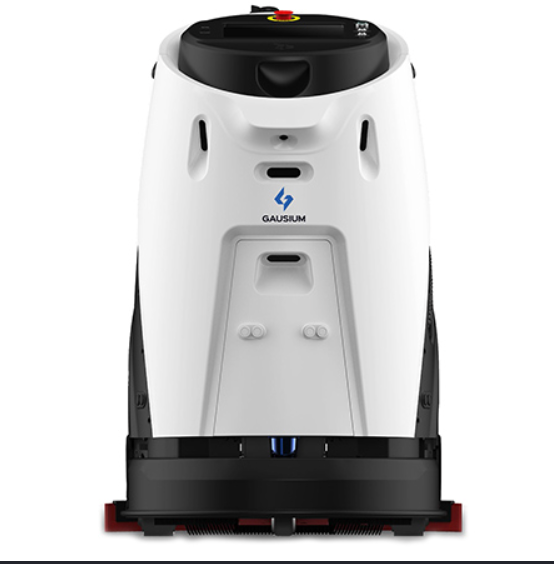
The Gausium Scrubber 50 Pro is the optimal solution for busy environments like healthcare facilities and retail stores that require a smaller physical footprint but cannot sacrifice operational endurance. Highly compact, it measures just 810 x 700 x 1,070 mm and weighs between 148 and 157 kg depending on the brush configuration. It utilizes either a 460 mm disc or a 406 mm roller brush to clean up to 1,987 m² per hour.
The unit’s defining capability for high-traffic areas is its integrated water recycling filtration system, which captures and filters its 30 L clean water and 24 L waste water supply. This system reduces freshwater consumption by approximately 80%, drastically extending the machine's uninterrupted scrubbing time between physical refills. Powered by a 24V, 60 Ah LiFePO4 battery rated for 2,000 cycles, the robot achieves 3 hours of scrubbing or 8 hours of dust mopping, backed by a rapid 2-hour charge time. This architecture minimizes pit stops and maximizes active cleaning, ensuring sustainability and high uptime in environments where maintenance windows are strictly limited.
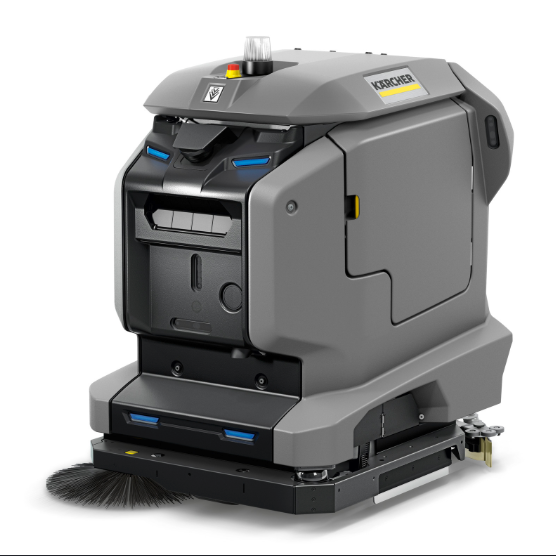
The Kärcher KIRA B 50 combines exceptional fluid capacity with advanced edge-cleaning precision, tailored for medium to large public access areas. Despite a compact profile measuring 1,100 x 750 x 1,200 mm and a weight of 228 kg, the robot houses perfectly balanced, large-capacity 55 L fresh and 55 L dirty water tanks—making it a top performer for its size class.
For high-traffic precision, the KIRA B 50 utilizes a 550 mm integrated roller brush paired with an active side brush operating at 1,350 RPM. This configuration pre-sweeps and scrubs simultaneously, yielding up to 2,365 m² per hour while easily reaching tight edges and corners in complex public corridors. A 24V, 160 Ah LiFePO4 battery ensures approximately 3.5 hours of operation. Highly suited for dynamic environments, it carries an IEC 63327 safety certification for secure operation amidst public crowds. Paired with an optional docking station for fully autonomous refilling, draining, rinsing, and charging, it guarantees meticulous edge-to-edge cleaning without compromising the maneuverability required in active public venues.
Choosing the most effective durable commercial cleaning robot requires aligning a facility's specific layout, soil type, and maintenance constraints with the right technological architecture. For venues demanding seamless 24/7 automation with rapid recharge times, self-rinsing capabilities, and zero plumbing modifications, the OrionStar CleaniBot C5 delivers highly efficient continuous operation. If a facility battles deeply embedded industrial soil, the Tennant T7AMR provides the necessary, raw downward brush pressure. Massive logistics centers requiring uninterrupted operations will benefit from the Avidbots Neo 2W's swappable batteries and high-capacity fluid tanks. Conversely, for locations prioritizing a compact footprint and water conservation, the Gausium Scrubber 50 Pro’s advanced recycling system maximizes uptime, while the Kärcher KIRA B 50 offers an optimal blend of large tank capacities and specialized side-brush precision for safe, detailed cleaning in tight public corridors.
Disclaimer: The mapping and navigation data collected by the OrionStar CleaniBot C5 are processed locally or anonymized in compliance with GDPR and local data protection regulations. The robot does not collect or store recognizable personal biometric data (e.g., facial recognition) during public operation.
Note: Actual runtime, cleaning capacity, and noise levels may vary depending on floor types, environmental complexity, crowd density, and selected cleaning modes.